Jared Tan
As you may now know, BirdSoc SG has recently partnered with eBird and are now part of the team managing eBird in Singapore! Our team has been hard at work reviewing the filters and records of rare and range-restricted species in Singapore, and we felt that it would be a good time to share some good practices and habits we should all have when using eBird.
| Table of Contents | ||
| 1 | Why should I use eBird? | Useful information about birds |
| eBird Alerts | ||
| Keeping of personal lists | ||
| 2 | Mobile App vs Desktop Site | |
| 3 | eBird Best Practices | Only key in species you are confident of identifying |
| Provide accurate estimates of bird counts | ||
| Include photos/videos/audio and comprehensive descriptions of rarities | ||
| Input locations accurately | ||
| Make use of List-building Checklists to key in pre-eBird life lists | ||
| Work closely with eBird moderators | ||
Why should I use eBird?
eBird is a free-to-use citizen-science database which contributes to research and monitoring of bird movements and abundance. By using eBird, all of us can contribute data to aid research and conservation of birds around the world!
Apart from contributing to data and conservation, we ourselves can benefit in several ways by using eBird too!
Useful information about birds
Species pages give us tips on how to identify birds, and provide reference photos of birds of various sexes, morphs and ages (all of which are contributed by fellow eBird users!).
Bar charts (which we have also embedded into our BirdSoc species pages) provide data showing the abundance of various species throughout the year. This gives you an idea of when to start looking out for a certain species! For example, a quick look at eBird bar charts would tell you that October to early-November is the best time of the year to look out for Brown-chested Jungle Flycatcher in Singapore.
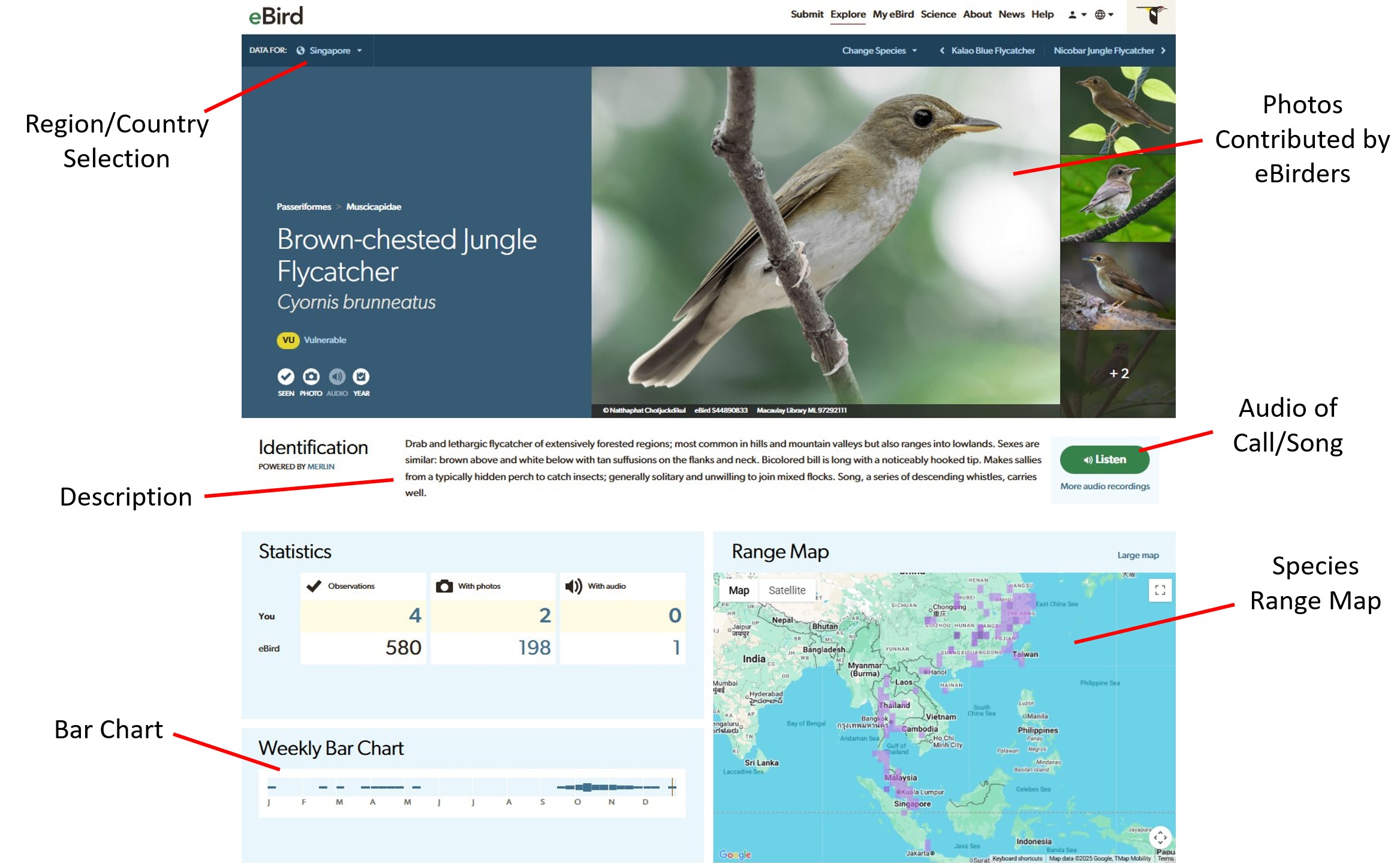
eBird species page for Brown-chested Jungle Flycatcher
Species range maps show us the global distribution of birds, which can give us an indication of whether we might expect to see a certain species in different parts of the world. Zooming in to the range maps will even show you all the various spots in Singapore where other eBird users have seen a particular species before, and recent sightings within the past month would show up in red. You may also filter the data to see the sightings for a specific range of months or years. This is a highly useful tool if you are wondering where to go to see a specific target species!
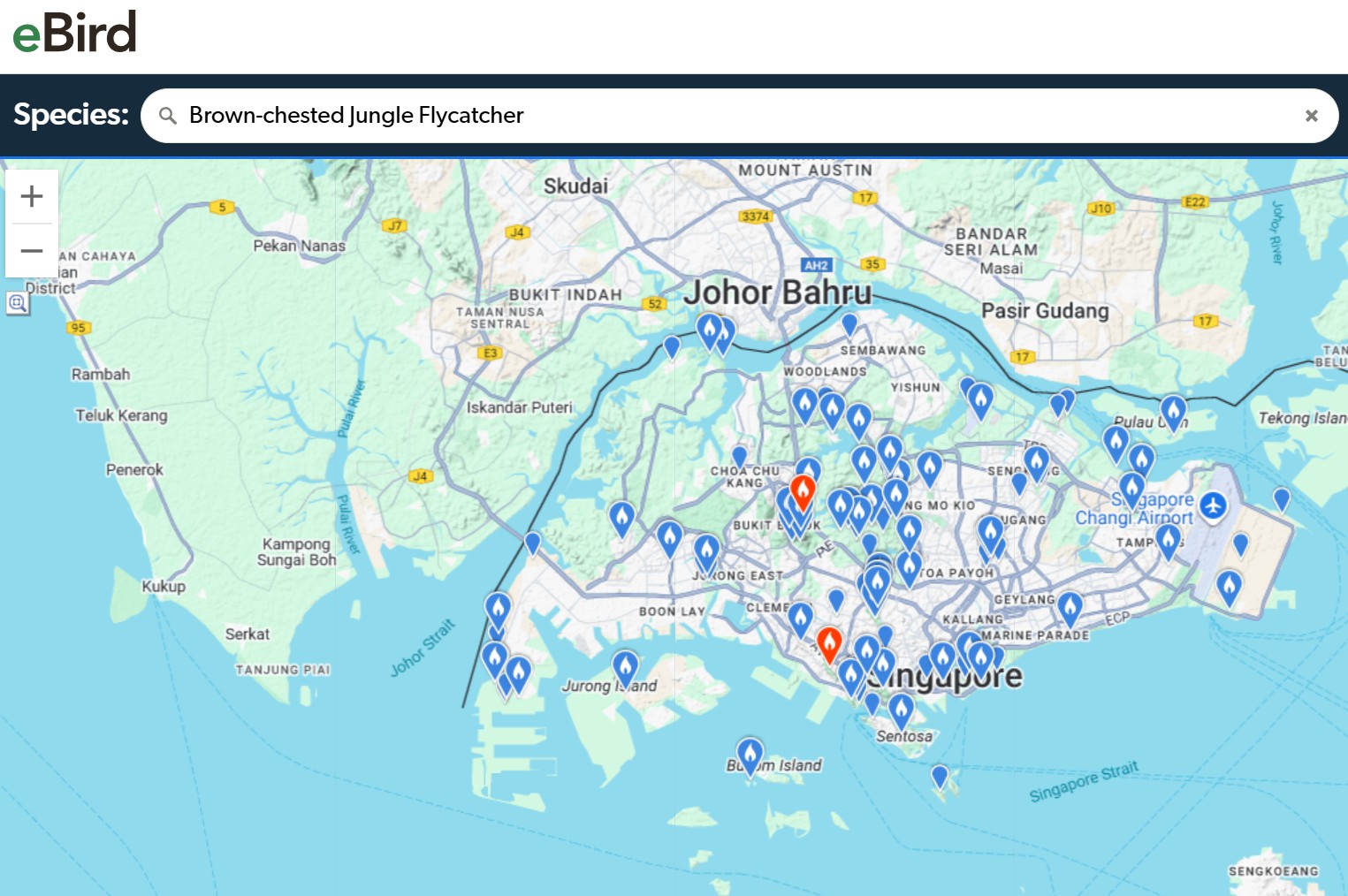
eBird species map for Brown-chested Jungle Flycatcher
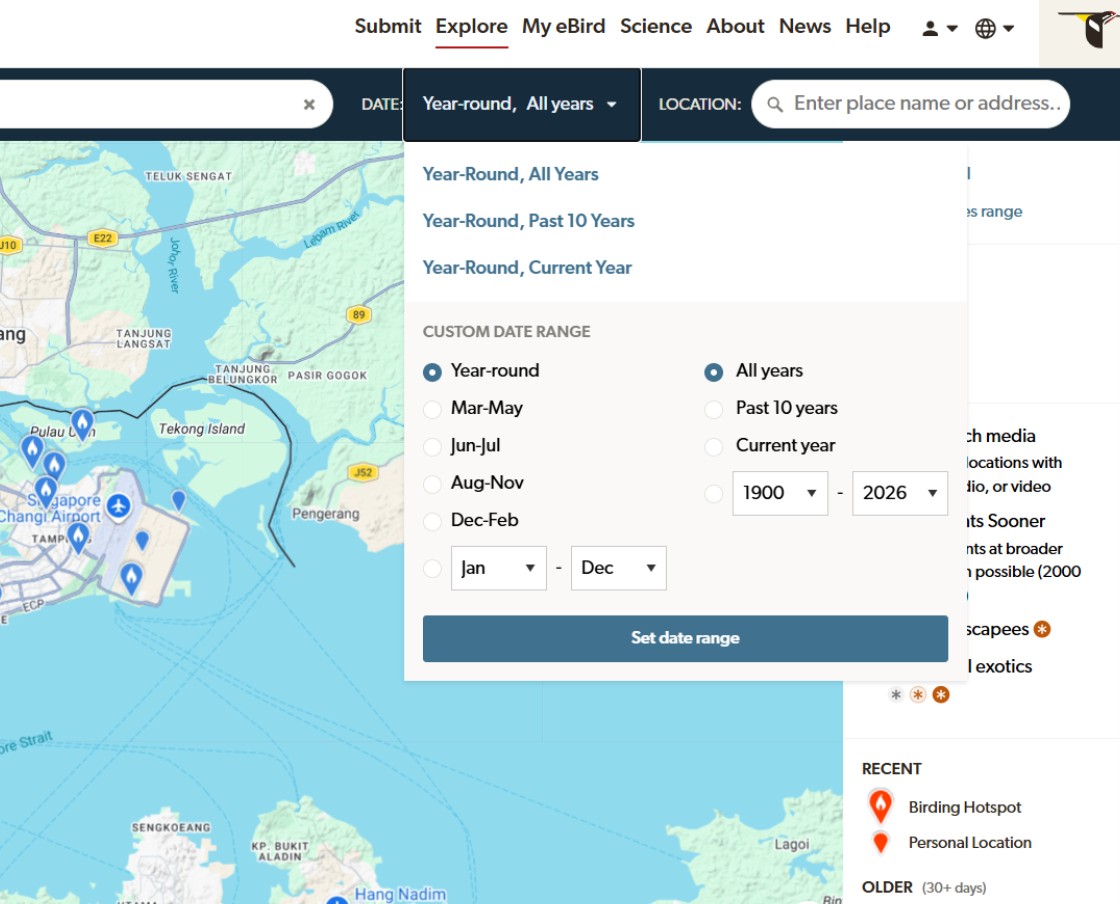
Filtering the date on the eBird species map page
eBird Alerts
eBird’s Rare Bird Alert (RBA) is an especially crucial tool for serious twitchers or for anyone hoping to see a rare bird species. This page gives a summary of all sightings of species deemed as rare in Singapore (be it throughout the year, or during a certain time of the year). Sightings are reviewed by our eBird moderators daily and will be listed as “confirmed” if there is sufficient evidence to back up a sighting, or left as “unconfirmed” if there is not enough documentation to prove the presence of a rarity. We seek your understanding that our eBird moderators may take some time to review your records on eBird, but we will try our best to do this as regularly as possible. Do also exercise your personal discretion when looking for sightings still listed as “unconfirmed” on the RBA, as we sometimes get sightings of misidentified birds. However, that is not to say that all records which are “unconfirmed” are not legitimate. Sometimes the observer may just take some time to upload the necessary documentation, or perhaps did not manage to take a photo of the bird. We often get sightings which are initially left as “unconfirmed” but later confirmed when other observers manage to connect with and photograph the bird.
The Needs Alert is also a great tool for listers as it will show you whenever a species you have not yet seen in Singapore has been sighted. This would be useful for pursuing species for your life list.
The Year Needs Alert is similar, except that it shows you when a species you have not yet seen for the year has been sighted. For those doing a Big Year, this would be a great source of timely information.
For these tools, you may subscribe to email notifications (either daily or hourly), or alternatively (as I prefer to do so), go directly to the websites for direct access. These tools may be used anywhere around the world, and can help you as you go birding on your travels as well.
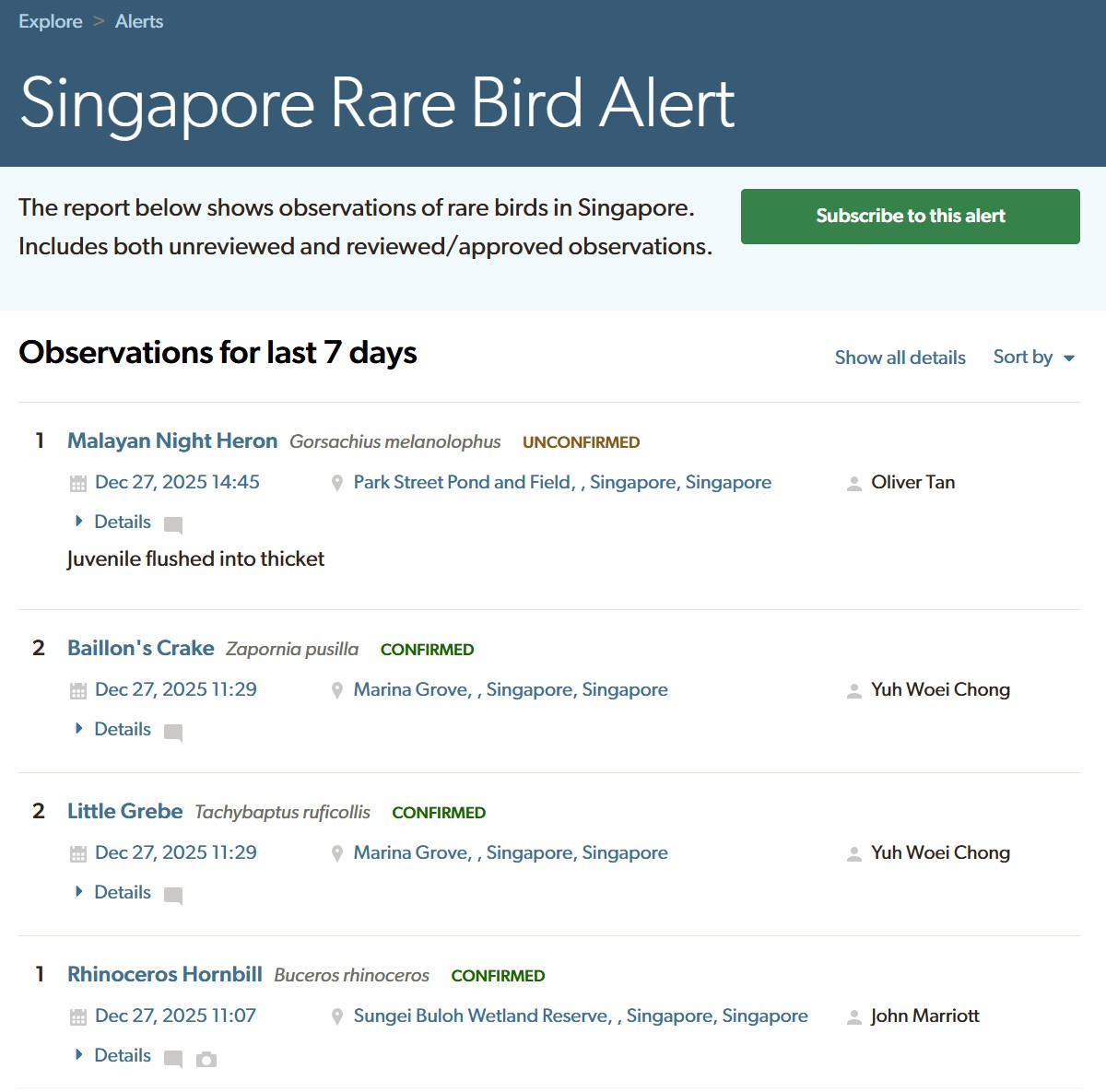
eBird Rare Bird Alert page for Singapore
Keeping of personal lists
Apart from being an excellent source of information, eBird can also serve as a place where you can store information about your birding trips and adventures, including the date, time, location and list of birds seen during each trip. eBird can also help you to keep track of how many birds you have seen in a certain country, or even around the world! You can easily check out your birding numbers over the years via the “My eBird” page, and from there also navigate to the “My Checklists” page to check out all your checklists.
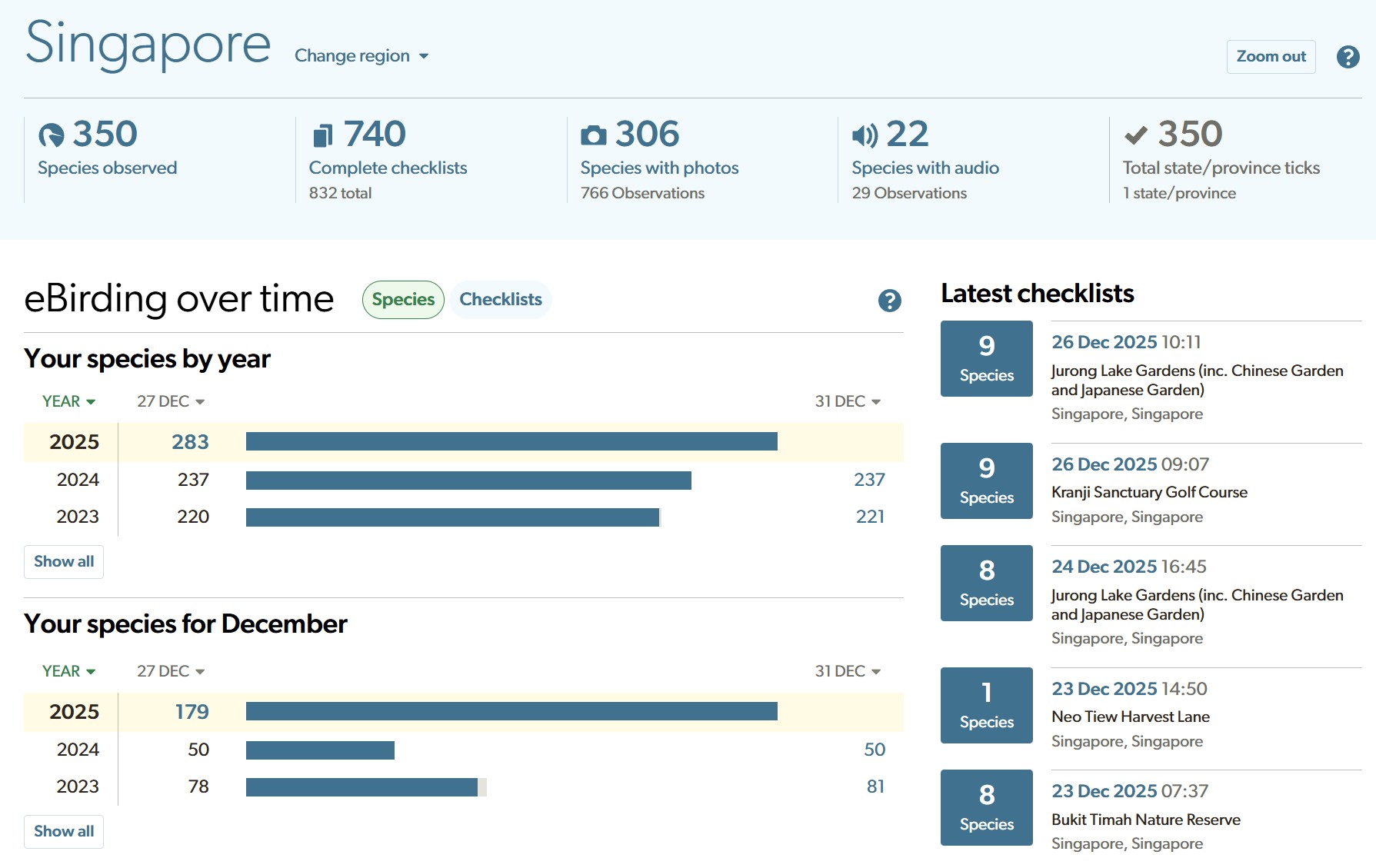
“My eBird” page
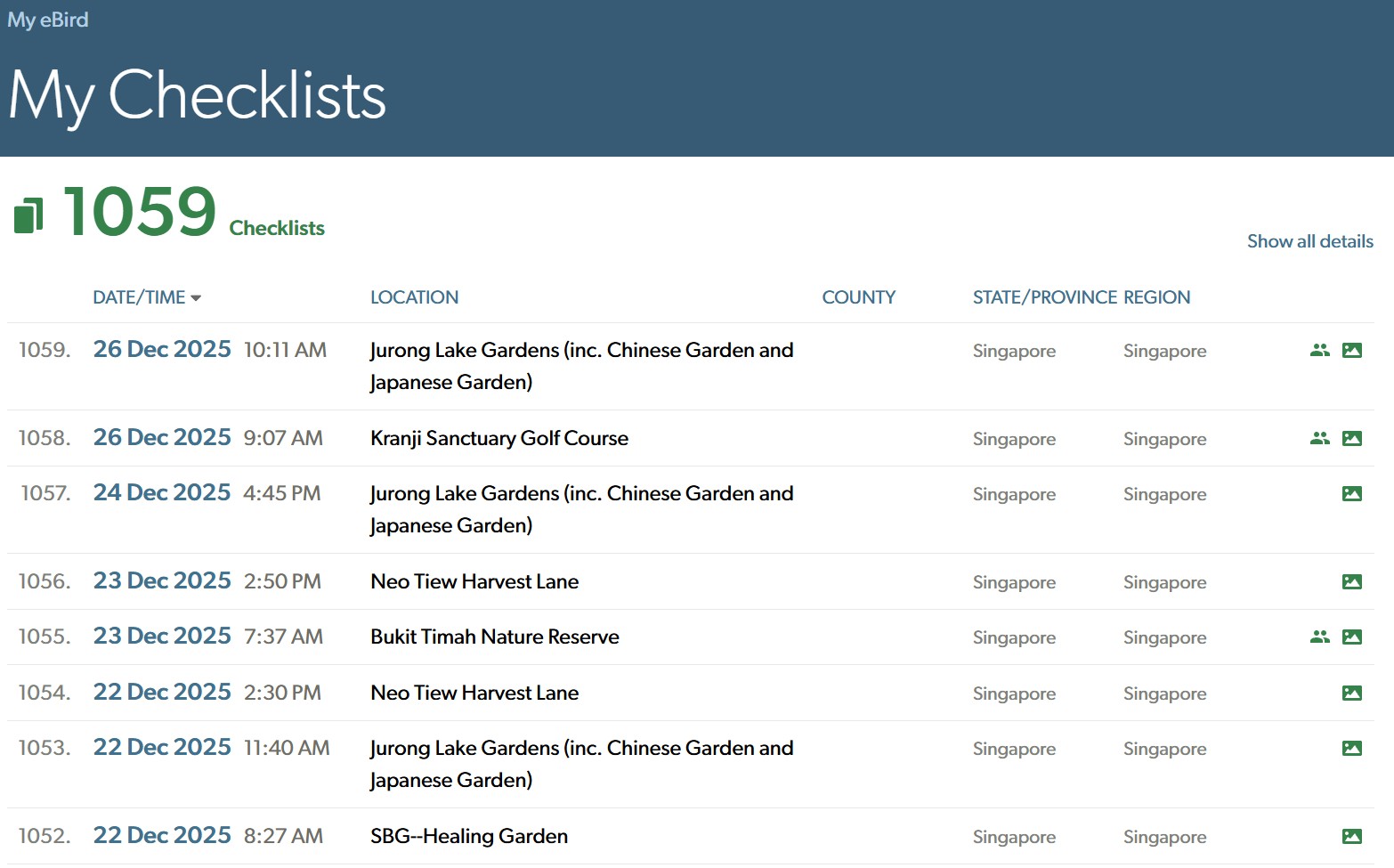
“My Checklists” page
Personally, I treasure each and every moment I spend birding, and each experience I have had seeing a bird holds a special meaning to me. As time goes on, it may be easy to forget where and when you saw a specific bird, however making use of eBird to faithfully log your checklists helps you to store information and photographs of your birding experiences in one place. Sometimes, I enjoy looking through old checklists and photos, giving me the opportunity to relive these special moments!
Mobile app or desktop site?
After you have registered for eBird and downloaded the mobile app (available on both Google Play Store and Apple Store), you may be wondering if there are any differences between the app and the desktop site. Here is a quick summary.
| Mobile app | Desktop site |
| More user-friendly experience of submitting checklists. | Submission of checklists may be slightly more challenging. |
| You have the option of keeping your checklist running while birding to keep track of the time and distance travelled using GPS. | Does not allow for live running of checklists. Use of the desktop site is more for submission of checklists after you have completed birding. You would have to estimate the distance travelled and duration spent birding. |
| Does not support attachment of media (photos and audio) to checklists. | Allows you to attach media to your checklists. |
| Does not allow mass uploading of checklists via Microsoft Excel. | Allows mass uploading of checklists via Microsoft Excel.
(Stay tuned for an article on how to do this) |
Personally, I prefer to submit my checklists using the eBird mobile app first, then upload my photos and audio to my checklists via the desktop site afterwards. The desktop site may be accessed via a computer, or also via the browser on your mobile phone.
eBird Best Practices
As previously mentioned, eBird data is used by scientists for research purposes and helps in conservation of birds around the world! As such, we should aim to keep the data that we key into eBird as accurate as possible.
1. Only key in species you are confident of identifying.
Keying in species you are not confident in identifying, or are not sure if you really saw them will affect the reliability of eBird data. For example, if you see terns which are too far out and you are unable to get photographs or good looks at them to identify them confidently, you should key them into your checklists as “tern sp.” instead of assuming that all of them are Little Terns. In reality, they could be White-winged Tern, Whiskered Tern, or some other kind of tern. If you are not sure of the identification of any sightings, don’t feel shy to ask directly on the Bird Sightings Facebook group!
In the same vein, there are some species which are not identifiable to species during certain times of the year, or unless certain criteria are met. Instead of assuming that the birds we see are one species or the other, we should key in our observations as detailed in the examples below.
Black-nest and Edible-nest (White-nest) Swiftlet
While they may be some of the most common birds in Singapore, Black-nest Swiftlet and Edible-nest Swiftlet (otherwise known as White-nest Swiftlet) cannot be identified to species without a view of a bird on its nest, or a view of the extent of feathering on the tarsi with a bird in hand.
These two species of Aerodramus swiftlets should be keyed in as dark-swiftlet sp. for birds only seen in flight.
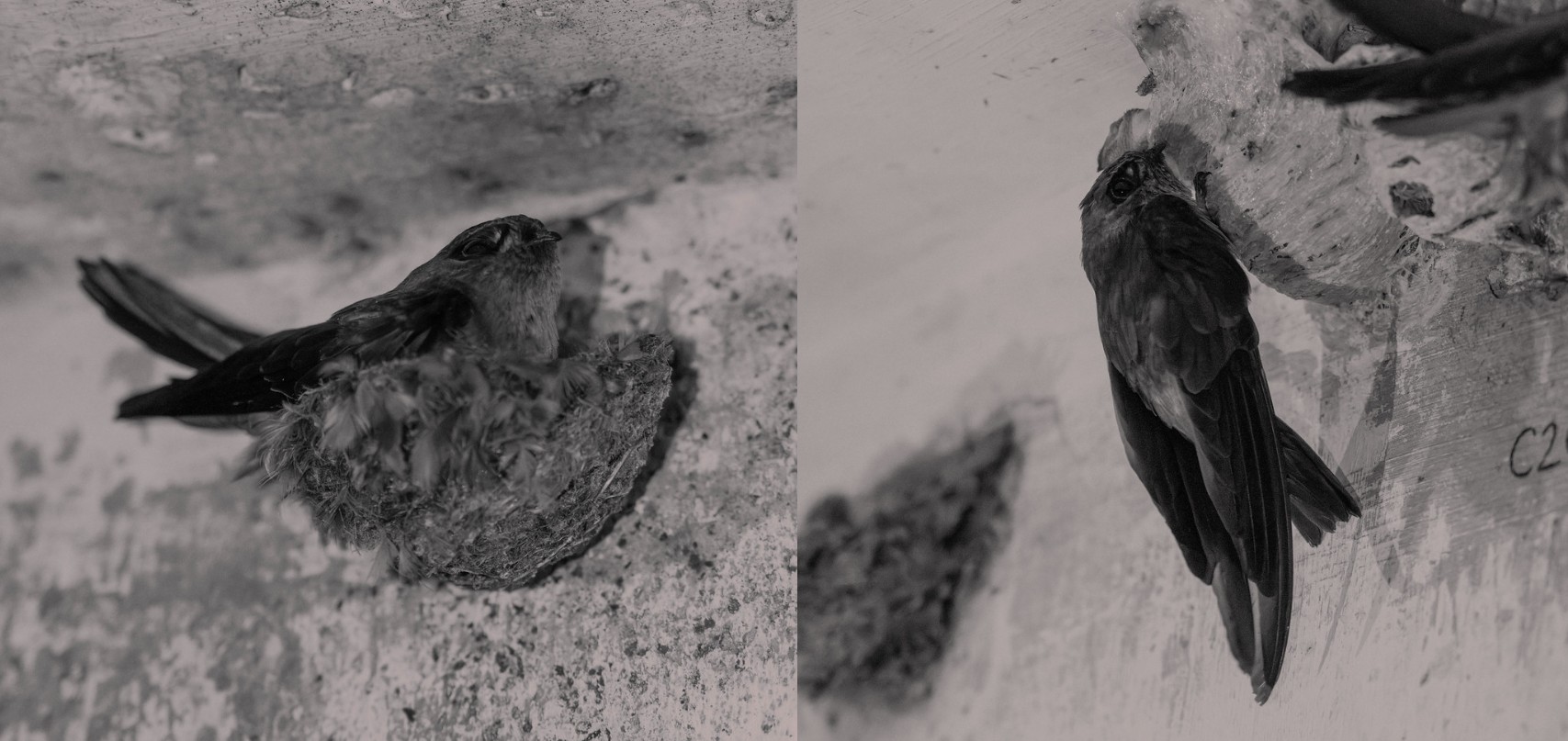
Black-nest Swiftlet (left) and Edible-nest Swiftlet (right) on their nests. Photo credit: Jared Tan
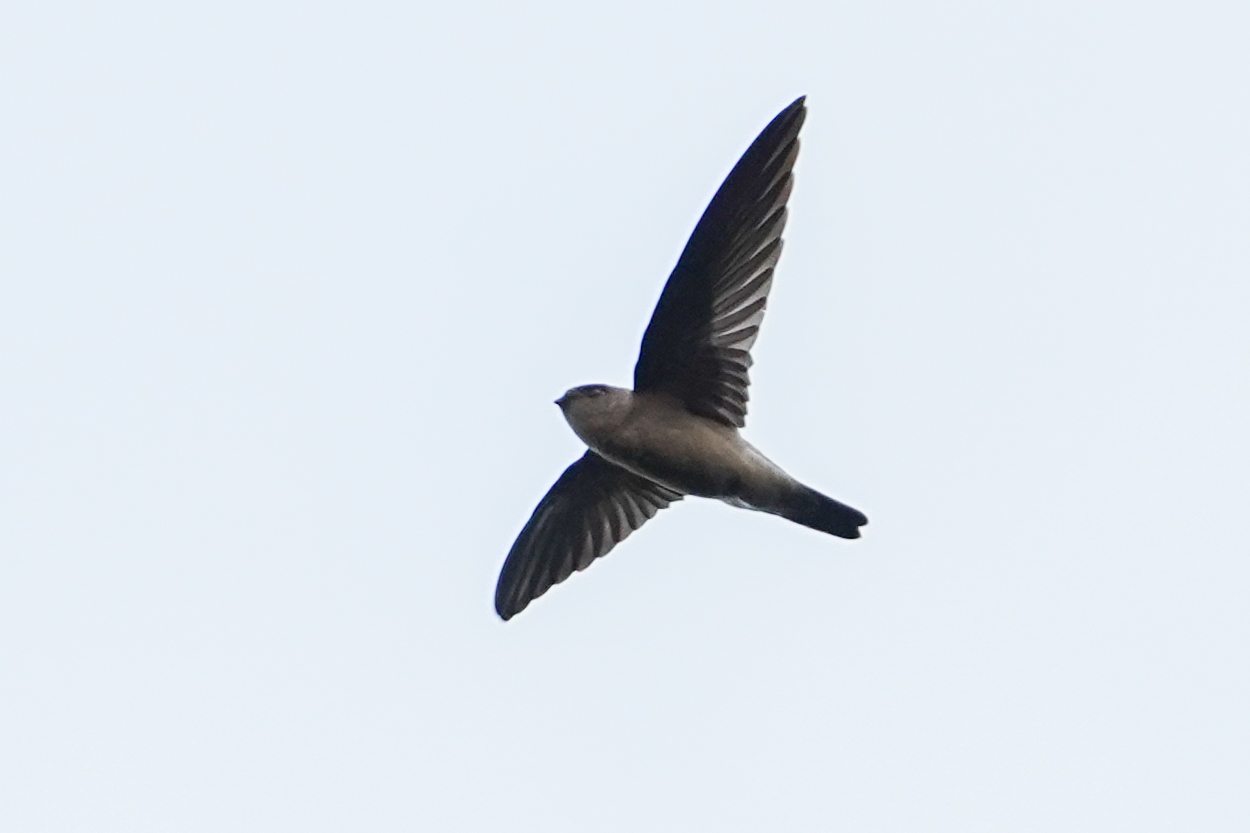
Black-nest/Edible-nest Swiftlet in flight. Photo credit: Jared Tan
Chinese, Javan and Indian Pond-Heron
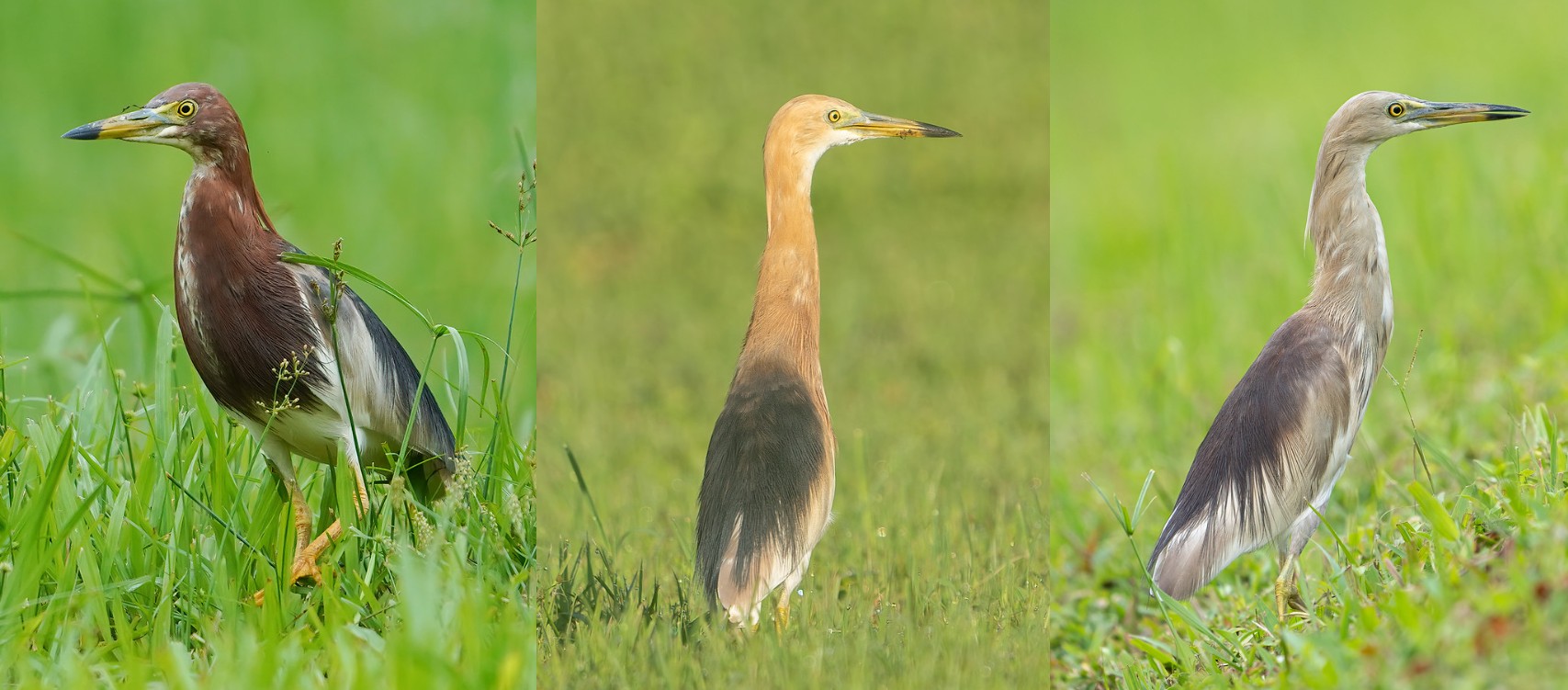
Chinese Pond Heron, Javan Pond-Heron and Indian Pond-Heron cannot be differentiated while in their non-breeding plumage. They typically start to develop their breeding plumage from March to May, before they return back to their breeding grounds. They are usually only identifiable to species during these months. Just because Chinese Pond Heron is the most common pond-heron species in Singapore does not mean that all non-breeding pond-herons should be automatically assumed to be of that species.
Birds in non-breeding plumage should be keyed in as pond-heron sp.
Chinese, Javan and Indian Pond-Herons in breeding plumage (from left to right). Photo credit: Jared Tan

Pond-Heron in non-breeding plumage. Photo credit: Keita Sin
Pin-tailed and Swinhoe’s Snipe
These two species cannot be differentiated without a view of the spread tail, in particular the width of the outer-tail feathers. Pin-tailed Snipe shows narrower outer-tail feathers which are similar in width (less than 2 mm wide) with one intermediate-width tail feather. Swinhoe’s Snipe shows wider outer-tail feathers which also increase in width towards the central tail feathers, with at least two intermediate-width tail feathers.
For birds seen without photographs of the spread tail, they should be keyed into your checklists as Pin-tailed/Swinhoe’s Snipe.
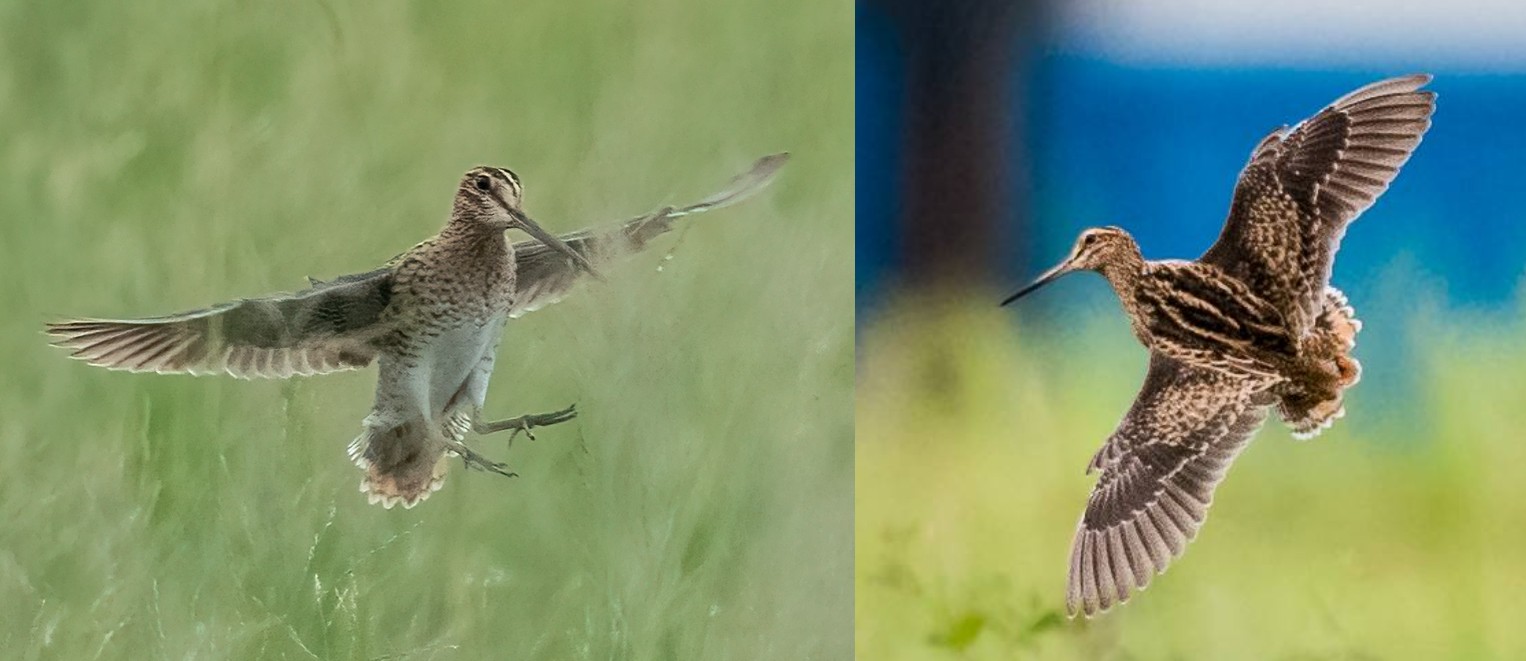
Pin-tailed Snipe (left) and Swinhoe’s Snipe (right) seen with a view of the spread tail. Photo credit: Lee Chien Nien and Lester Tan
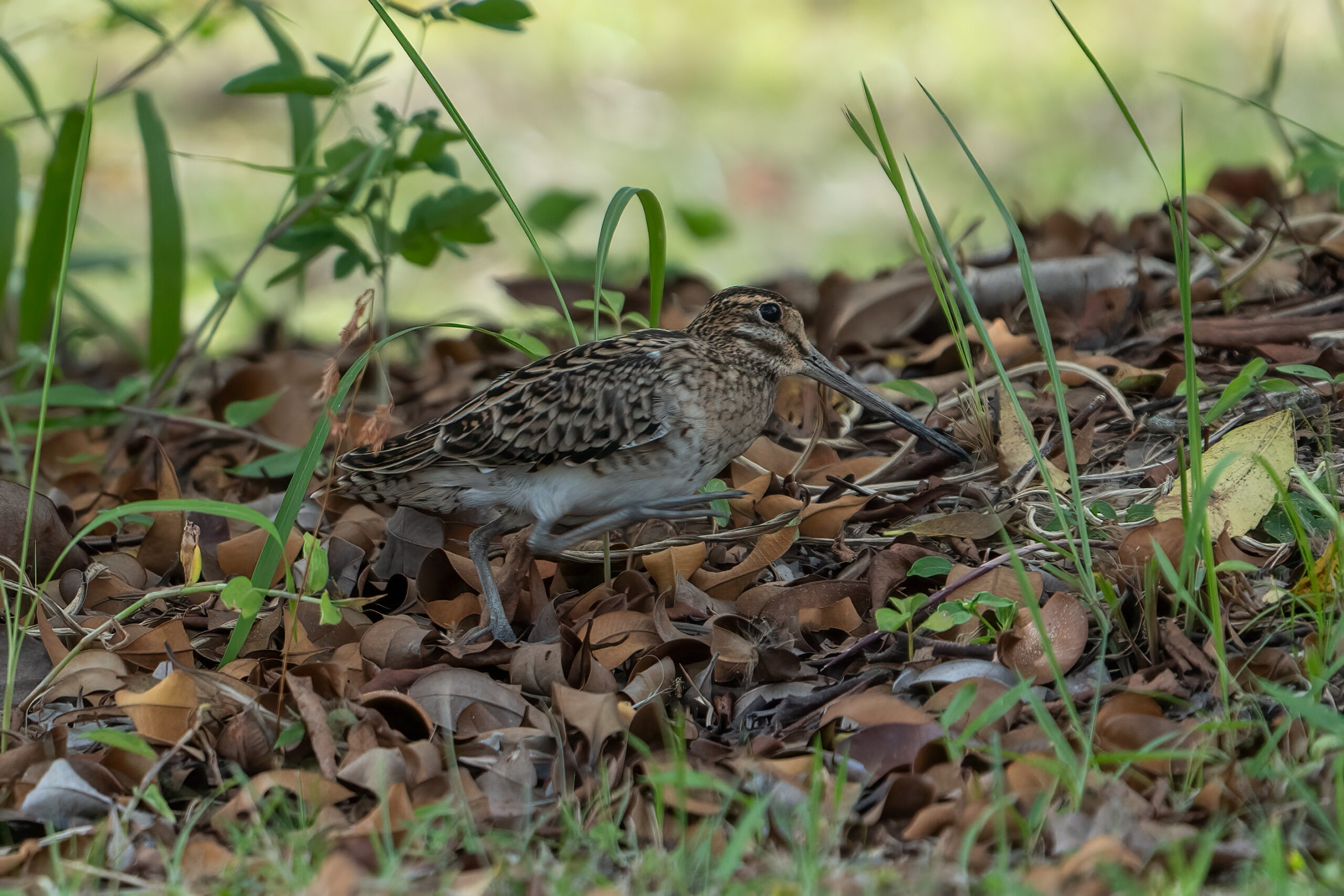
Pin-tailed/Swinhoe’s Snipe. Photo credit: Jared Tan
Blue-and-White and Zappey’s Flycatcher
Blue-and-White and Zappey’s Flycatchers can only be separated in adult male plumage. In immature male or female plumages, they cannot be identified to species and should be keyed in as Blue-and-White/Zappey’s Flycatcher.
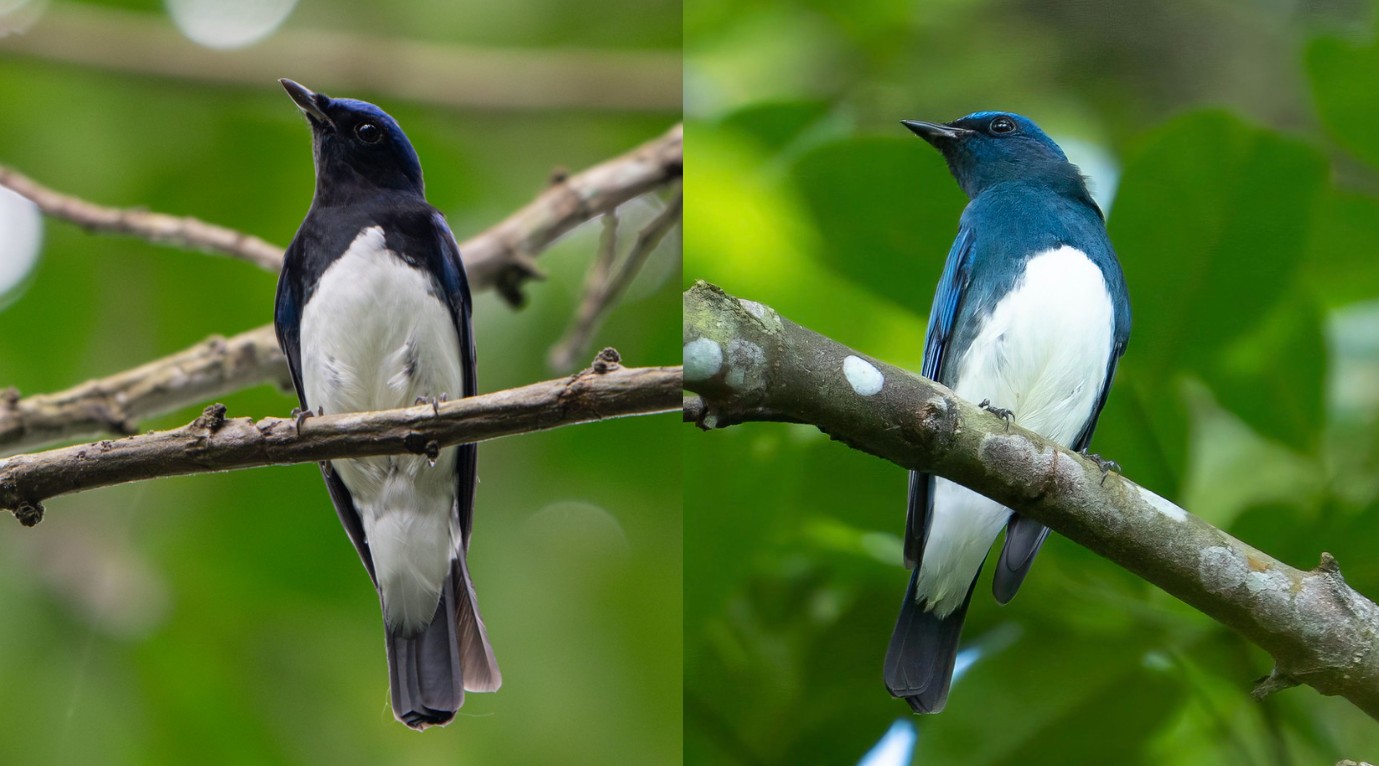
Blue-and-White and Zappey’s Flycatcher in adult male plumage. Photo credit: Jared Tan
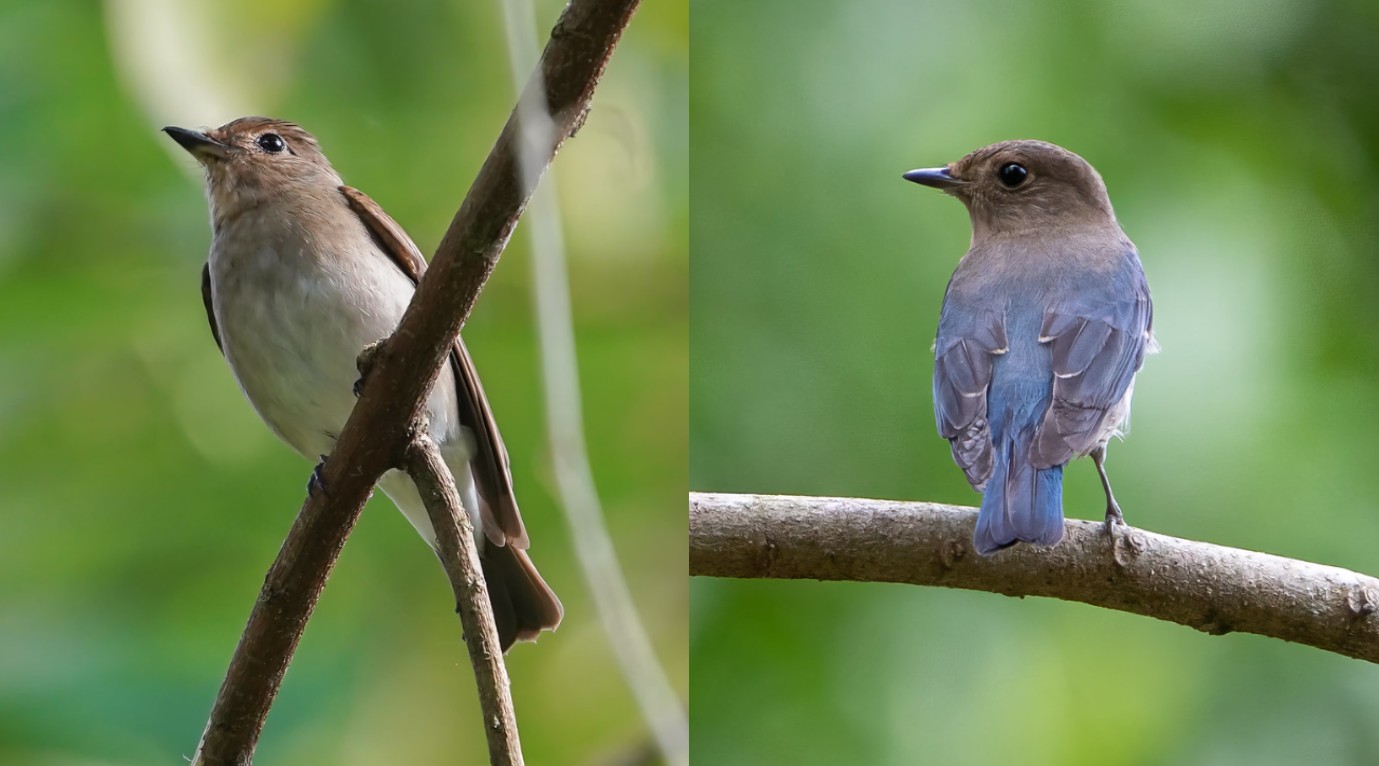
Blue-and-White/Zappey’s Flycatcher in female (left) and immature male (right) plumage. Photo credit: Jared Tan
Amur Paradise Flycatcher and Blyth’s Paradise Flycatcher
Amur Paradise Flycatcher and Blyth’s Paradise Flycatcher are usually able to be separated, but often with some difficulty, through good views or photographs. However, birds in the white morph are not identifiable to species based on current knowledge. While some have made hypotheses that the thickness of the dark shaft streaks on the upperparts may be used to distinguish between the two species (possibly thicker in Blyth’s and thinner in Amur), there have not been any official studies to prove this yet. Until then, we should record white morph birds as Amur/Blyth’s Paradise Flycatcher.
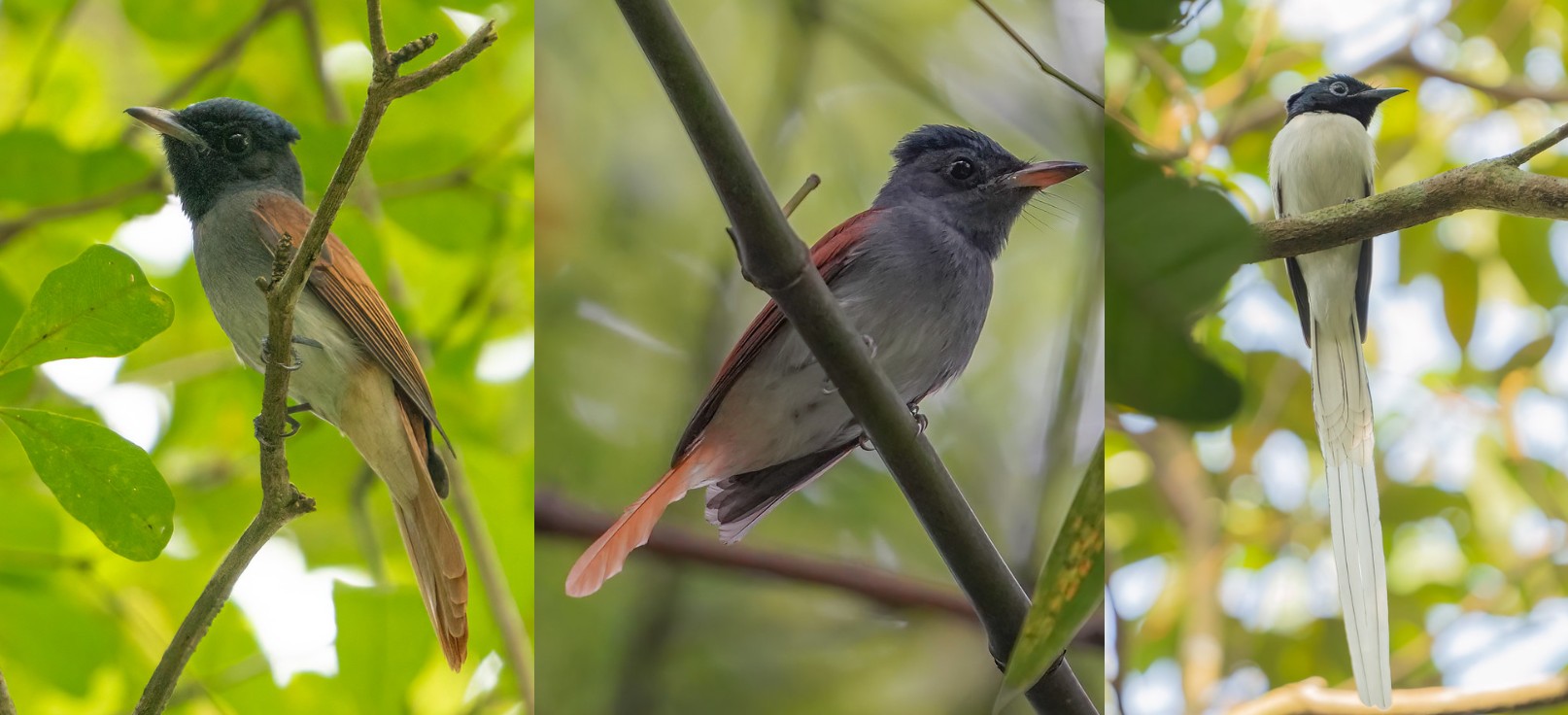
Amur Paradise Flycatcher, Blyth’s Paradise Flycatcher and Amur/Blyth’s Paradise Flycatcher. Photo credit: Jared Tan
Himalayan and Oriental Cuckoo
While both Himalayan Cuckoo and Oriental Cuckoo are technically possibly encountered in Singapore by range, currently only Himalayan Cuckoo is in the Singapore Bird List from two confirmed records in 1995. They are unable to be separated without vocalisations or morphometrics. However at the moment we will be allowing submissions of Himalayan/Oriental Cuckoo as Himalayan Cuckoo as a placeholder, so that data is well-captured in eBird.
You may key in your records as either Himalayan/Oriental Cuckoo or Himalayan Cuckoo.
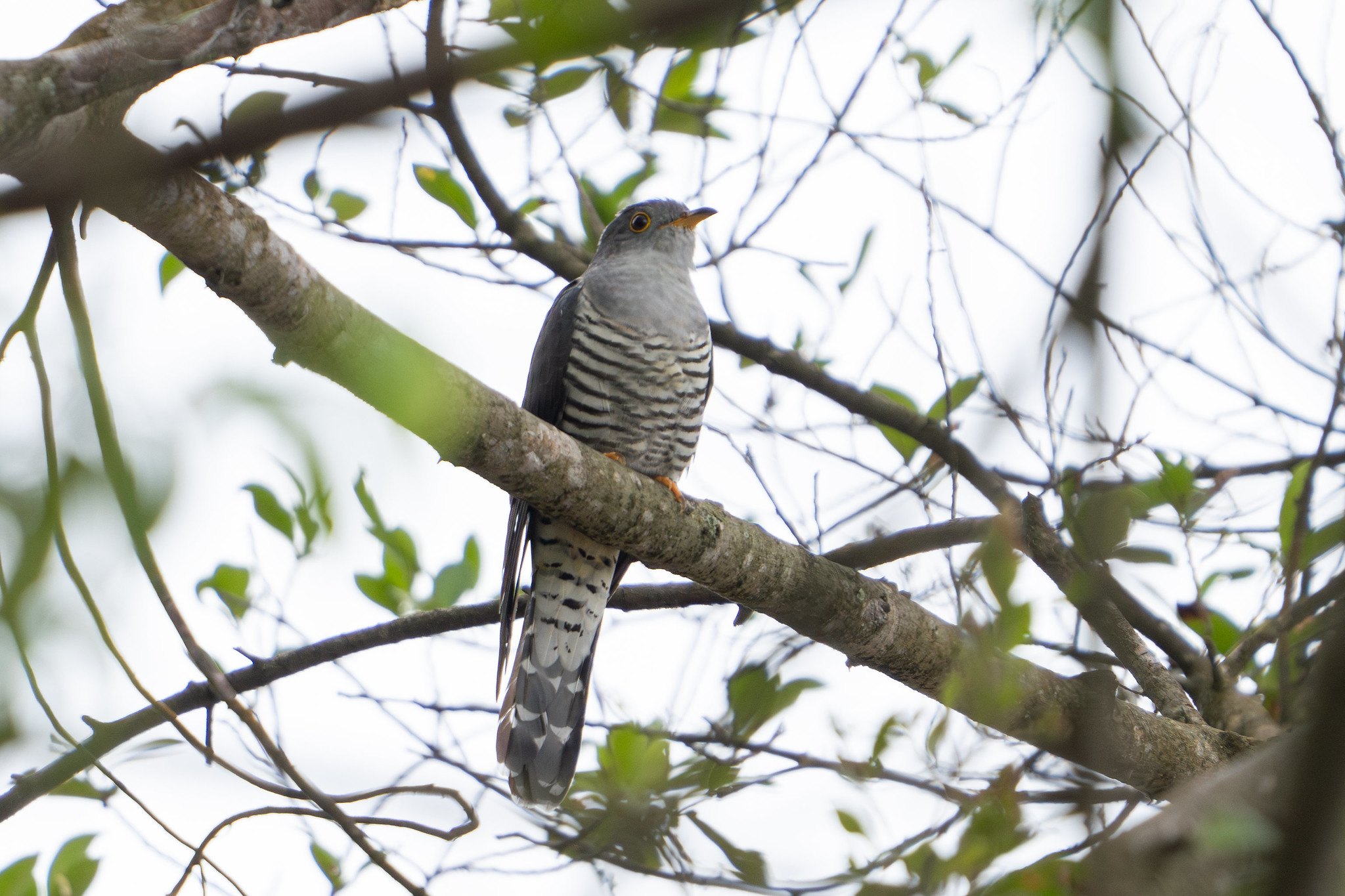
Himalayan/Oriental Cuckoo. Photo credit: Jared Tan
Summary of birds which should not be identified to species on eBird
| Species | What to key into your eBird checklist |
| Black-nest Swiftlet
Edible-nest Swiftlet (also known as White-nest Swiftlet) |
dark swiftlet sp.
for birds seen flying around and not on their nests) |
| Chinese Pond-Heron
Indian Pond-Heron Javan Pond-Heron |
pond-heron sp.
(for birds in non-breeding plumage) |
| Pin-tailed Snipe
Swinhoe’s Snipe |
Pin-tailed/Swinhoe’s Snipe
(for birds seen without a view of the spread tail) |
| Blue-and-White Flycatcher
Zappey’s Flycatcher |
Blue-and-White/Zappey’s Flycatcher
(for female or immature male birds) |
| Amur Paradise Flycatcher
Blyth’s Paradise Flycatcher |
Amur/Blyth’s Paradise Flycatcher
(for white morph birds) |
| Himalayan Cuckoo
Oriental Cuckoo |
Himalayan/Oriental Cuckoo or
Himalayan Cuckoo *(At the moment we will be allowing submissions of Himalayan/Oriental Cuckoo as Himalayan Cuckoo as a placeholder, so that data is well-captured in eBird) |
While rare species will still be subject to review from moderators, common species will easily slip under the radar and automatically be accepted into eBird. Just because you have more species on your checklist, or have seen more individuals of a particular species, it doesn’t mean you are a superior birder! Let’s do our part to be responsible in reporting our sightings and try to keep eBird data as accurate as possible. In addition to the species you see, also do remember to include the species you hear as well – but again, only if you are confident of your identification.
2. Try to provide an accurate estimate of the number of birds seen instead of using “X”.
While there is the option of putting an “X” to show that a bird is seen (without providing an exact count), it is always best to provide a count of the number of birds seen. Even if you are unable to count the exact number, it is still good to give an estimate. As a general, stay conservative with your counts. For example, if 20 white-shouldered starlings fly by, and 10 minutes later, another flock of 20 flies by again in the opposite direction, they are likely to be the same flock. In some cases it might feel daunting to count the many birds you are observing, for example, if a flock of 237 Asian Glossy Starlings fly by you, a ballpark figure of 200 to 250 will be alright. The numbers you provide will act as useful data points for research and conservation.
3. Include photos, audio and/or comprehensive descriptions for rare species
When submitting your checklists, you may realise that some species are labelled with an “R”. This would denote a rare species for the location (either year-round or for that specific time of the year). You would then be prompted to insert comments for your observation, as well as to add photos, videos or audio to substantiate your sighting. This is particularly important, as this helps to show eBird moderators that your sighting is accurate and genuine, particularly when you are the first (and perhaps only) person to spot it. This is crucial as our eBird moderators have to exercise due-diligence when confirming sightings, and cannot confirm a sighting of a rarity which does not have sufficient evidence to back it up. For sightings of continuing birds seen by multiple observers and shortly after the last sighting, it is acceptable to state “continuing” under the checklist comments. However, perhaps if the bird has already not been seen for a few days, and you are also the sole observer for that specific day, it would still be important for you to provide good documentation to back the sighting up.
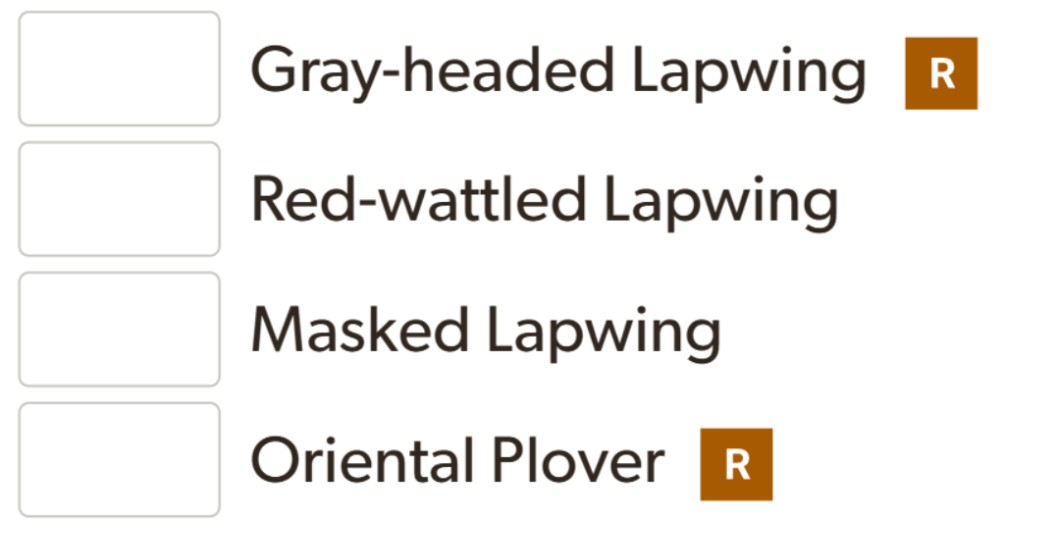
Examples of species listed as “rare” on eBird in Singapore
While photographs are the best evidence, we do know that not all birders carry a camera or we may not have our cameras with us all the time, and also that sometimes the birds are just too quick for us to get a picture. If no photographs are available, your descriptions become all the more important to prove the presence of a rarity.
When inserting comments for rare species, it is important to describe the following:
- Appearance of the bird such as:
- Size (usually by comparing to other common species, for example, “slightly bigger than Javan Myna”)
- Proportion (was the tail long? How were the wings shaped?)
- Colour (describing species colours for different body parts can be very helpful!)
- Behaviour of the bird
- For example: did you notice any specific flight pattern, was the bird wagging its tail, was it hunting using a specific technique?
- How similar-looking species were eliminated
- Duration of sighting
- Distance to the bird
- Whether binoculars were used
- Whether photographs were obtained (and if so, remember to upload them as soon as you can!)
Merely stating “perched on a tree”, “flying about” or “feeding” does not help to prove a rarity! Do try to make sure you describe birds to the best of your abilities. It is perfectly fine if you did not get to see or take note of every single feature of the bird, but just be honest about what you saw, and why you reached your conclusion about its identification. This will help our eBird moderators to make a well-informed verdict on your sighting. We are currently working on an article on how to best write descriptions, so stay tuned!
4. Input locations accurately and make use of eBird hotspots whenever possible
Make use of eBird hotspots instead of creating a new custom location
Generally, try to key in the location based on an existing location available in eBird (i.e. selecting “Sungei Buloh Wetland Reserve” rather than creating a new custom pinned location). This will be beneficial as your checklist and sightings will be classified under the existing data for that location.
If no existing hotspot is available for selection, it is ok to create a new pinned location as well. You can even suggest new “hotspots” for our moderators to consider! Alternatively, if you would like to use your checklist to show people a specific pinned location to look for a specific bird, it is also ok to create a custom location.
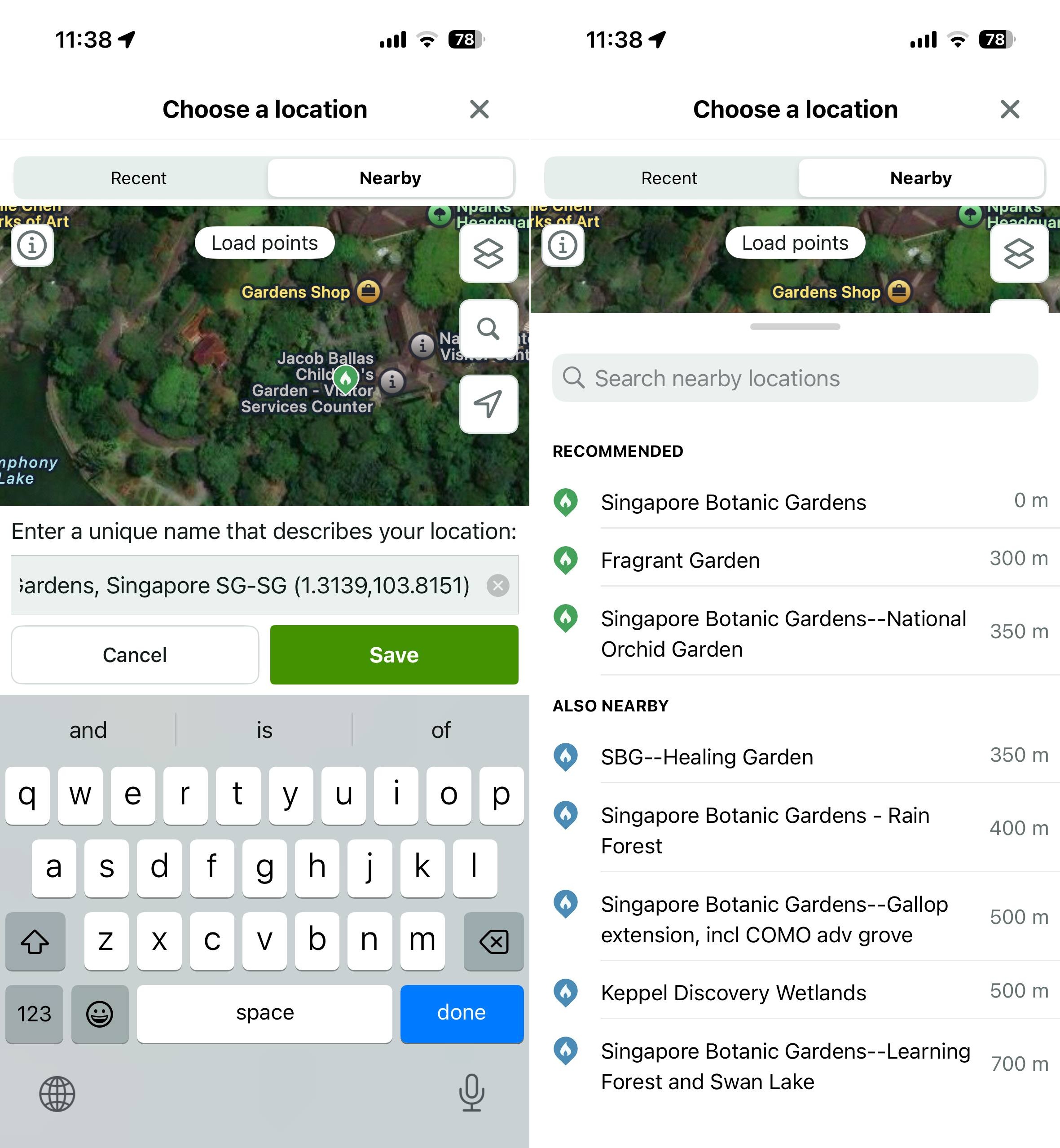
Creating a custom location (left) and selecting location from existing eBird hotspots (right)
Input locations accurately
Do also ensure that you input locations accurately. For example you saw a bird in Sungei Buloh Wetland Reserve, make sure that your checklist location is as such. We have also seen many instances of people mistakenly setting the location of their checklist as their home address!
It is also quite common (alarmingly!) to see some eBird users creating long, continuous checklists spanning multiple locations, which is misleading for other users and affects the accuracy of eBird data. For example, if you start your day with a trip to Jelutong Tower followed by Sungei Buloh Wetland Reserve, and record all your sightings in one checklist, this would lead to a “jumbo” checklist of 80 species, spanning 8 hours and 25 km being created.
Someone experienced enough would be able to tell that something is off about this checklist. While the location says “Jelutong Tower”, several species in the checklist are not found in our Central Catchment, and instead found along coastal mudflats such as Pacific Golden Plover, Eurasian Whimbrel, Terek Sandpiper, Common Sandpiper and Common Redshank. In fact, the high number of species, long duration and distance should set alarm bells ringing when seeing checklists like this. However, those new to birding may not know this, and may even end up going to Jelutong Tower to look for the Eurasian Whimbrels and Common Redshanks, and be sorely disappointed when none are seen at the location!
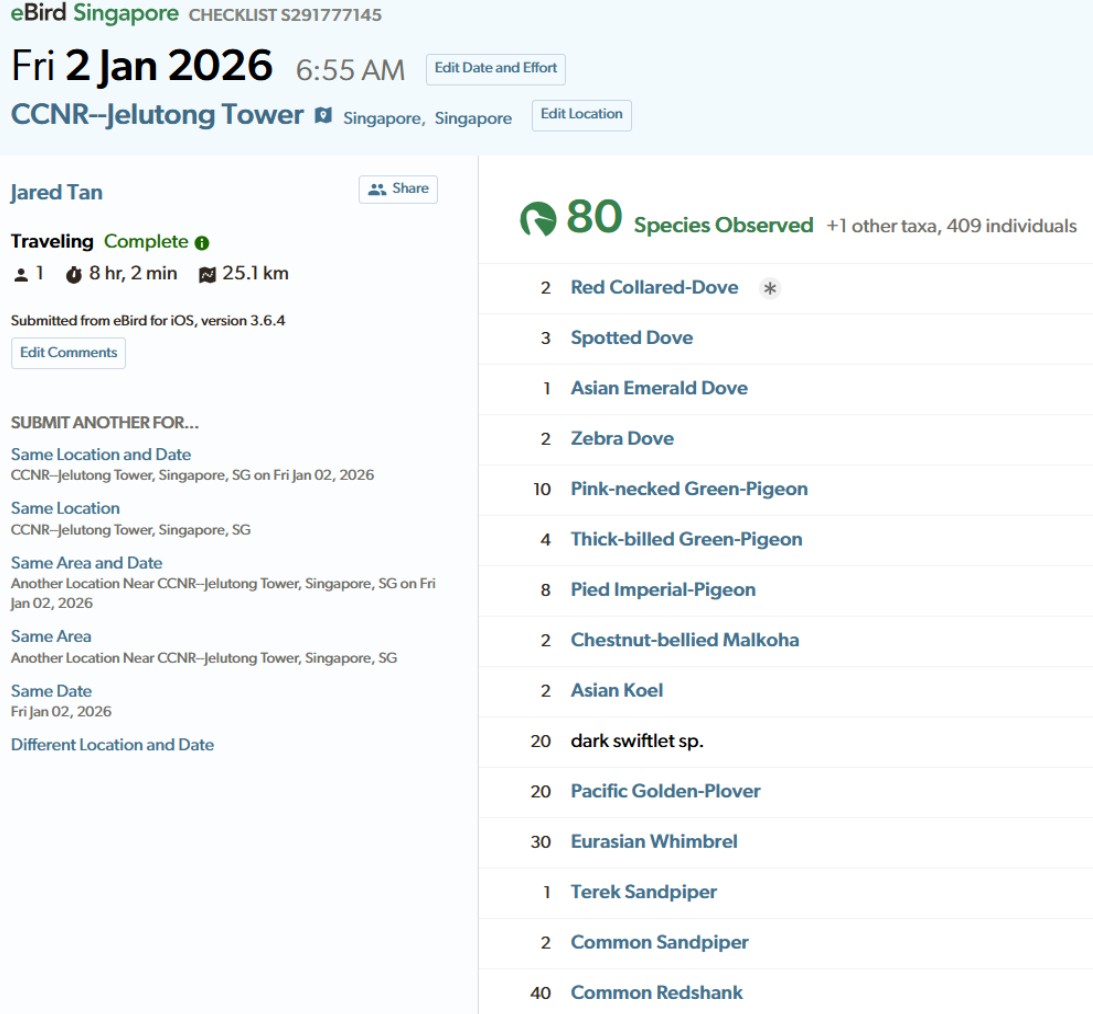
Negative example of a “jumbo” checklist. Do not do this!
On the same note, even locations in somewhat close proximity to each other should be split to separate checklists. For example, if I visit Kranji Marsh, Neo Tiew Harvest Lane, then head to Sungei Buloh Wetland Reserve, I should submit three different checklists instead of submitting one large checklist under “Kranji Marsh”.
While we benefit from the sightings of other eBird users, let us try to be responsible eBird users and keep our data as clean and accurate as possible so that our data can be used for research and also in turn benefit other eBird users as well.
When eBird moderators come across such checklists, we will have to flag the entire checklist and remove the checklist from public view so as to preserve the eBird data quality.
5. Make use of List-building Checklists to record your pre-eBird life lists
While it is preferred for eBird users to key in all checklists accurately based on exact dates and locations, eBird also recognises that historically, a lot of birding activity was recorded at a coarser scale of day lists, trip lists, or life lists, and submission of such detailed checklists may not be possible. As such, eBird has provided special guidelines on how you may input your historical life lists, with the use of “List-building Checklists”.
A List-building Checklist allows you to add in all the species you have seen in a certain region, and can span multiple locations within that region. You do not need to put in the exact count of birds seen, as you can simply use an “X” to show that you have seen each species before.
These checklists will be flagged and will not show up on the eBird public output, but will show up under your personal eBird bird count for each region. This way, you can still record your total number of birds seen without affecting the accuracy of eBird data being used by researchers.
As eBird moderators, if we come across checklists used for list-building which are not correctly flagged as such, we would have to manually flag them and remove them from public view.
You may refer to this link for more information.
6. Work together with eBird moderators
Our eBird moderators are constantly reviewing submissions of rarities throughout the year. We may contact you regarding rarities after you submit your checklist. When that happens, it doesn’t mean that we are looking down on you or do not trust you in any way! Rather, we need to exercise due diligence to ensure that high and consistent standards are kept in the eBird database. Rather than just leaving reports of rarities with insufficient documentation unconfirmed, as far as possible, we hope to contact observers to find out more information about each sighting, so that we do not miss out legitimate records.
To make things as smooth as possible, do your best to provide media/thorough descriptions on your checklists and reply to the moderators via email accordingly. Unfortunately, sightings of rarities without sufficient documentation will not be able to be confirmed on eBird. Nevertheless, unconfirmed sightings will still be added to your personal eBird counts.
On a final note, we would like to remind everyone again to be responsible eBird users, being conservative about sightings and keeping checklists as accurate as possible! Let us continue to take the time to enjoy the birds around us and learn more about them together. eBird is a community effort, and I am sure it will continue to grow both in Singapore and around the world in the years to come!