Written by Collin Chua and Kaeden Sim
Introduction
Have you ever looked up at the sky and wondered what those little aerodynamic birds swooping around are? These are likely swifts, one of the more commonly sighted groups of birds in Singapore. These birds are known to spend most of their lives in flight. This means that whether you are in or outdoors, if you stare at the sky, there is a good chance you will see these amazing birds. But you might be puzzled, is that a swift, treeswift or swallow? Are they the same? How do you differentiate them? Fret not, for this article will answer these questions.
Differentiating Swifts from Swallows
As you might have already guessed, swifts and swallows are not the same. In fact, they belong to two very different groups of birds and are distantly related from one another. Swifts (Family: Apodidae) and treeswifts (Family: Hemiprocnidae) belong to the same order (Apodiformes) and are closely related to hummingbirds (which are not found in Asia) and nightjars. On the other hand, swallows (Family: Hirundinidae) belong to the order of perching birds (Order: Passeriformes), which includes more than half of all bird species, like the commonly seen mynas, bulbuls and sparrows. But how do we tell them apart?
Firstly, you would never find swifts perching, and the only time you will find one not in flight is likely when it is in its nest (or if it’s grounded for some reason). This means that when you spot a perched bird which you are unsure whether it is a swift or a swallow, it is unlikely to be a swift. However, it is possible to find treeswifts perching, and we will go through the identification of treeswifts in the next section.
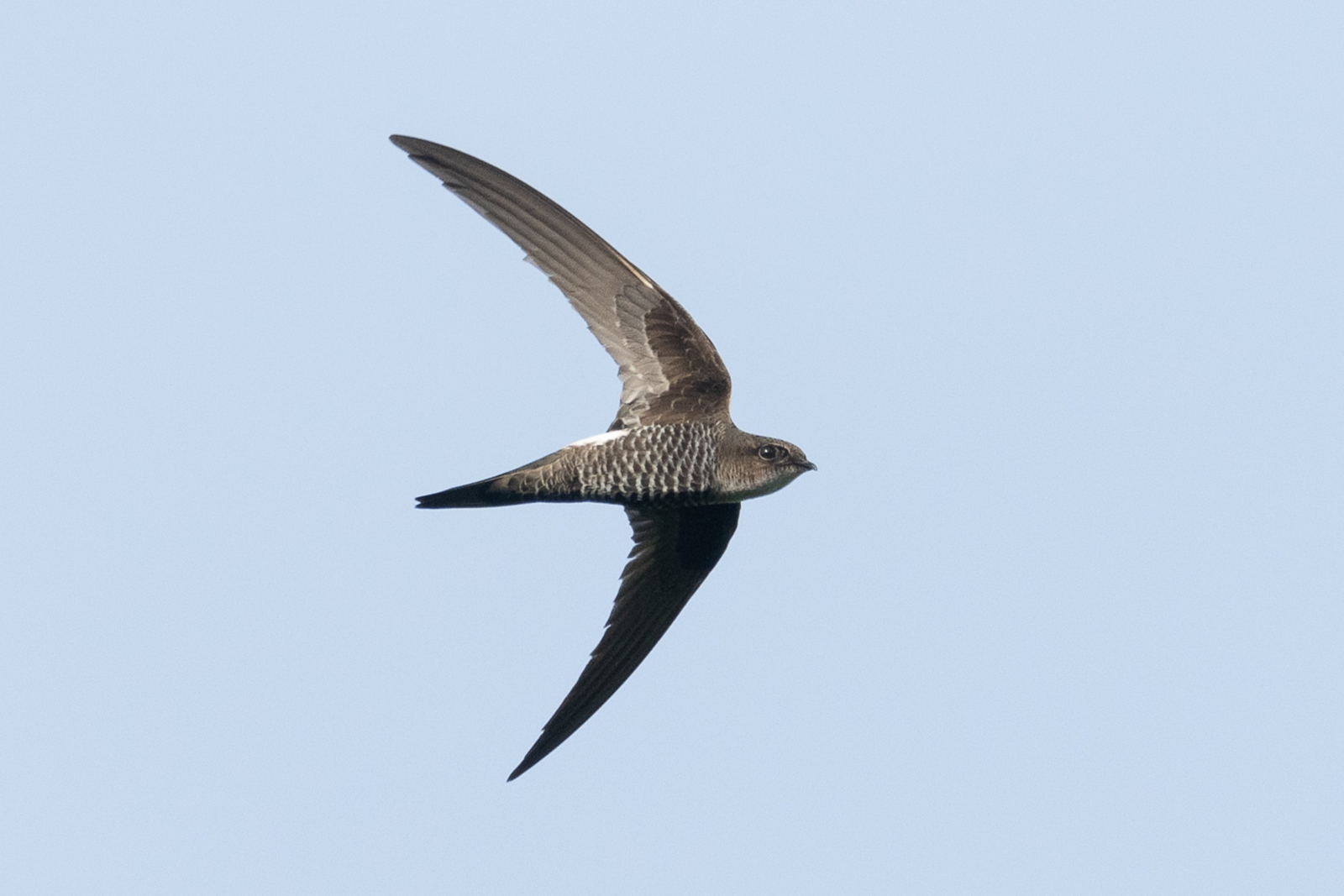
Secondly, the shape of swallows in flight is quite different from that of swifts. Swallows generally have broader wings, while swifts have narrower wings that give them either a sickle-shaped or paddle-shaped look.
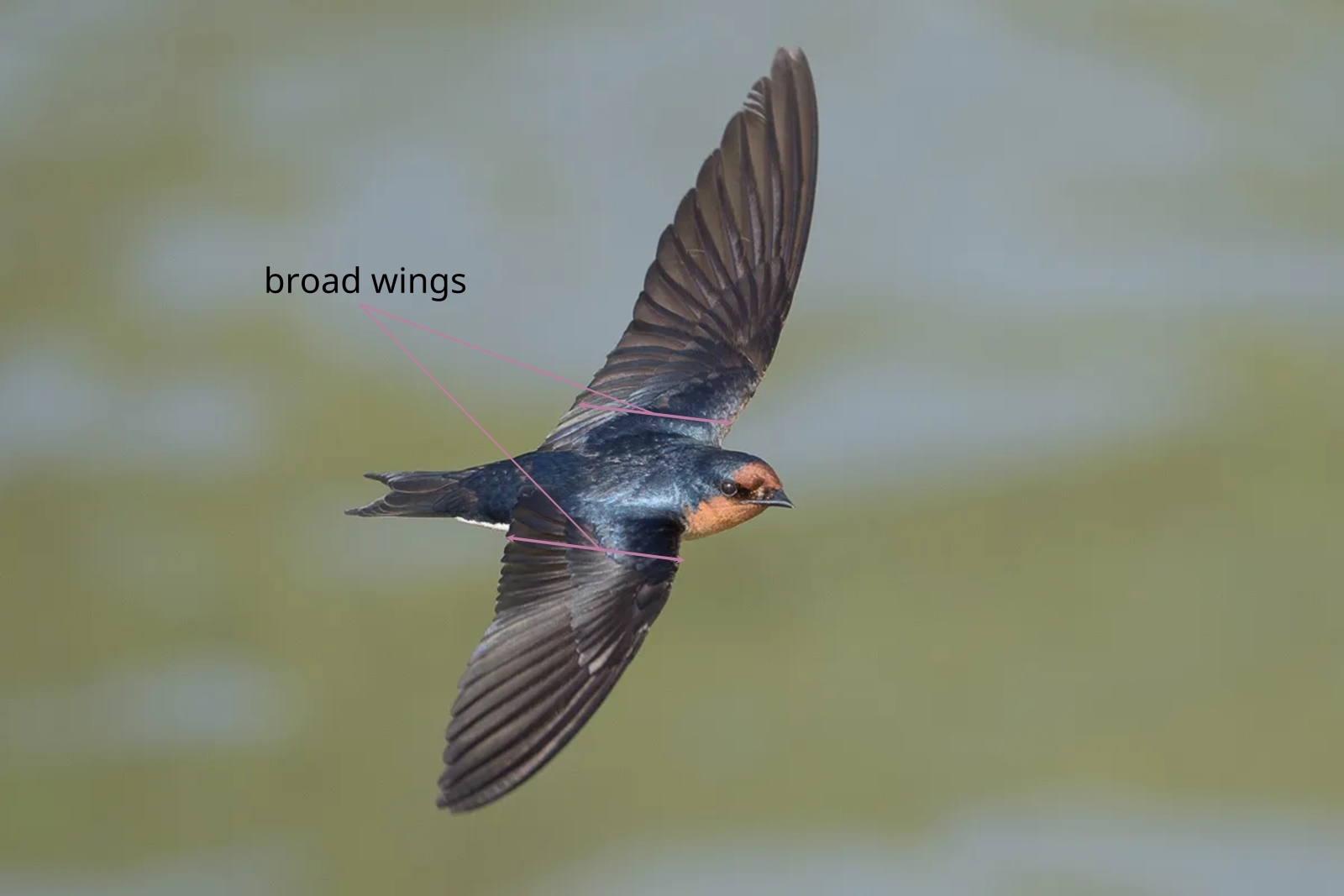
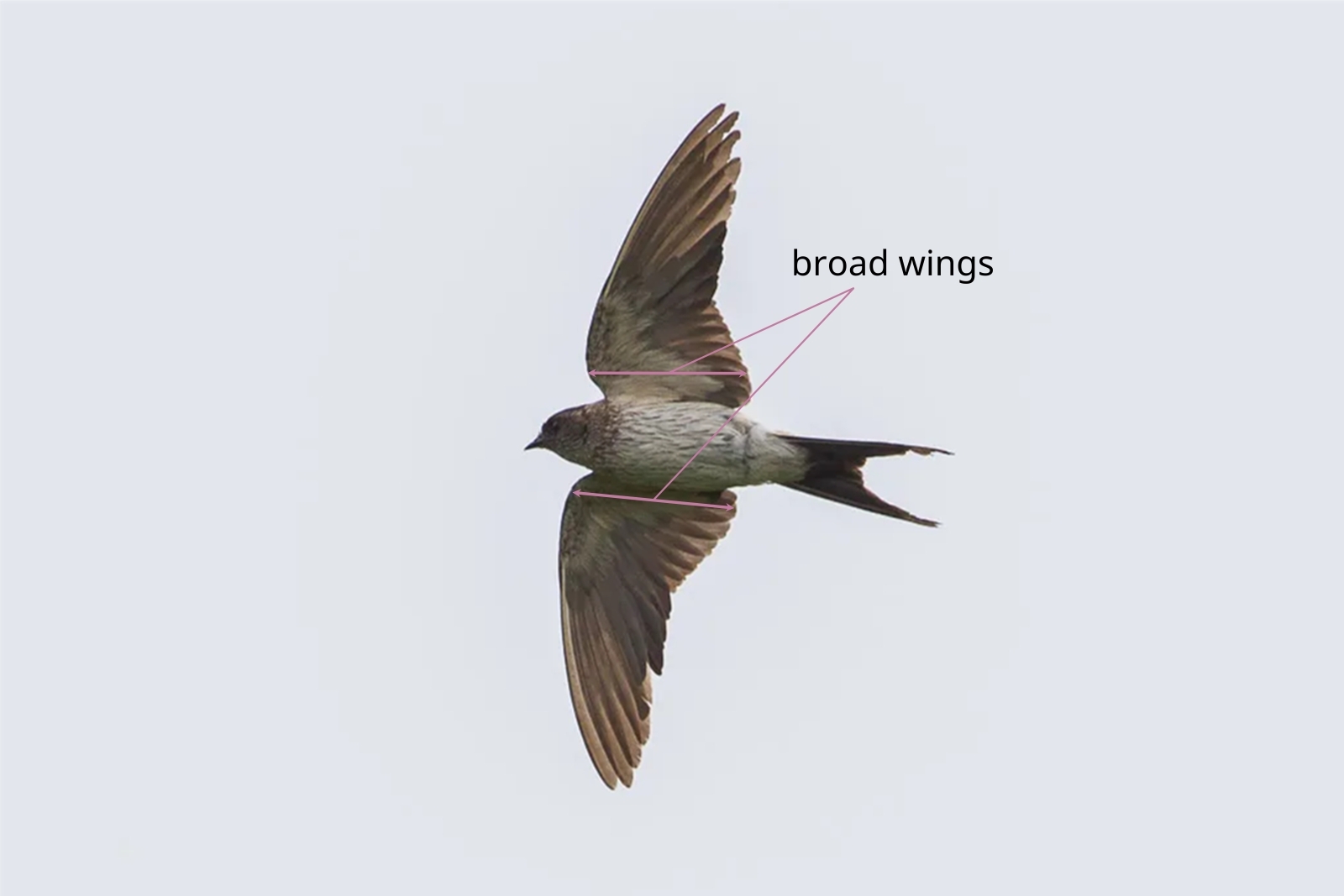
Thirdly, the two groups can be differentiated by their flight pattern. Swallows typically fly with their wings swept down and back. swifts on the other hand do not sweep their wings back in such an exaggerated motion and tend to glide or soar more than swallows.
Identifying Treeswifts
While treeswifts belong to their own family (Hemiprocnidae), they are closely related to swifts and appear more similar in flight to swifts as compared to swallows. However, as mentioned above, treeswifts perch, while swifts do not. Treeswifts also appear more elongated with proportionally longer bodies and tails compared to swifts.
Grey-rumped Treeswift (Hemiprocne longipennis)
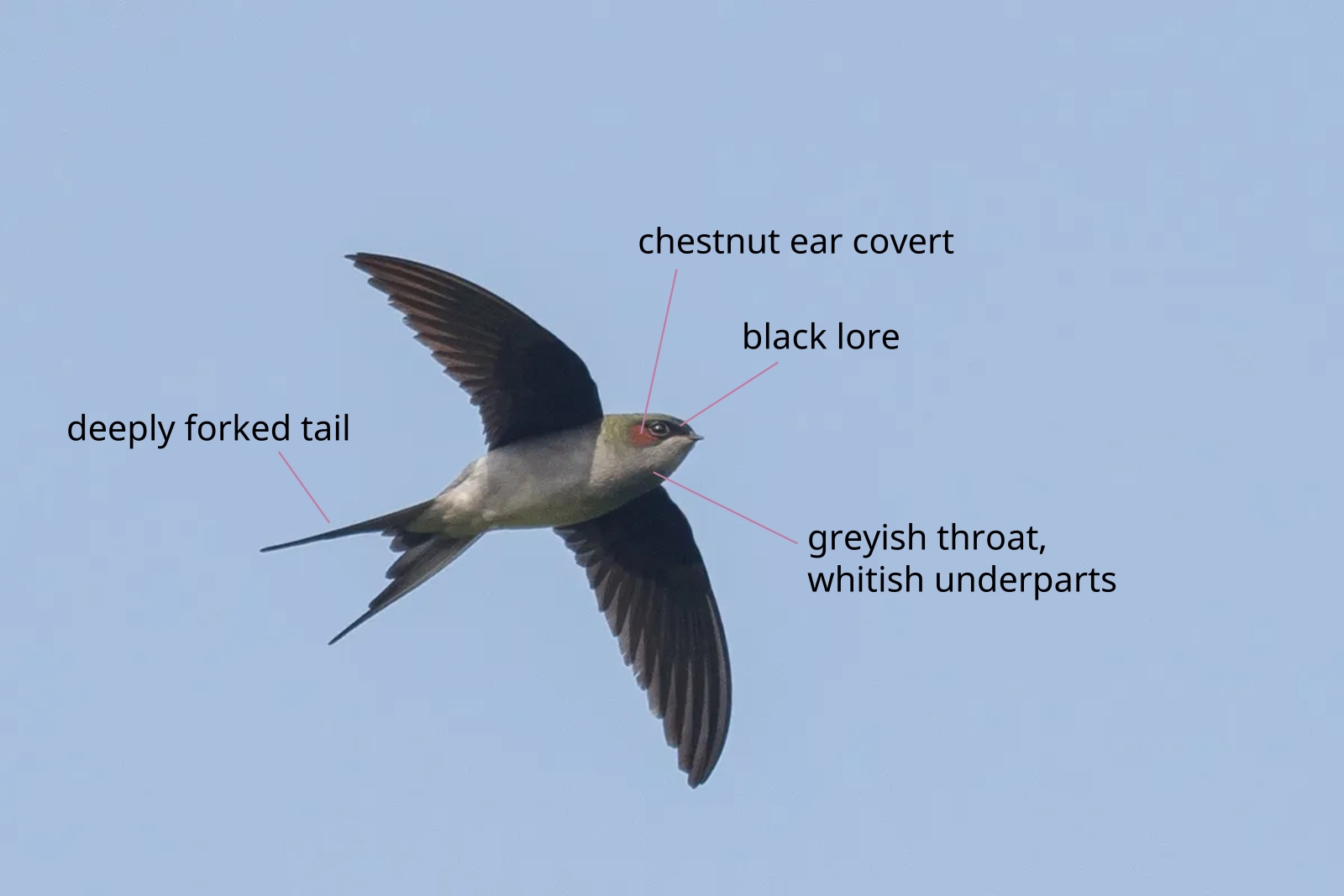
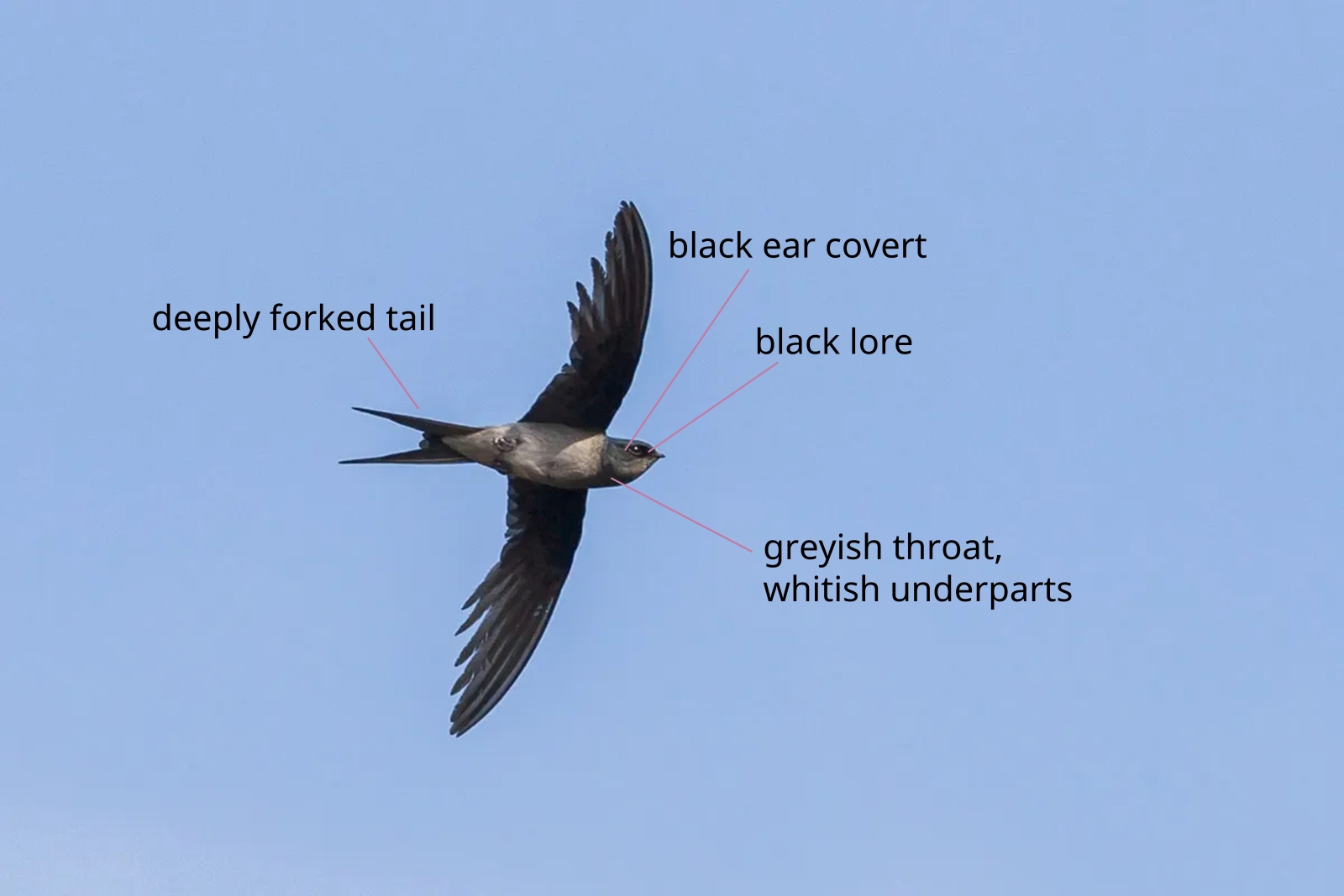
The Grey-rumped Treeswift superficially looks like a swift in flight, but they are larger. The body is elongated compared to swifts and possesses a relatively long tail with a deep fork. The underparts are whitish with a greyish throat. The head, nape and mantle are a dark glossy green, contrasted by a grey back and rump. This species has blackish lores, and the males have chestnut-coloured ear-coverts, while females have black ear-coverts—one of the key features to look out for, because no swifts in Singapore have such an elaborate-looking face. Immatures have some whitish spots on the head instead of a clean glossy green head, and whitish underparts peppered with blackish scales.
Whiskered Treeswift (He. comata)
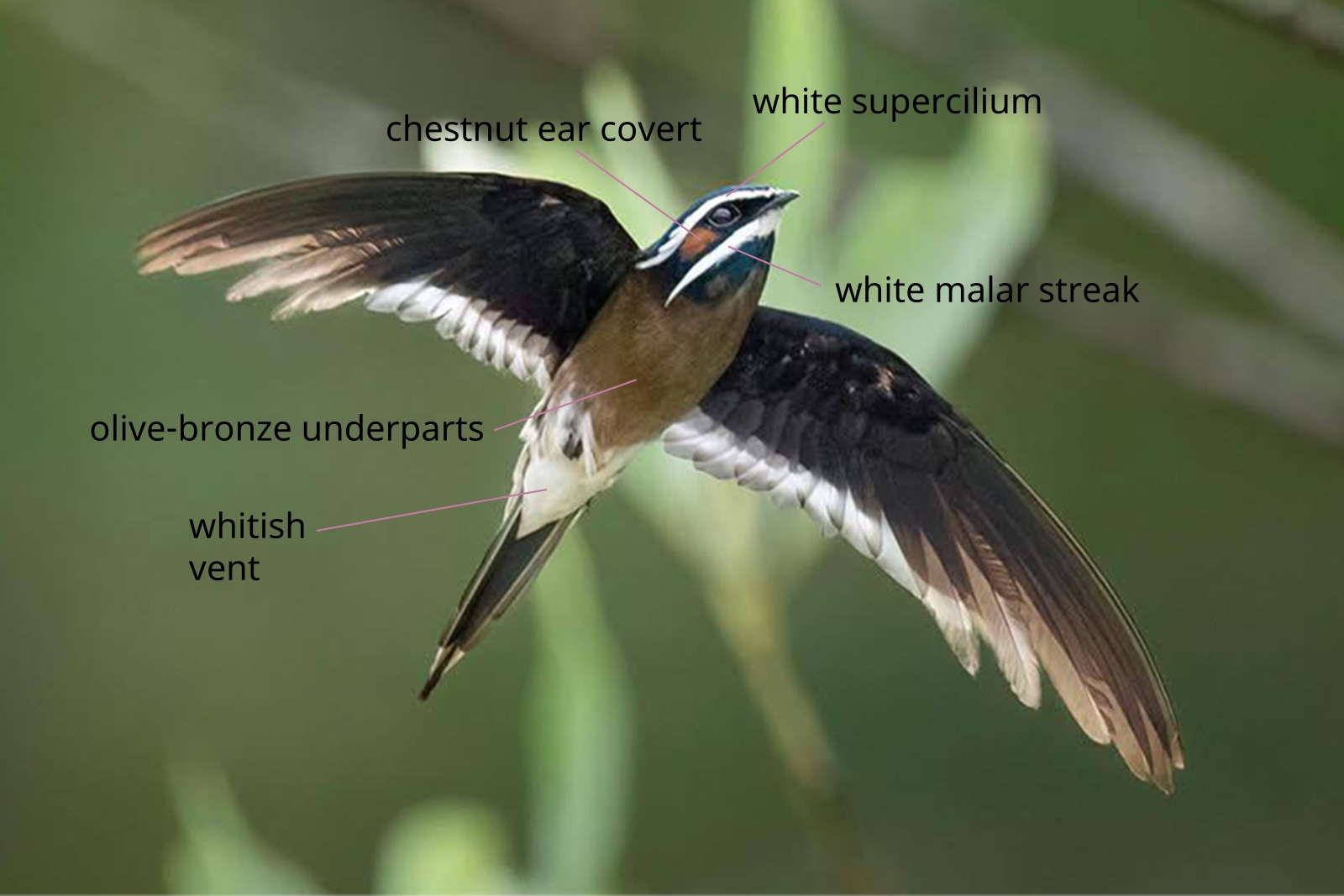
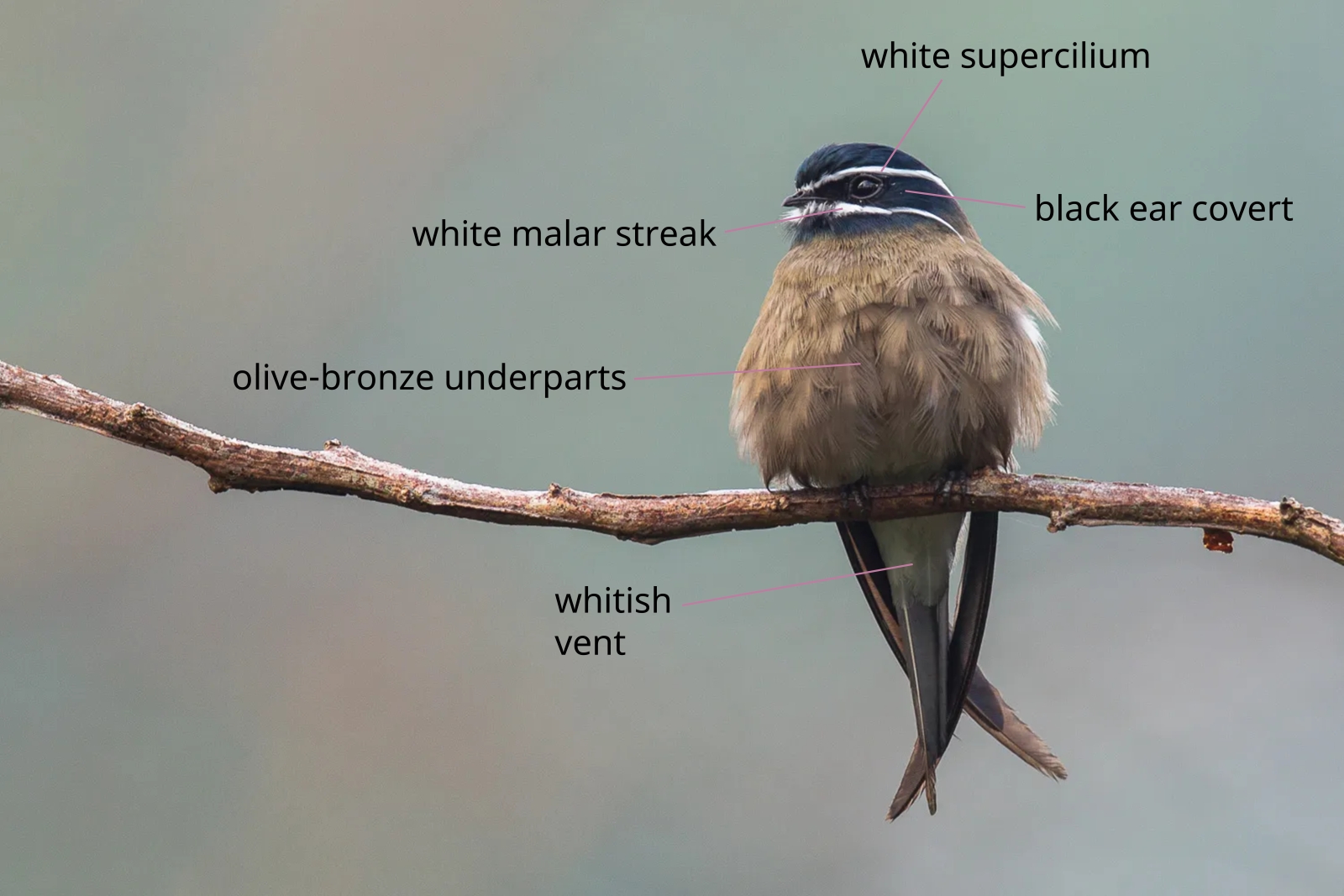
The Whiskered Treeswift resembles the Grey-rumped Treeswift in flight but can be distinguished by their smaller size and differences in plumage colours. The back and underparts of the Whiskered Treeswift are mostly olive-bronze, with a whitish vent. The head, upper throat, nape and wings are a dark glossy blue, and the most distinguishing feature from the Grey-rumped Treeswift is the clean, white supercilium and malar streak running across the face of this species. Like the Grey-rumped Treeswift, male Whiskered Treeswifts have chestnut ear-coverts while females have black ear-coverts. This species is a very rare visitor to Singapore and was last recorded in 2011.
The Swifts of Singapore
With the confusing non-swift taxa out of the way, we can now proceed with the identification of swifts (Family: Apodidae). Currently, we recognise 11 species on the Singapore checklist, of which five are resident species that can be seen year-round, five are either migratory or rare visitors, and one vagrant. Swifts are powerful fliers, often darting and dancing around high in the sky against the glare of the sun, making their identification especially challenging. Here are the diagnostic characteristics and their flight behaviours which could help you identify these birds with confidence. The following species are introduced in order of rarity of occurrence, and both good- and record-quality photographs are presented to help you identify each species even if you only managed to record shots of the birds.
Edible-nest Swiftlet (Aerodramus fuciphagus) and Black-nest Swiftlet (Ae. maximus)
We will deal with these two species together, collectively known as Aerodramus swiftlets (or if scientific names are confusing for you, we recommend you refer to them as “Blackible-nest” Swiftlets), as the common consensus is that they are indistinguishable in the field.
Should you find the nesting sites of Aerodramus swiftlets, the Edible-nest swiftlets can be distinguished from the Black-nest Swiftlets by the white nests they build with their saliva, which is prized for the popular Asian delicacy bird’s nest. Black-nest Swiftlets add their feathers on top of using their saliva, giving the nests a blackish look (hence their common name). Alternatively, if caught in hand, they can be distinguished by measurements.
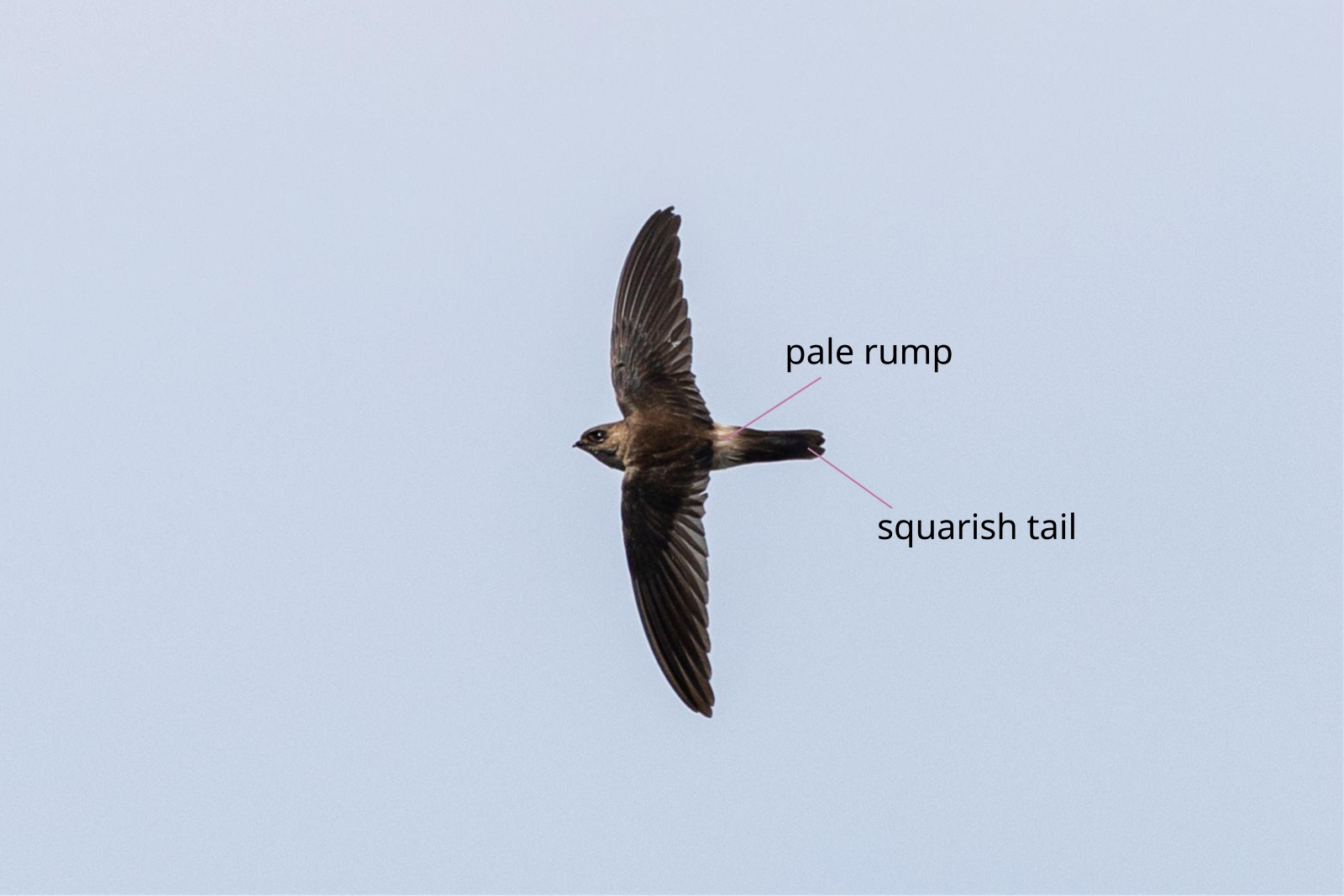
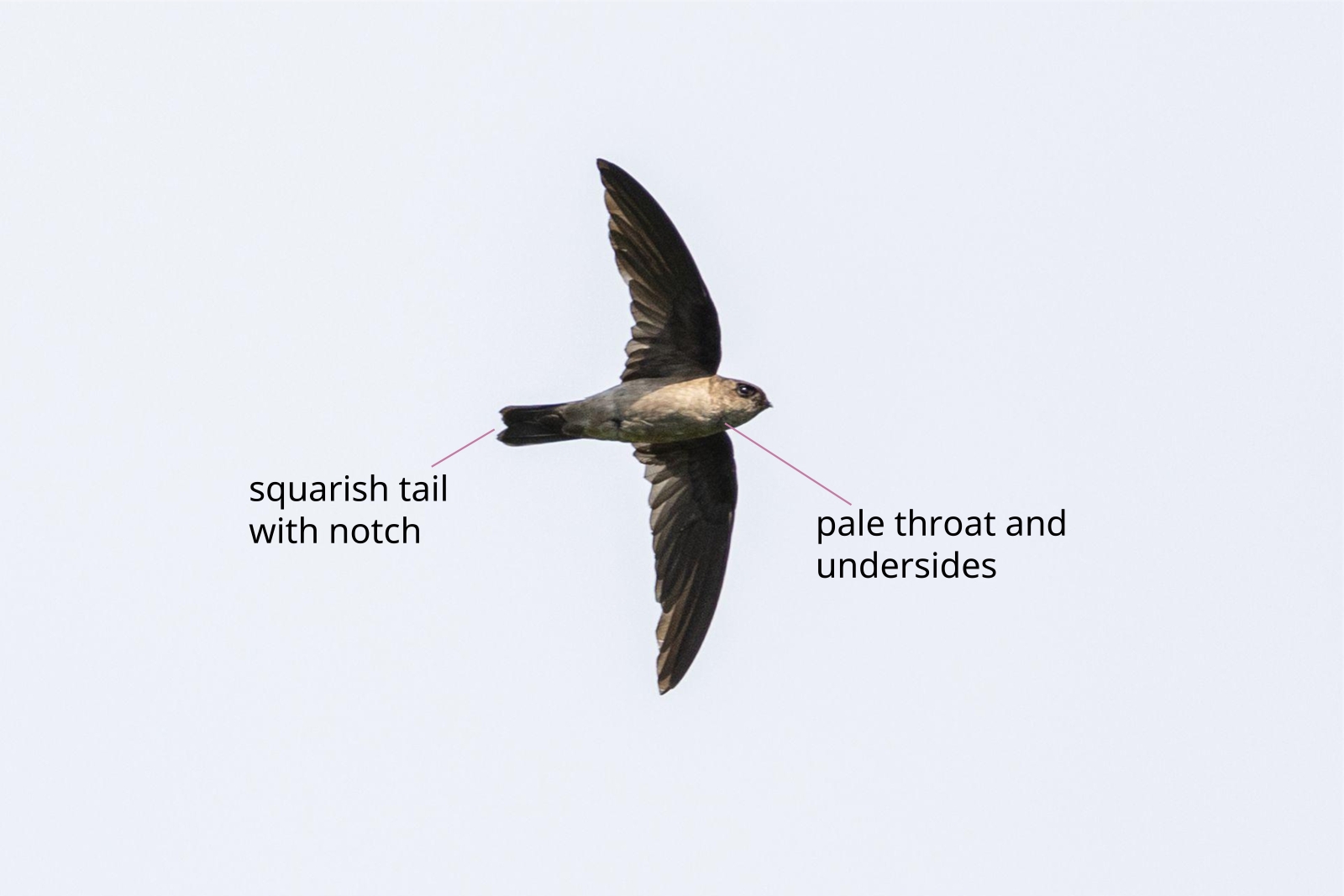
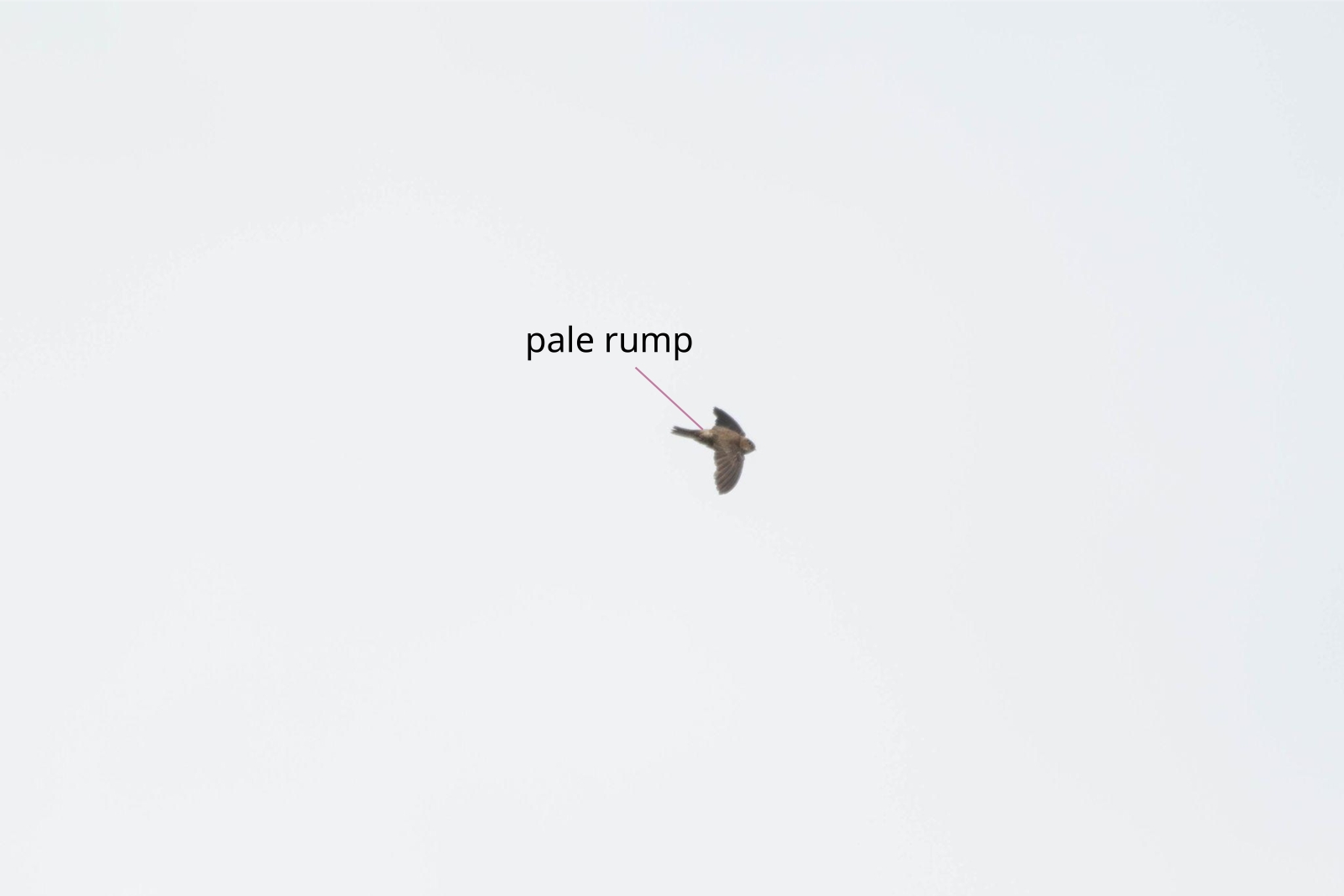
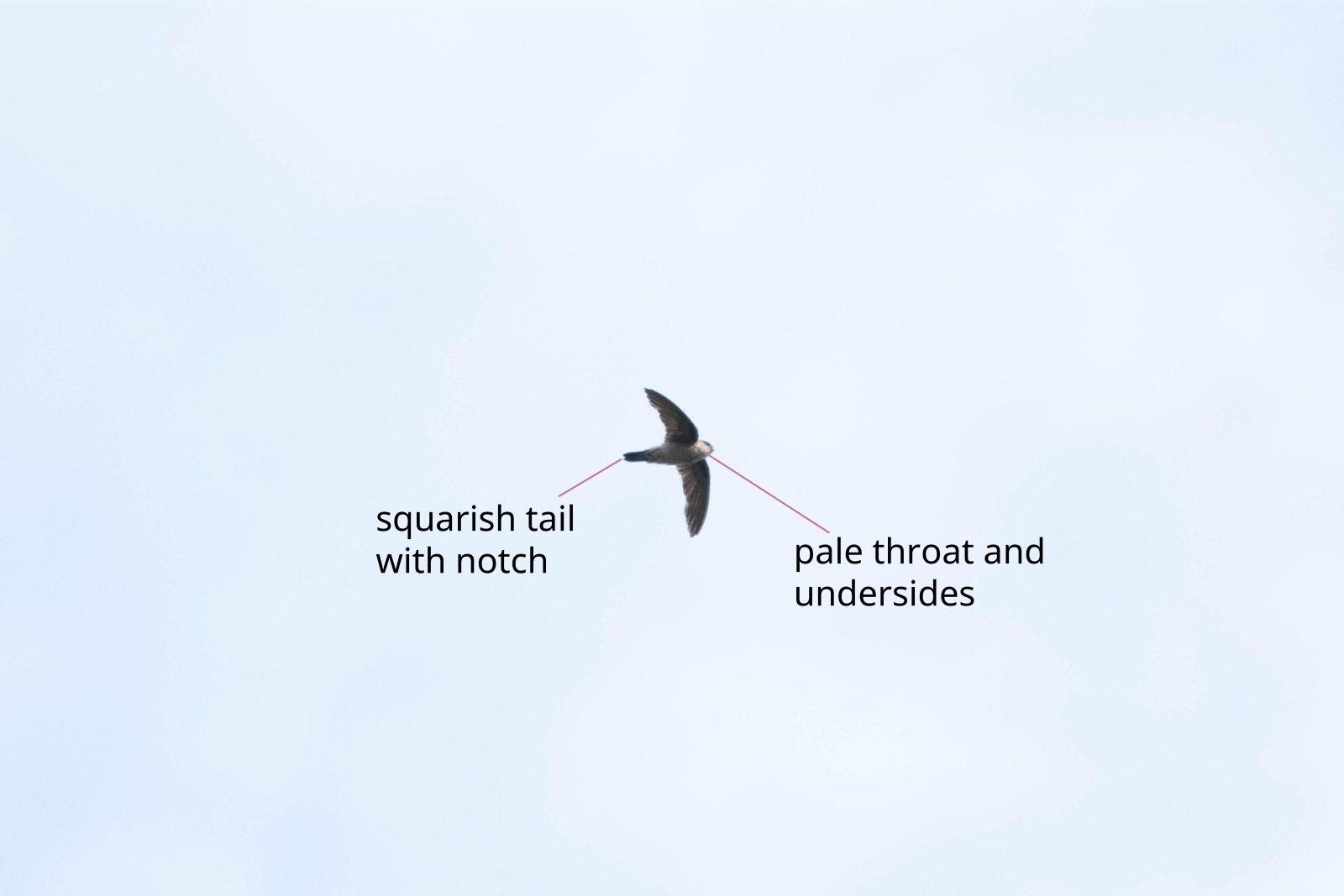
The Aerodramus swiftlets have an overall non-glossy brownish plumage with pale underparts and rump. Being the most common species of swift we can observe in Singapore, we will be describing the shapes of other swift species with reference to these birds.
The flight behaviour of the Aerodramus swiftlets is typically slow and erratic, likened to a drunken characteristic where a couple of wingbeats would often be followed by a sudden veering off or a twitch in a slightly different direction that is followed by gliding (sometimes even preening), rarely flying straight and true. Occasionally, the Aerodramus swiftlets can be seen cruising along wind drafts, appearing to fly straight in one direction, but other swift species generally fly faster.
Plume-toed Swiftlet (Collocalia affinis)
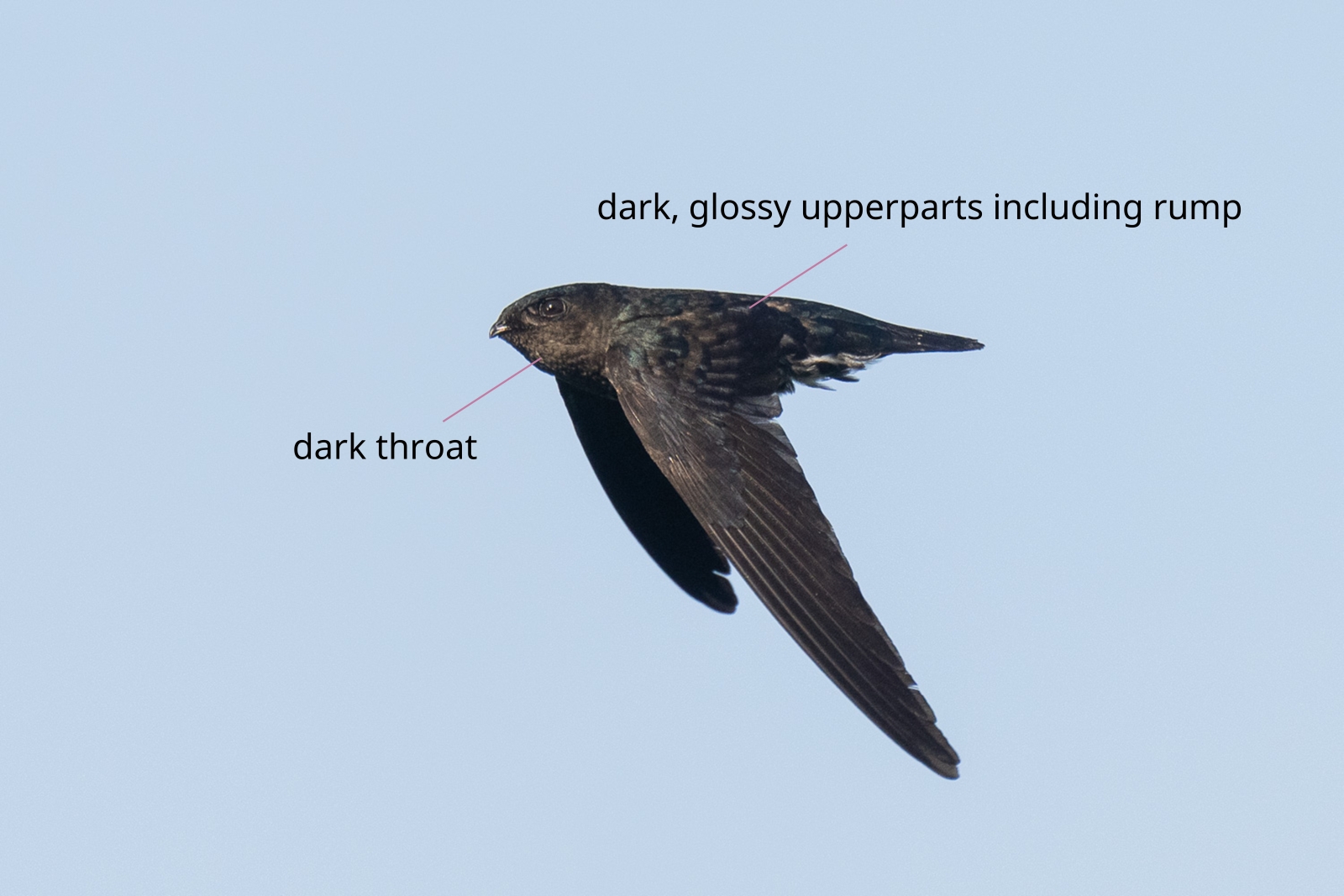
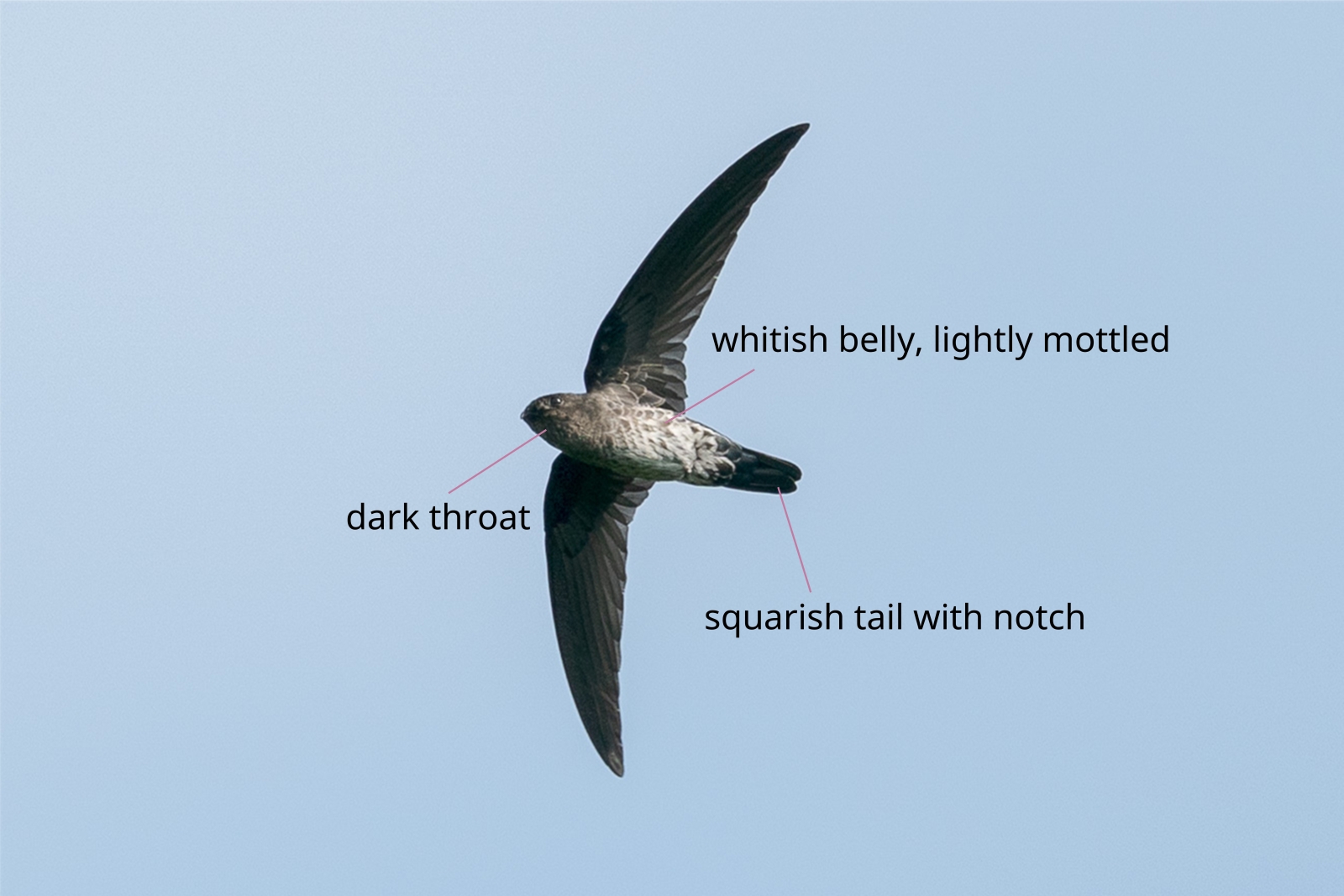
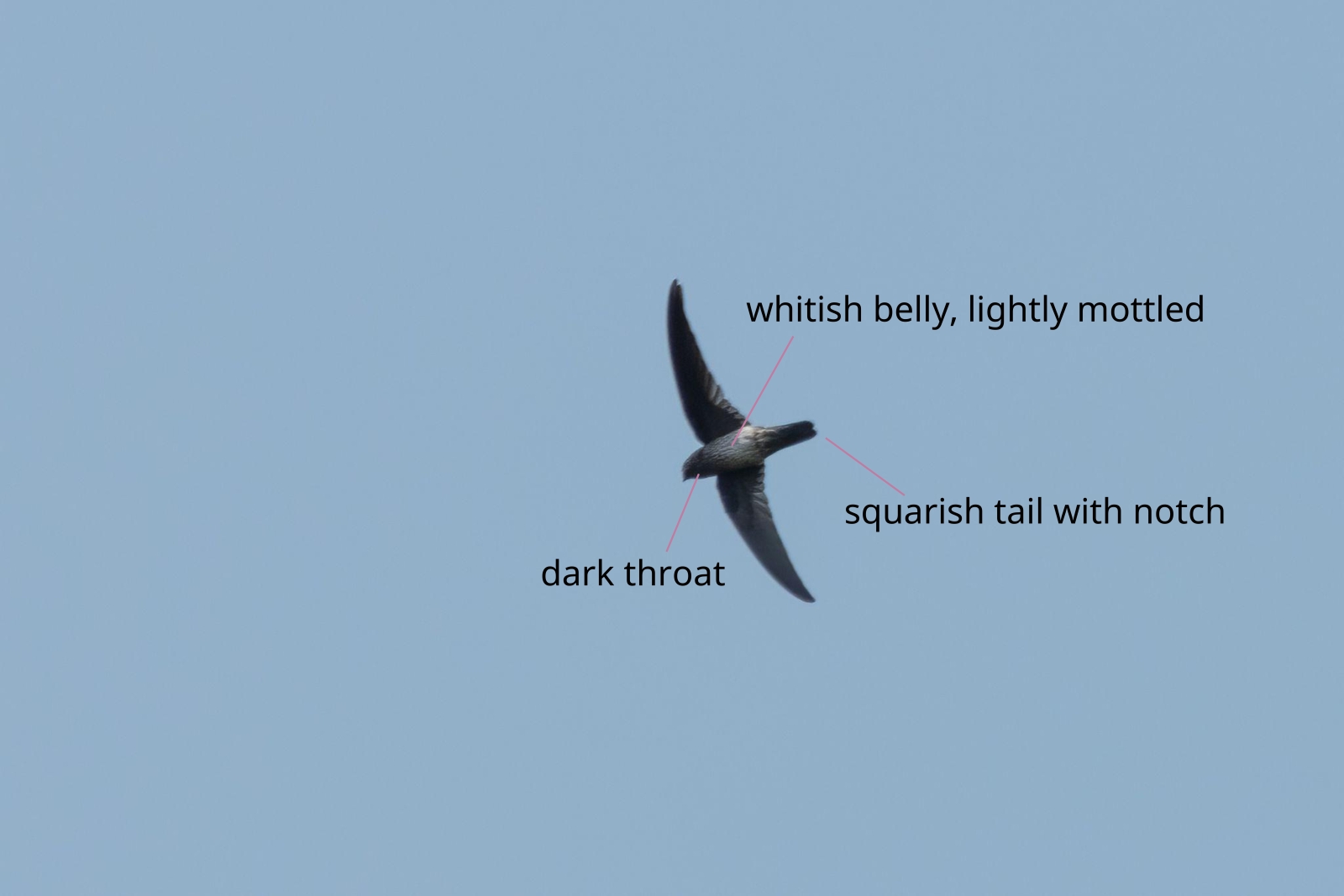
The Plume-toed Swiftlet is a smaller swift compared to the Aerodramus swiftlets, but they share a similar shape, with the Plume-toed Swiftlet having a more squarish notched tail. It possesses an overall uniform glossy blackish plumage with bluish to greenish shine on the upperparts, lacking a pale rump patch. The throat is light brown, breast is mottled black, and the underbelly is white – often fairly distinct in the field. Immature individuals may have pale fringed flight feathers. In flight, the Plume-toed Swiftlet is fast-flying, and even more erratic than the Aerodramus swiftlets. Its flight pattern is best described as bat-like, constantly flapping and twisting and turning in the air with hardly any gliding.
House Swift (Apus nipalensis)
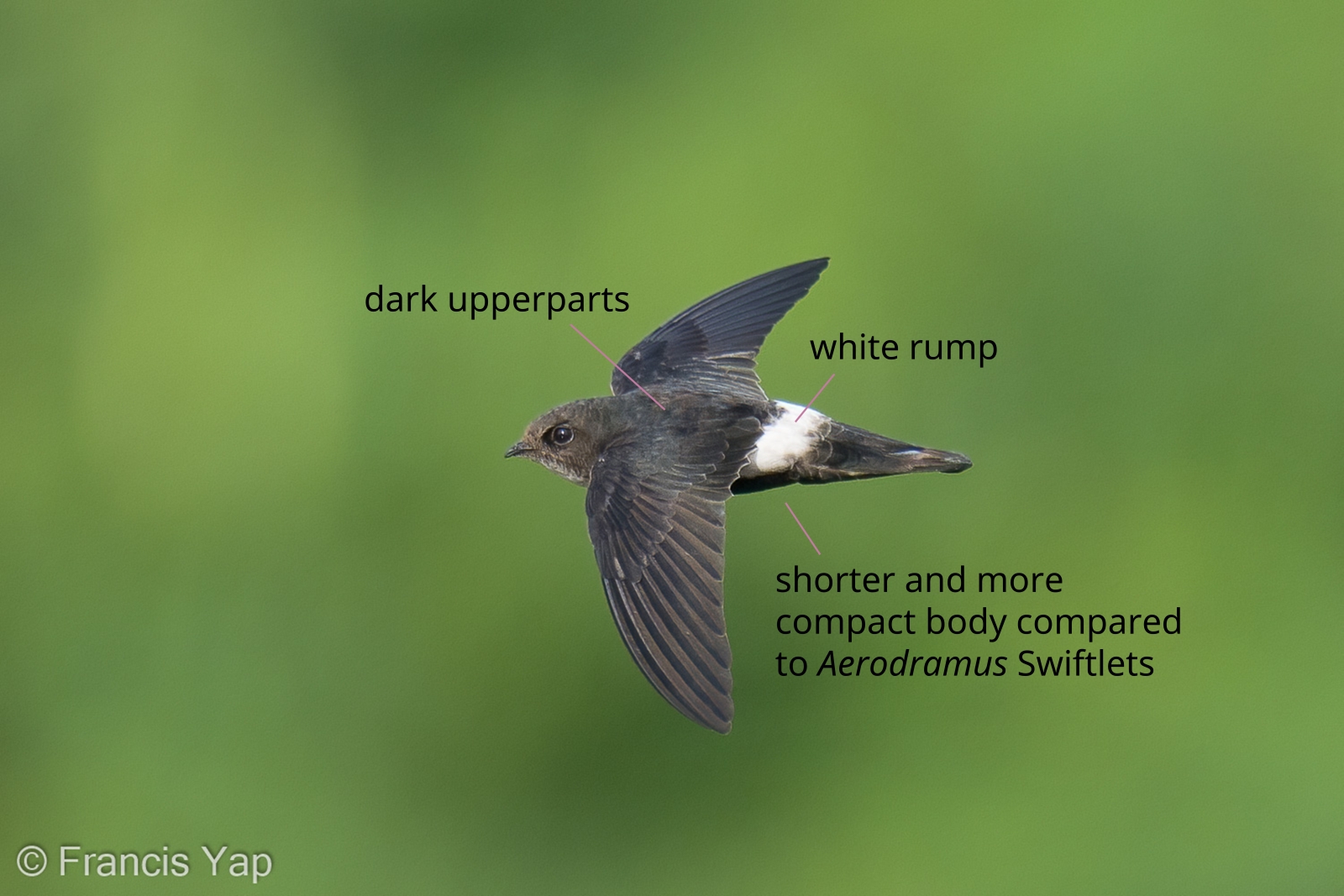
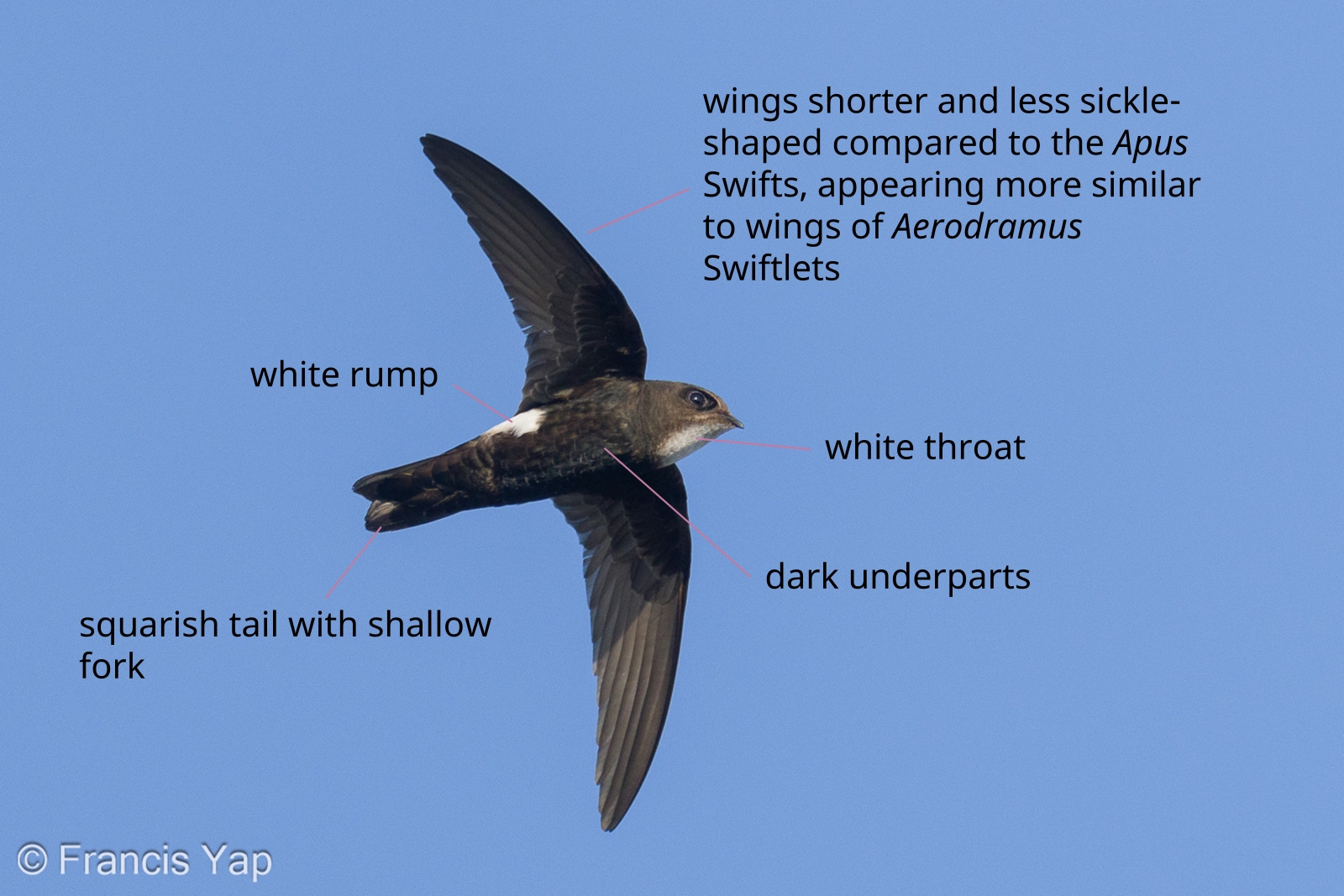
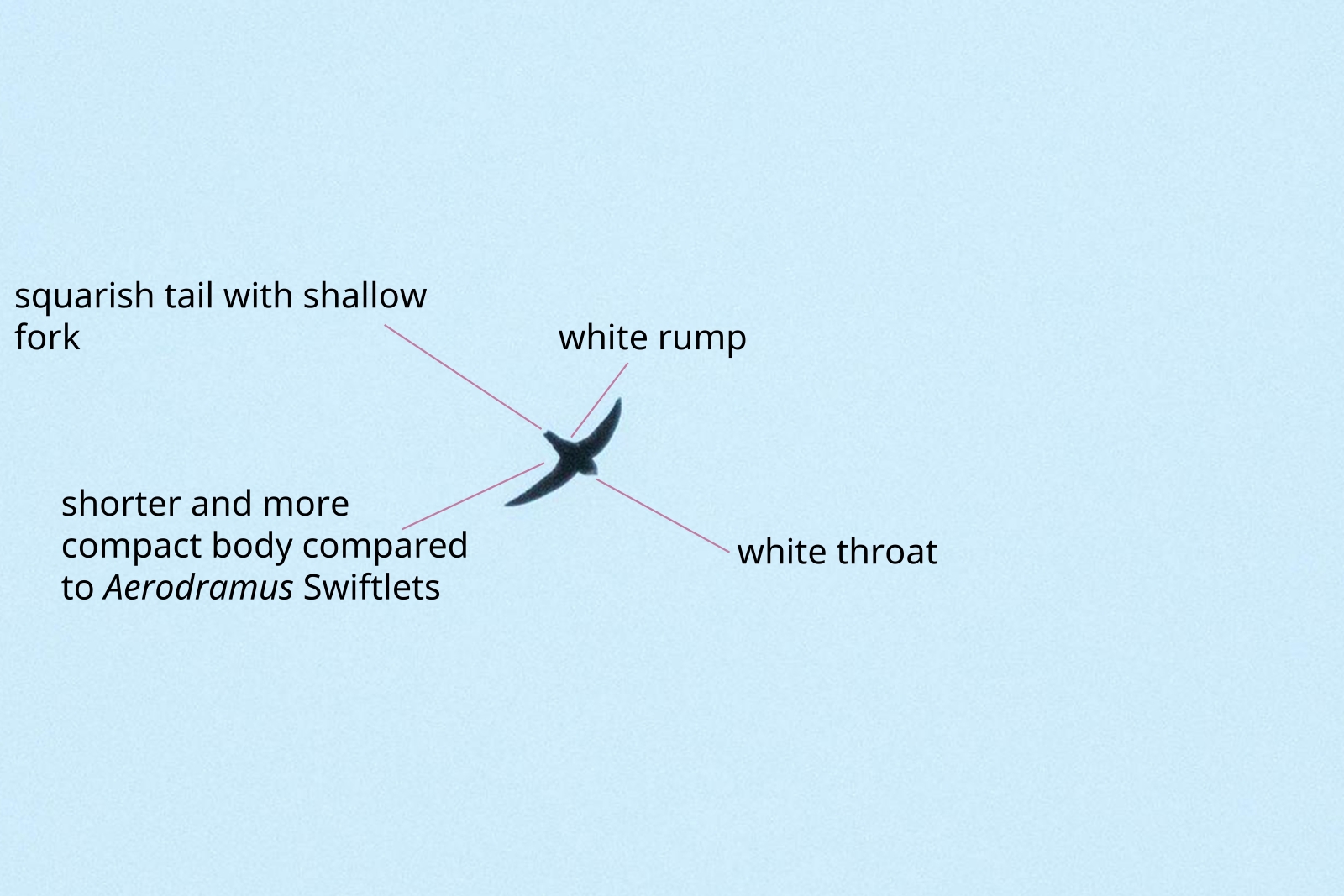
The House Swift has a general shape similar to the Aerodramus swiftlets, making them distinct from other Apus swift species. It has broader wings ending in a blunter tip, as well as a squarish tail with a slight notch. The House Swift differs from Aerodramus swiftlets by having a proportionally shorter, more compact body, although the overall size of the House Swift is larger. It has an overall blackish (not brownish), non-glossy plumage, with a distinct clean white rump and whitish throat. The House Swift flies faster and generally more directly than the swiftlets – looking almost like they have a set destination in mind – wobbling less than the Aerodramus swiftlets.
Asian Palm Swift (Cypsiurus balasiensis)
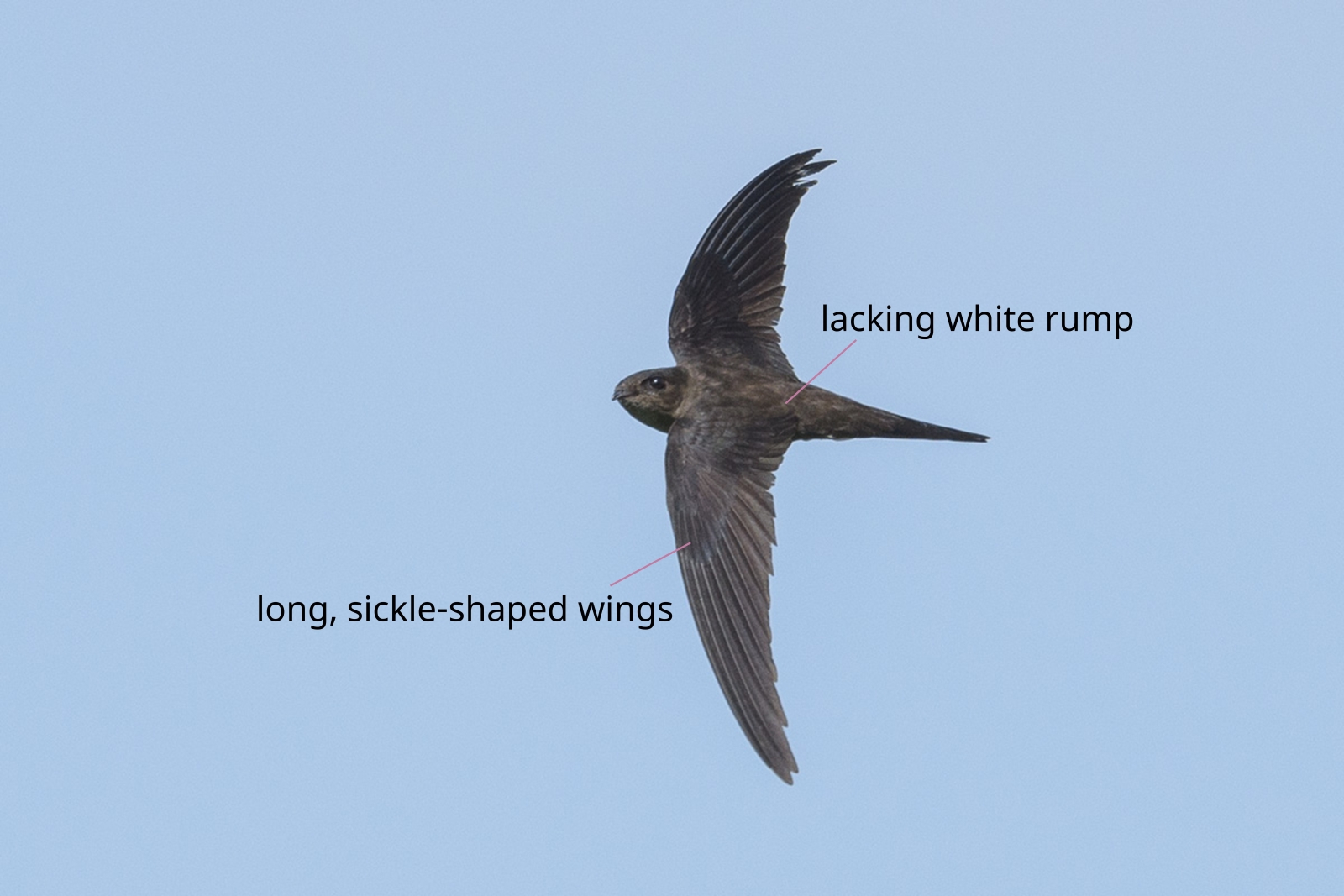
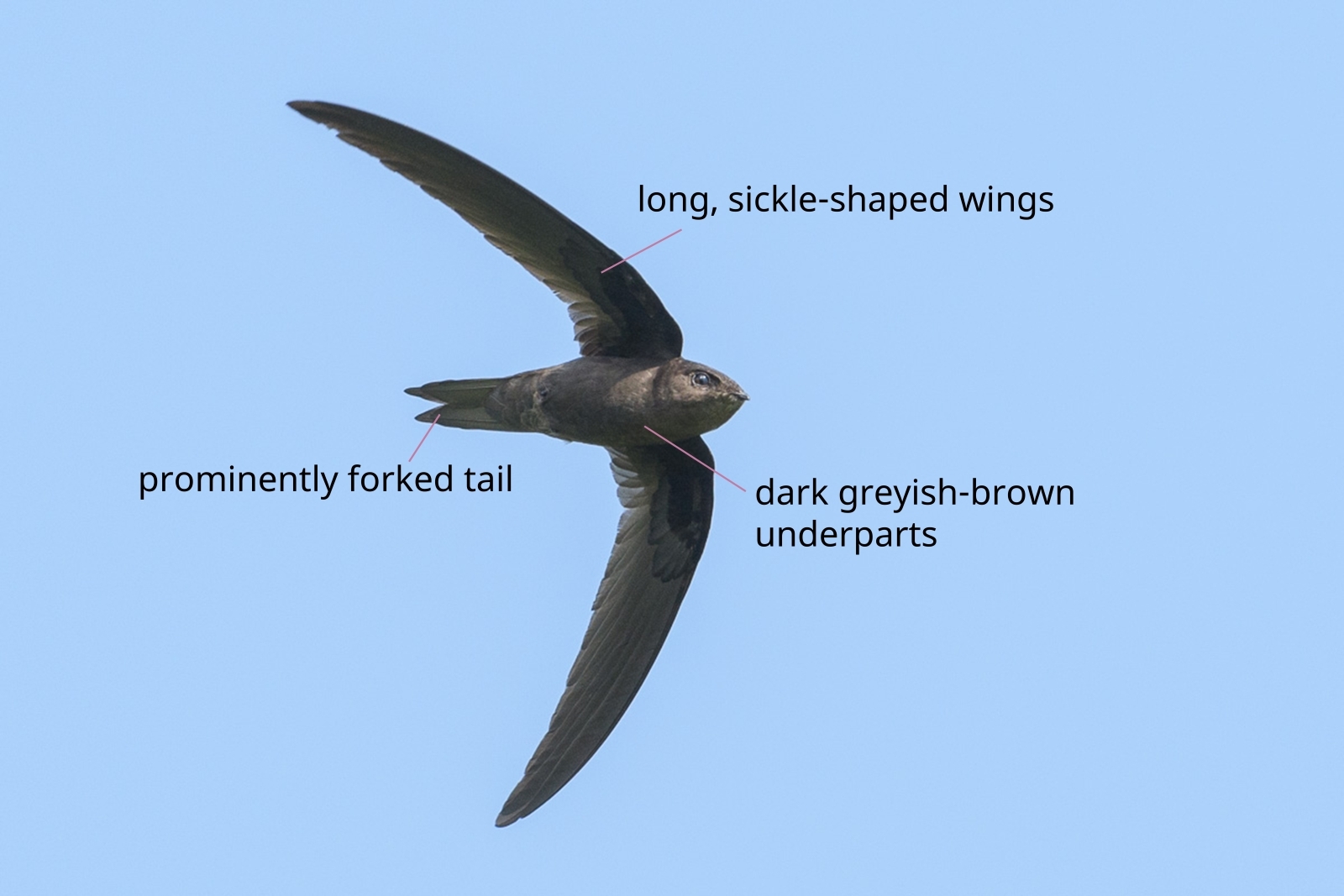
The Asian Palm Swift is a small swift, similar in size to the Aerodramus swiftlets. The shape of the Asian Palm Swift appears more aerodynamic compared to the swiftlets, possessing long, slender, sickle-shaped wings that end in a more pointed tip. The body and tail are proportionally longer than the swiftlets, with a forked tail that can be visible when open, otherwise appearing as a long, narrow and pointed tail. Immature individuals have a less deeply forked tail. The Asian Palm Swift has an overall uniform greyish-brown plumage, lacking a pale rump. The throat is a paler brown compared to the upperparts. The Asian Palm Swift generally flies similarly to the Aerodramus swiftlets, but often with more stiff looking wings.
Fork-tailed Swift (Ap. pacificus)
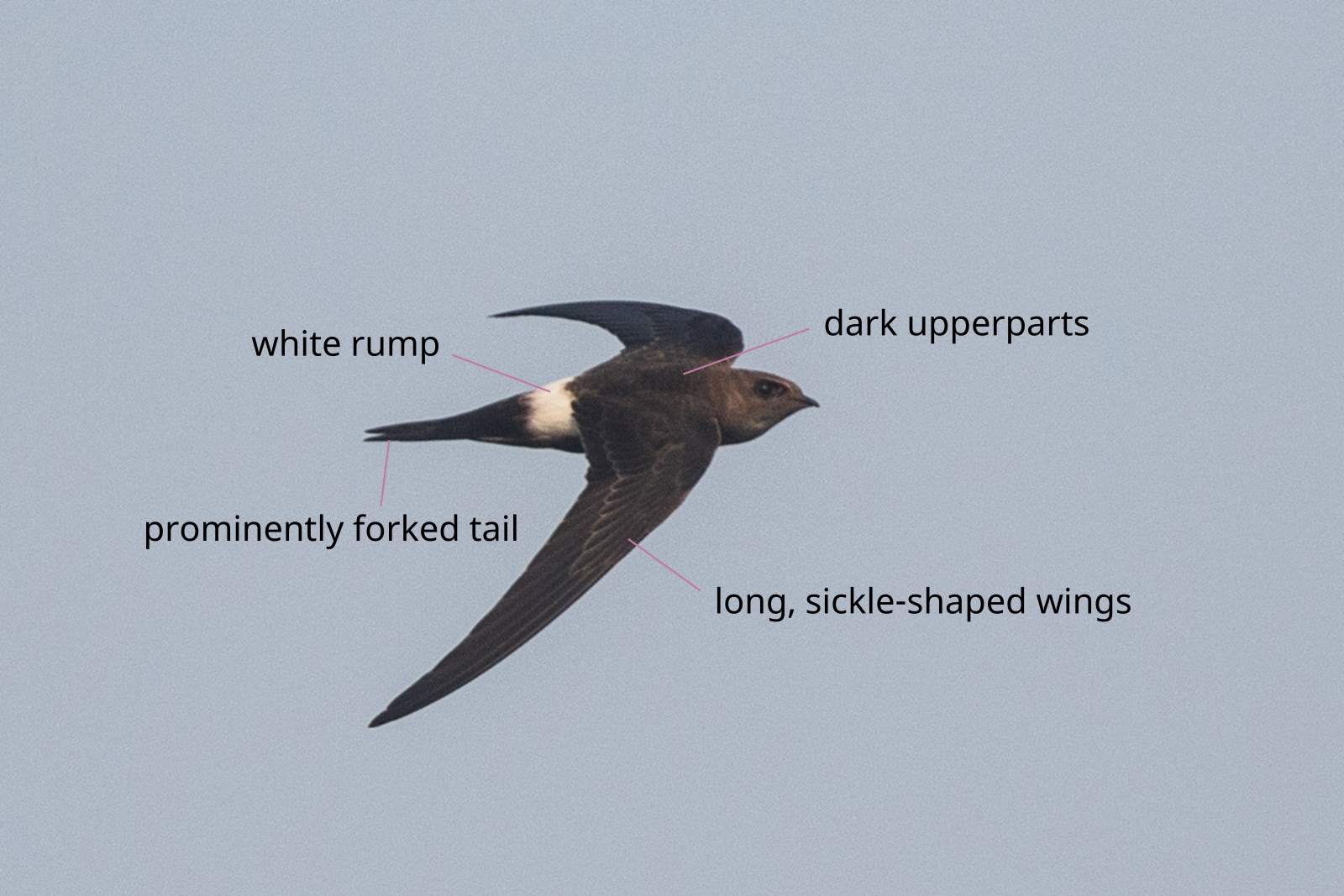
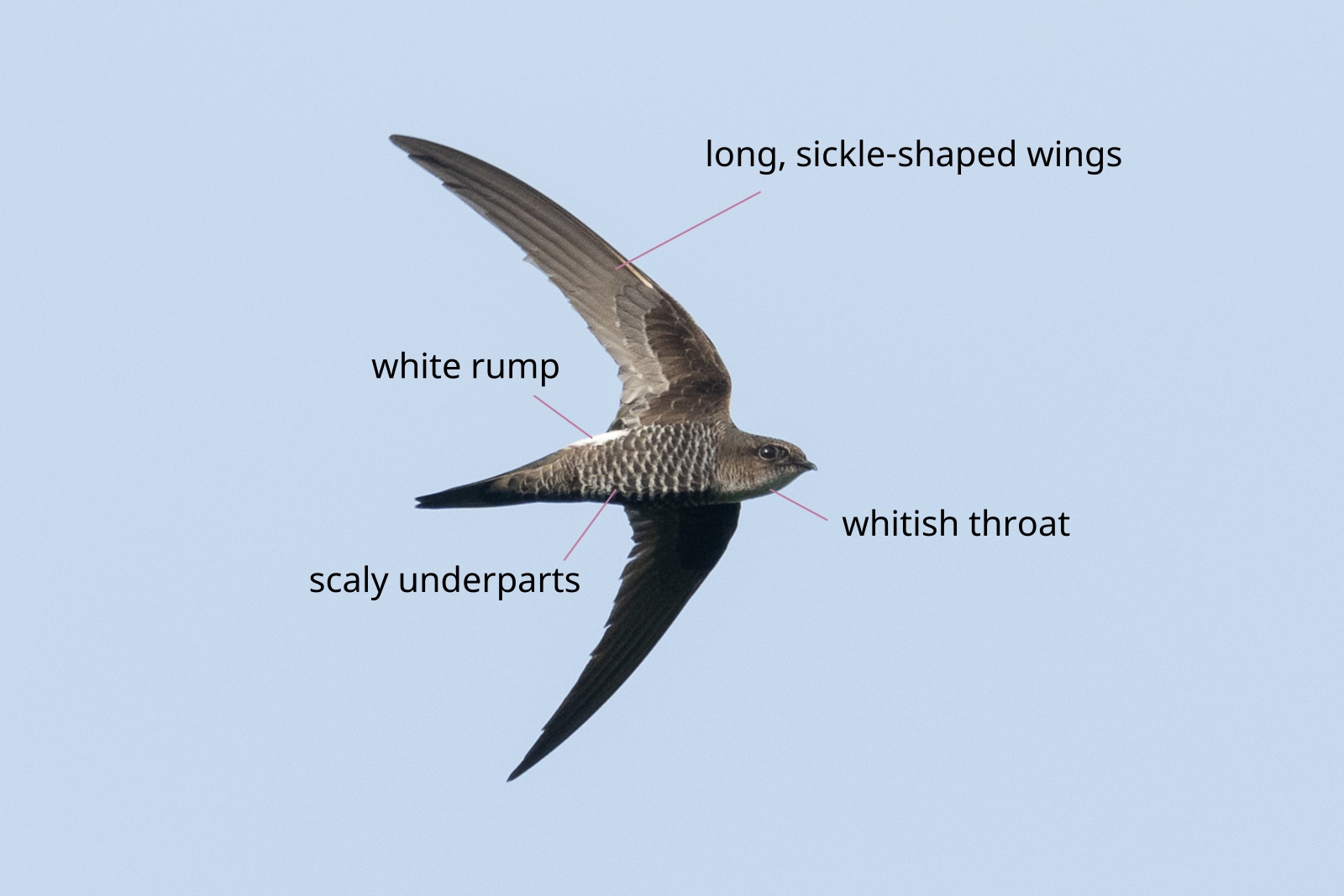
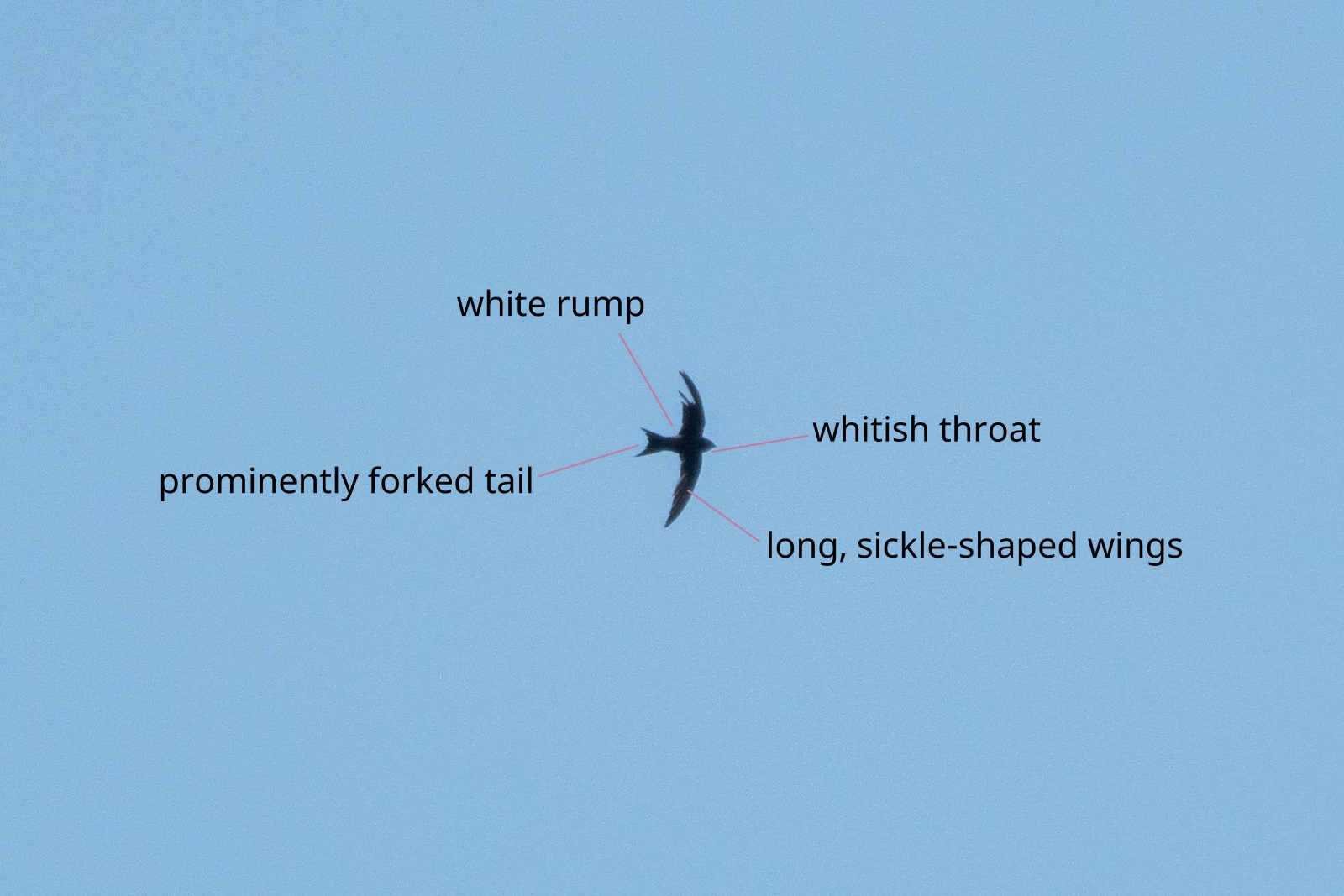
While the swifts introduced thus far have resident populations in Singapore, the Fork-tailed Swift (formerly known as Pacific Swift) is a winter migrant. It shares a similar form to the Asian Palm Swift with long, sickle-shaped wings and sharply forked tail, but the Fork-tailed Swift is significantly larger in size. It can also be distinguished by its plumage, where it has a distinct white rump and whitish throat. The overall plumage is brownish with off-white fringes on its underparts, giving it a scaly appearance. The Fork-tailed Swift is a powerful flier, flying fast and in one clear direction.
Needletails and Spinetail
The following four swifts look distinctively different from the other swifts introduced thus far, making it easier to distinguish them. These are the needletails and spinetail, named as such given their unique tail spines protruding from the tail feathers. While it may not always be easy to spot the “spines” on their tails, the general shape and colour of these swifts are very different from the other swifts, which is what would aid us in our identification of swifts from these genera.
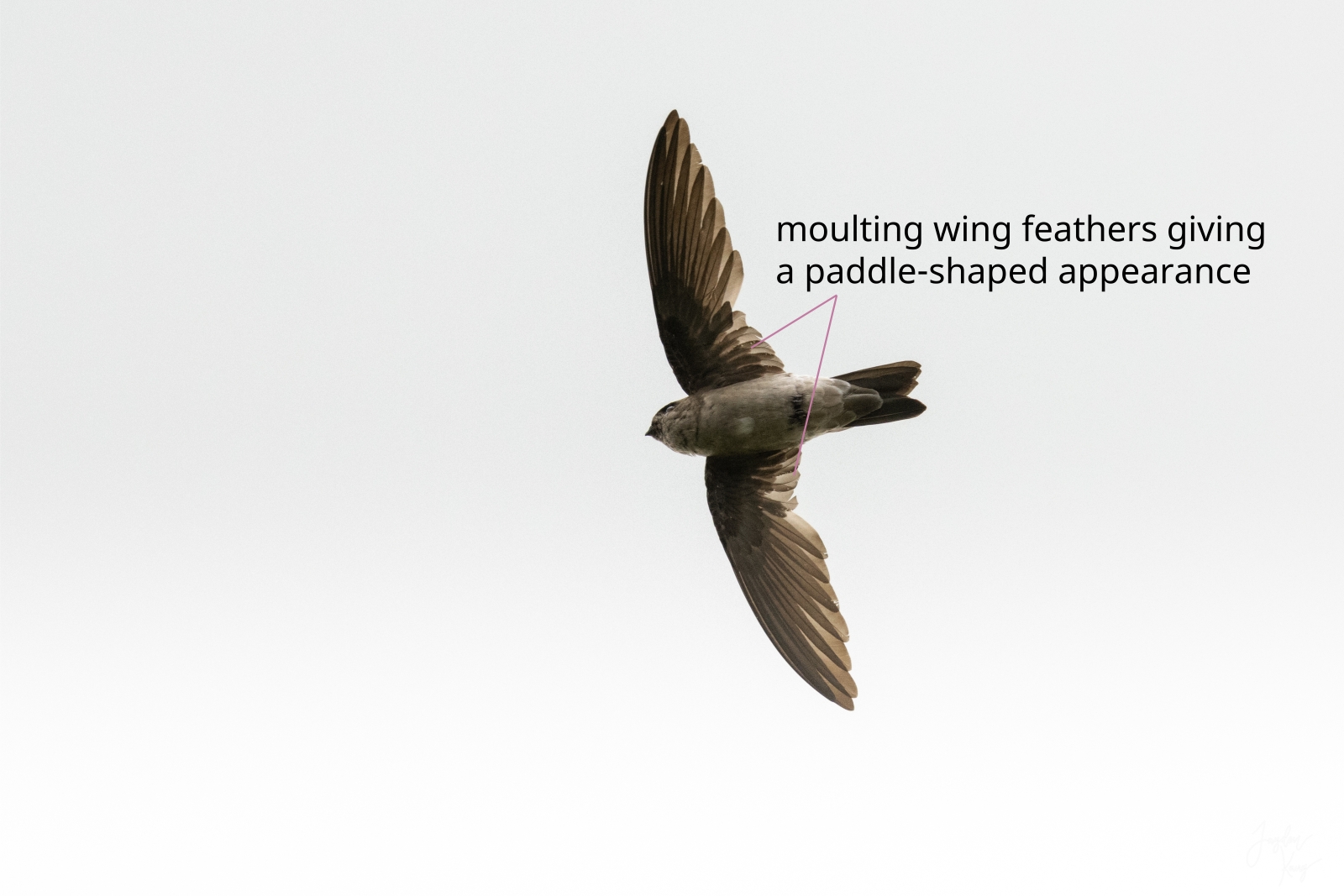
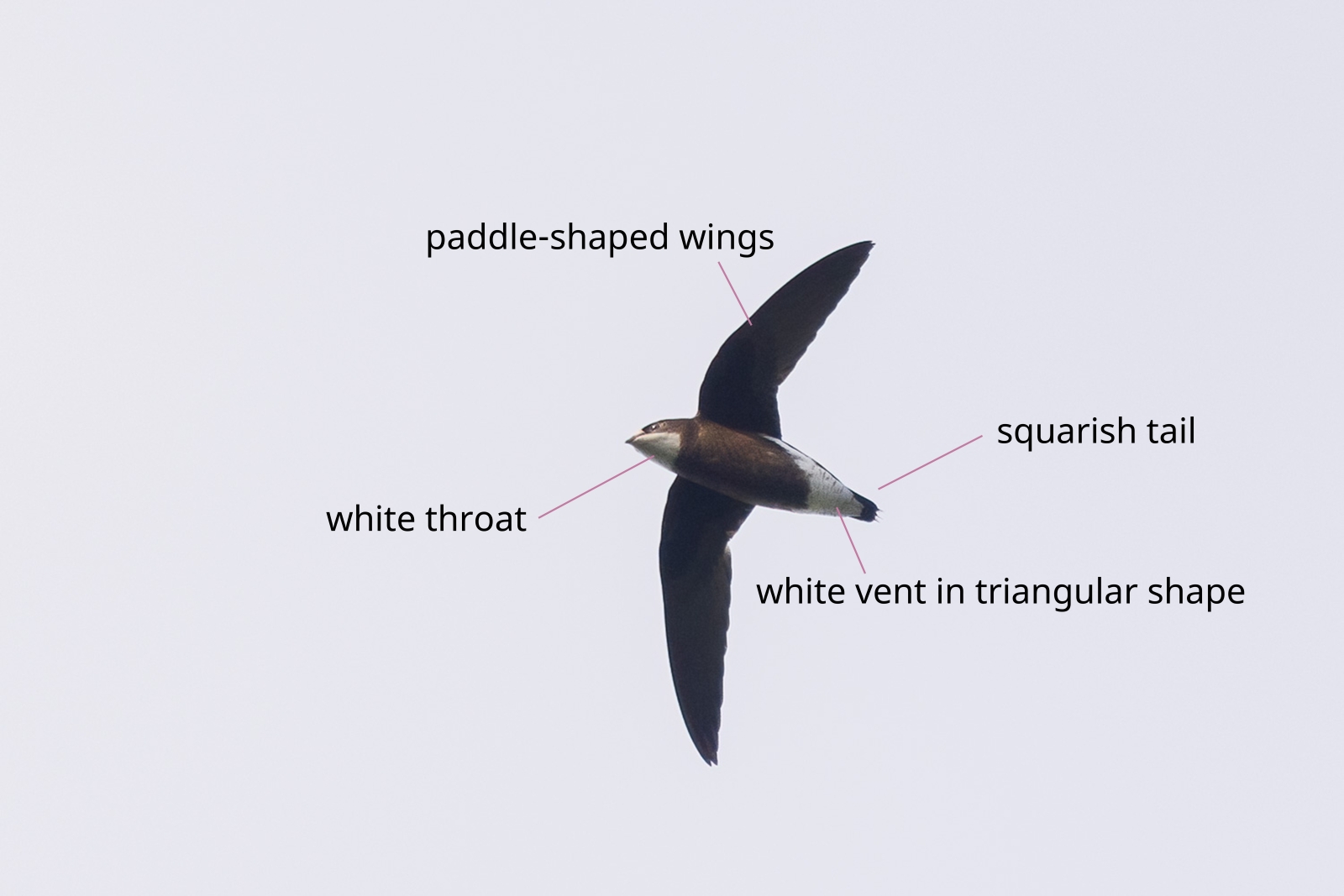
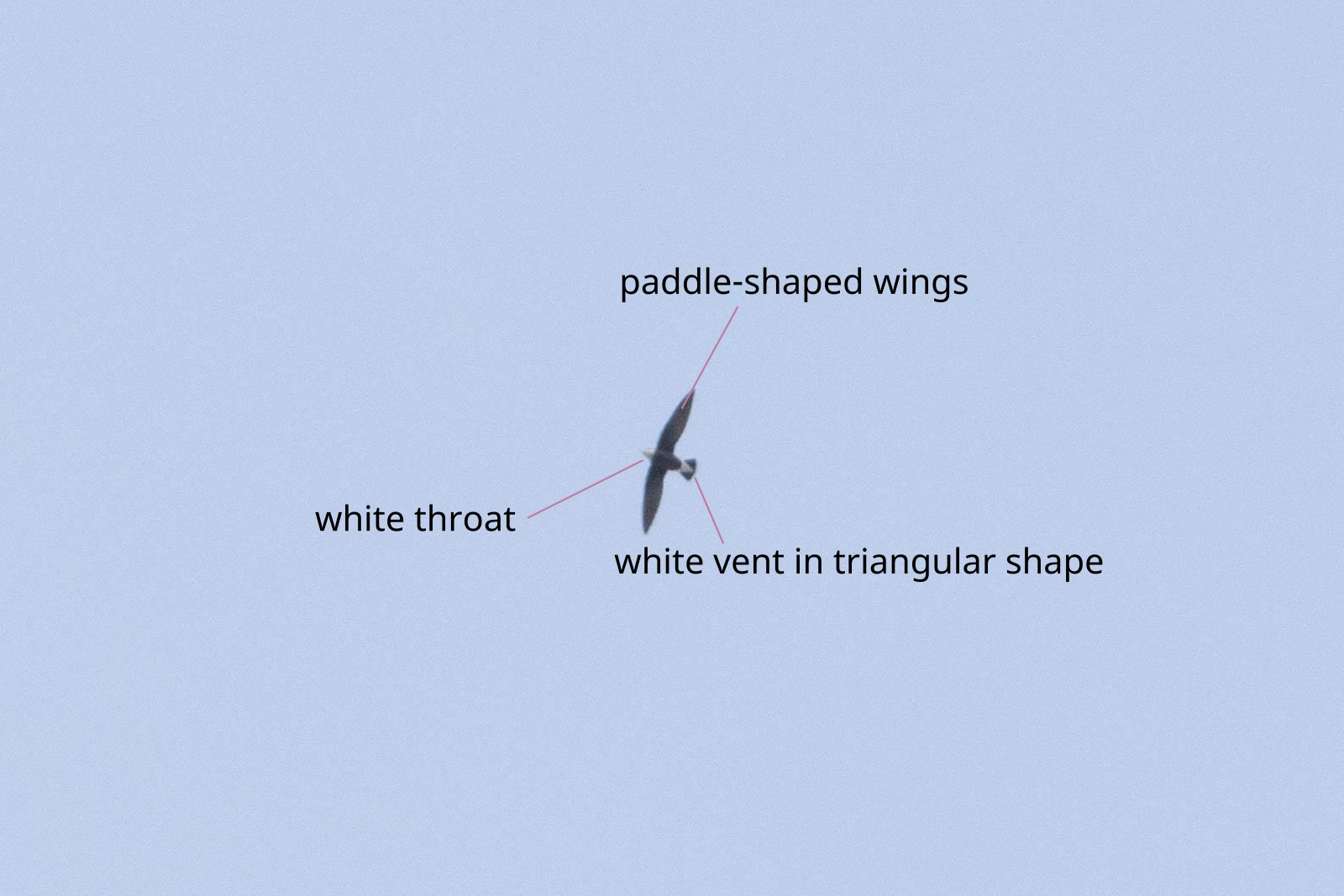
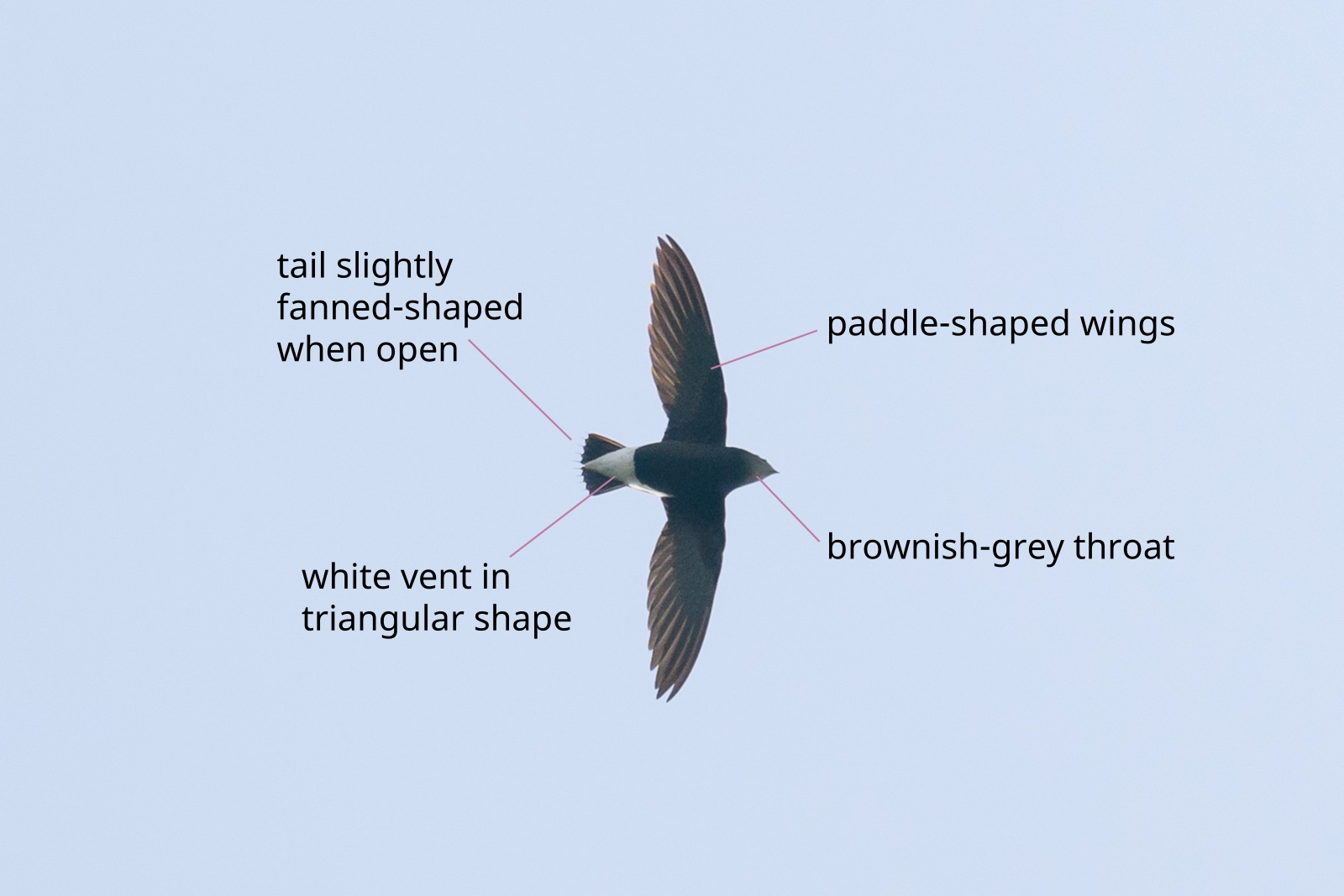
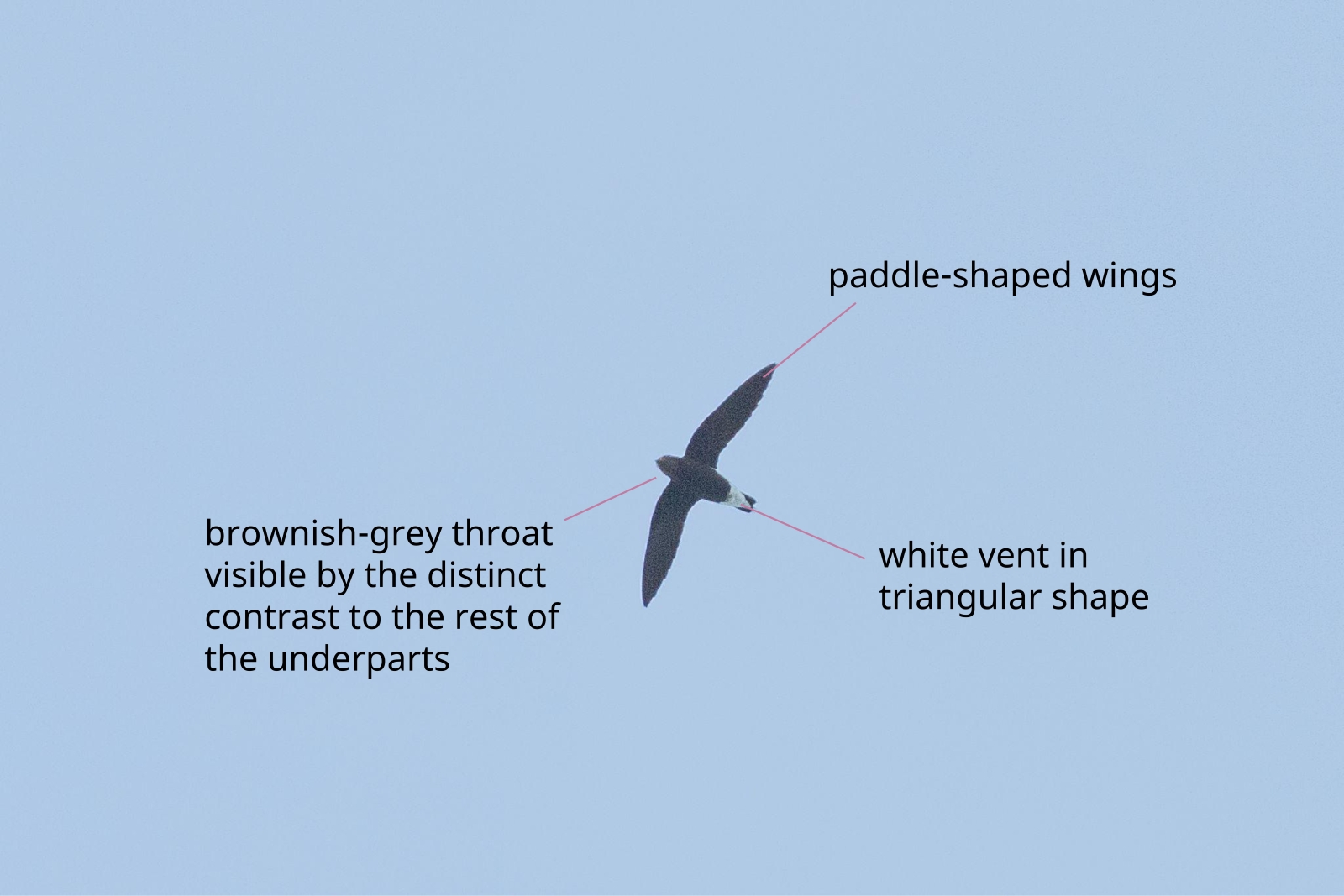
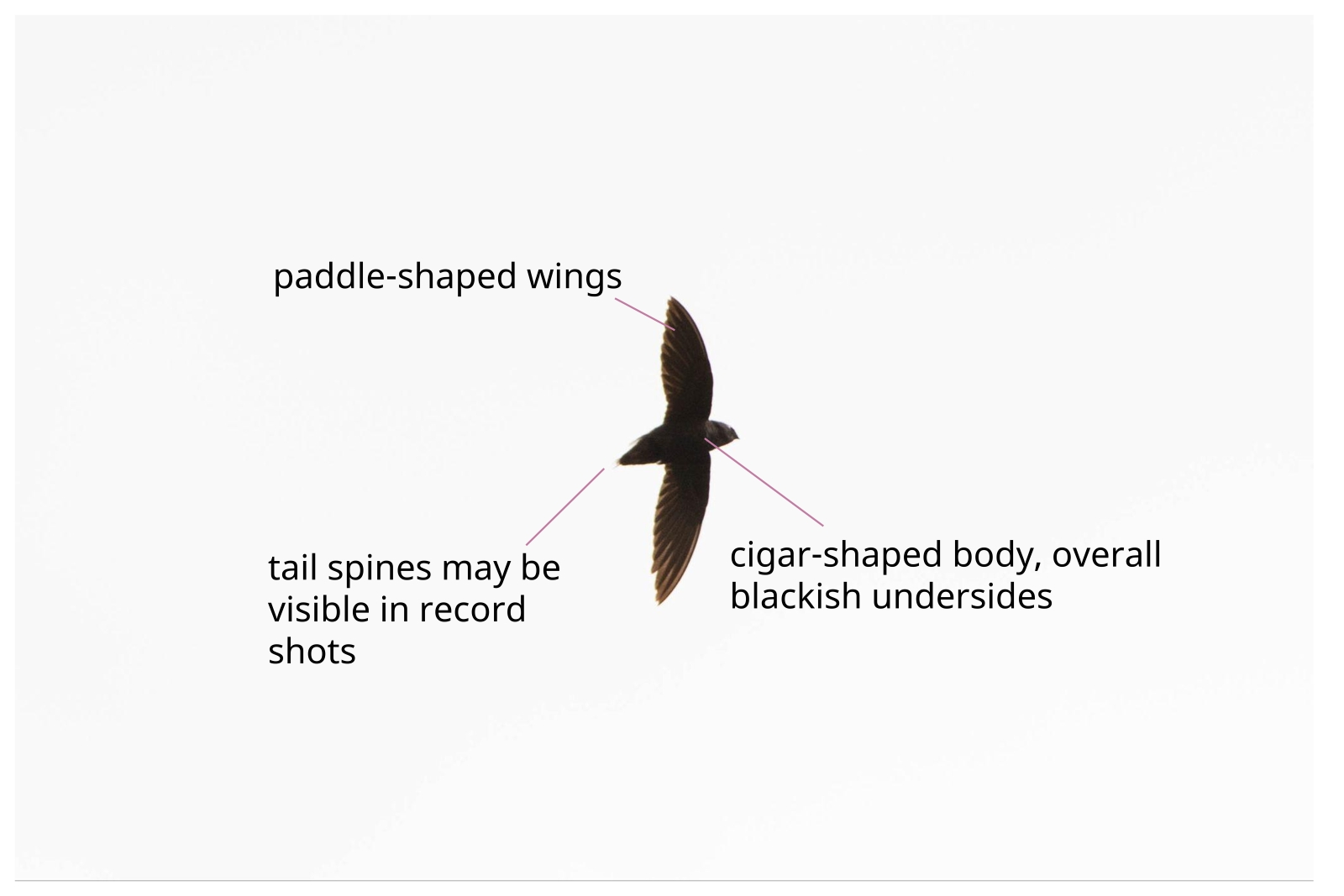
The needletails have broader and less pointed wings which could be described as paddle-shaped rather than the sharp-tipped, sickle-shaped wings of the swifts and slightly less pointed tips for swiftlets. Their torsos are more cigar-shaped compared to the other swifts. They are also the largest swifts that can be observed in Singapore. Overall, the needletails possess a dark brown to blackish plumage with a saddle patch on the mantle with the colourations unique to each species. Additionally, the needletails have a broad white vent which extends to their flanks, forming somewhat of a backward pointed arrow when viewed from the underside.
Do note, however, that an Aerodramus Swiftlet in moult can have wings resembling the paddle-shaped wings of the needletails and spinetail, although the size and plumage of an Aerodramus should easily allow you to eliminate the other options.
White-throated Needletail (Hirundapus caudacutus)
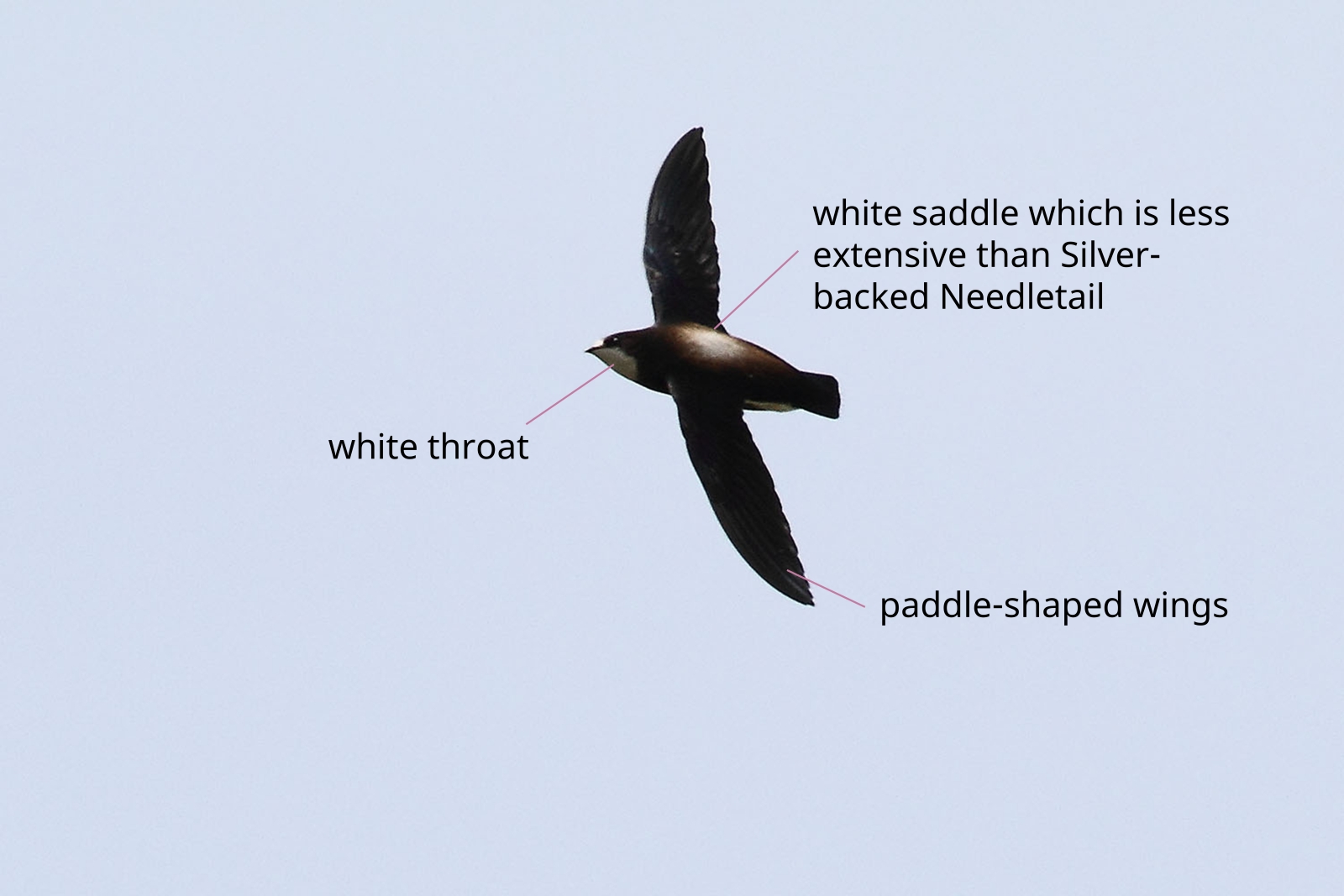
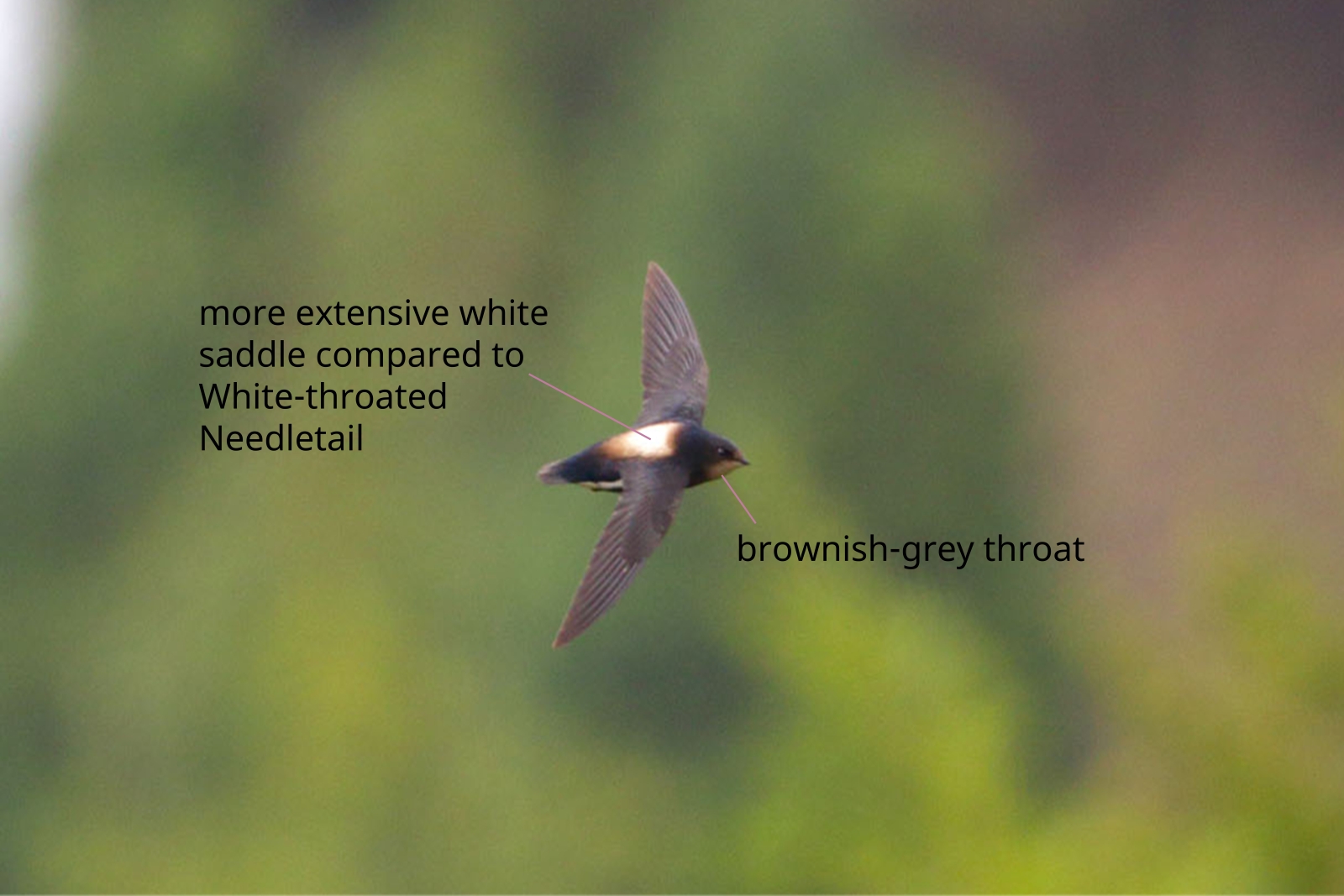
The White-throated needletail, as its name suggests, boasts a distinct white throat absent in the other needletail species. It is also the glossiest of the needletail species, although it can be very difficult to observe the upperparts of these birds in Singapore. Immature individuals have less glossy underparts. The saddle of the White-throated Needletail is whitish, similar to but less extensive than the Silver-backed Needletail. The tail of the White-throated Needletail is squarish, where with good views, the needles can be observed protruding past the rectrices.
The White-throated Needletail is a winter migrant to Singapore, where we can find two different subspecies, the nominate caudacutus whose breeding range stretches from Siberia to the northern East Asia; and nudipes, which breeds along the Himalayan foothills. The nominate caudacutus possesses a white forehead and lores, while nudipes lacks those features and has a full dark head.
The White-throated Needletail has a powerful flight, often observed gliding and soaring while making purposeful turns unlike the erratic flight of swiftlets. They can also fly at high speeds with seemingly effortless wingbeats, which creates a whooshing sound if close enough to the observer.
Silver-backed Needletail (Hi. cochinchinensis)
The Silver-backed Needletail possesses the typical features of a needletail, similar to that of the White-throated Needletail. Instead of a white throat, it has a pale brownish-grey throat patch. The saddle of the Silver-backed Needletail is larger than the White-throated Needletail. The Silver-backed Needletail does not have white forehead or lores and are always uniform in colour to the rest of its plumage. The tail of the Silver-backed Needletail, like the White-throated Needletail, is slightly fan-shaped when open, but the tips are less pointed compared to the Brown-throated Needletail. In flight, the Silver-backed Needletail shares a similar flight behaviour to the White-throated Needletail. Take note that the greyish throat of this species can be difficult to observe in poor light.
Brown-backed Needletail (Hi. giganteus)
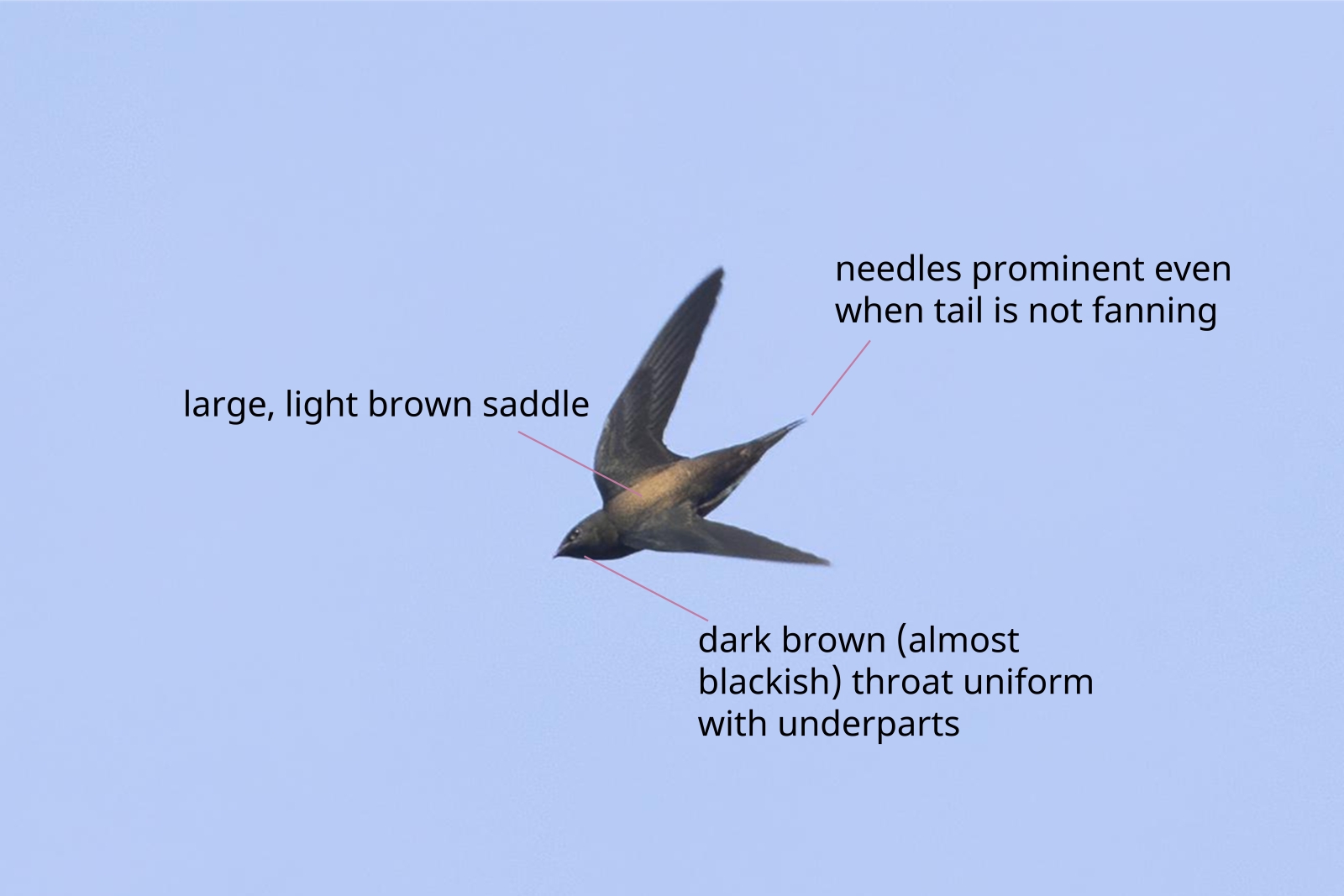
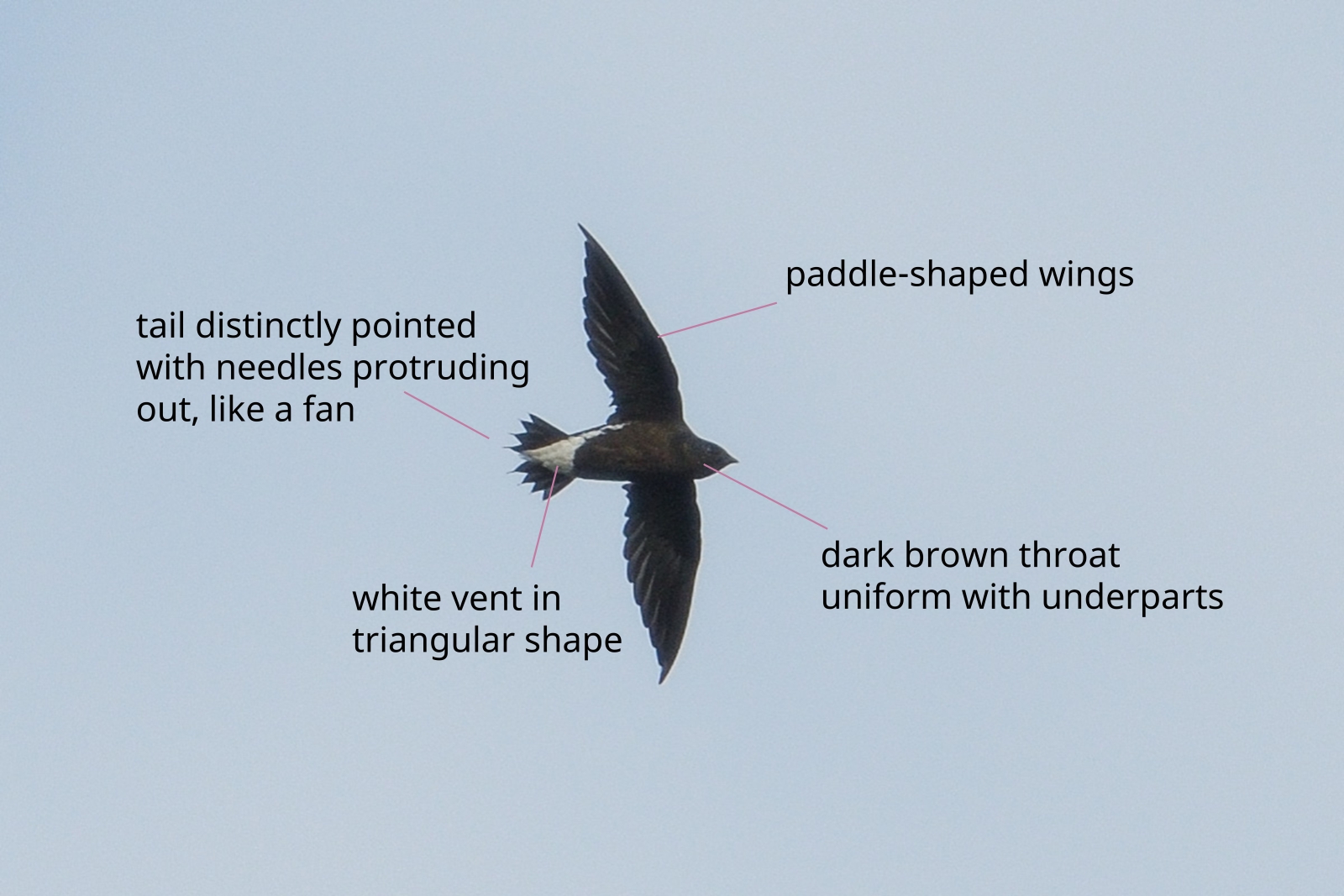
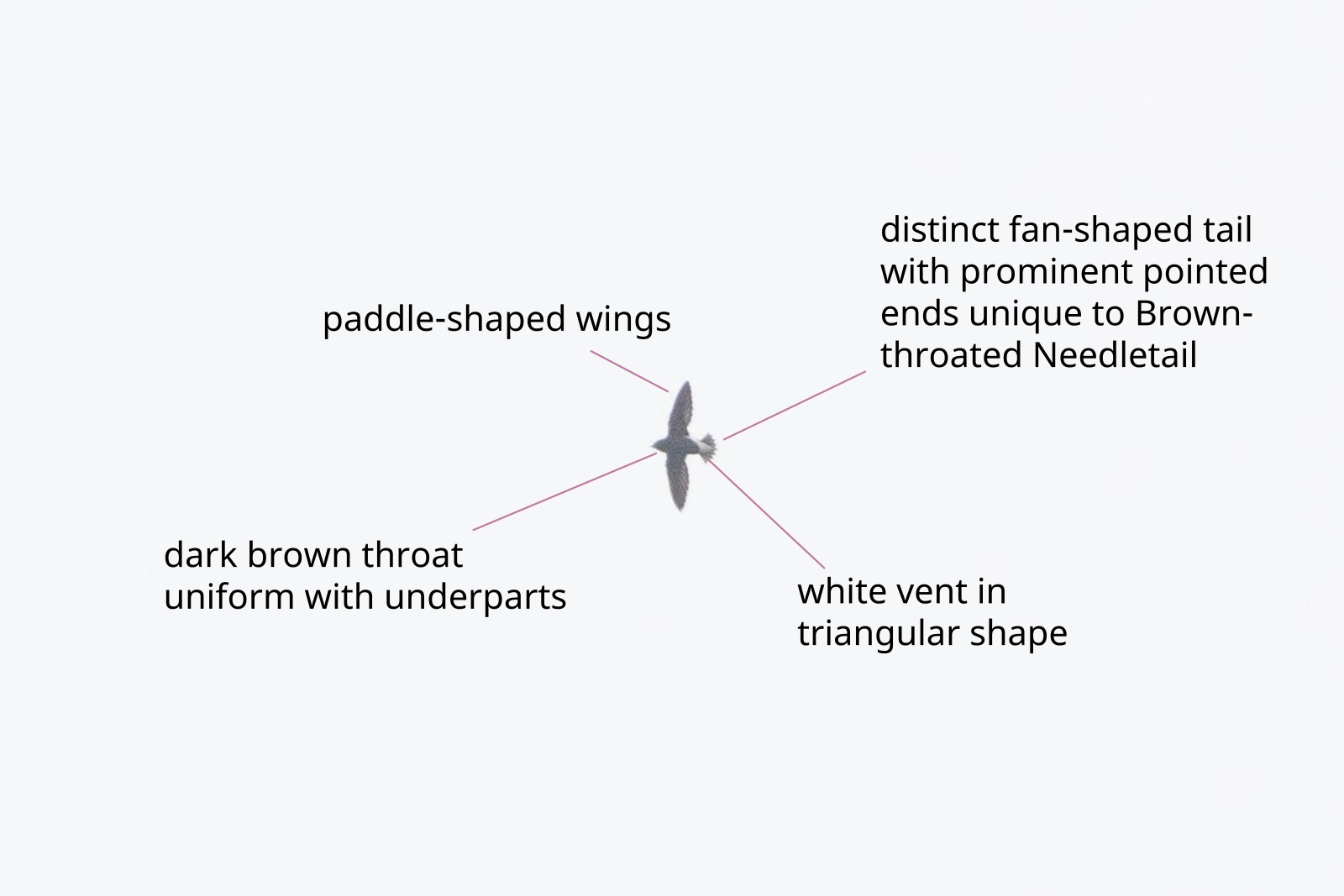
The Brown-backed Needletail is the largest needletail, and while the general features are typical to that of all needletails, such as the overall blackish to dark brown plumage and the broad white vent, it is the most distinct from the previous two needletails. Instead of a square tail, the Brown-backed Needletail has the most obvious needles, which look like a fan with pointed tips when the tail feathers are spread open. When the tail is closed, the needles are still clearly visible, which is not as obvious a feature for the other two needletails. It also has broad wings that appear pinched in as the wings connect to the torso, giving its wings a stronger paddle-shaped appearance compared to the other two needletails. The throat of the Brown-backed Needletail is dark, uniform with the rest of its plumage, though it can sometimes have a pale chin. The saddle is a pale brown, a feature which also sets it apart from the other needletails. In flight, the Brown-backed Needletail shares a similar flight behaviour to the other needletails.Like the White-throated Needletail, the Brown-backed Needletail also has two subspecies – the nominate giganteus found in the Thai-Malay Peninsula is a rare visitor to Singapore; and the migratory indicus, which breeds in South Asia. The nominate subspecies giganteus has a full black head uniform with the body plumage, while the migratory indicus has white lores.
Silver-rumped Spinetail (Rhaphidura leucopygialis)
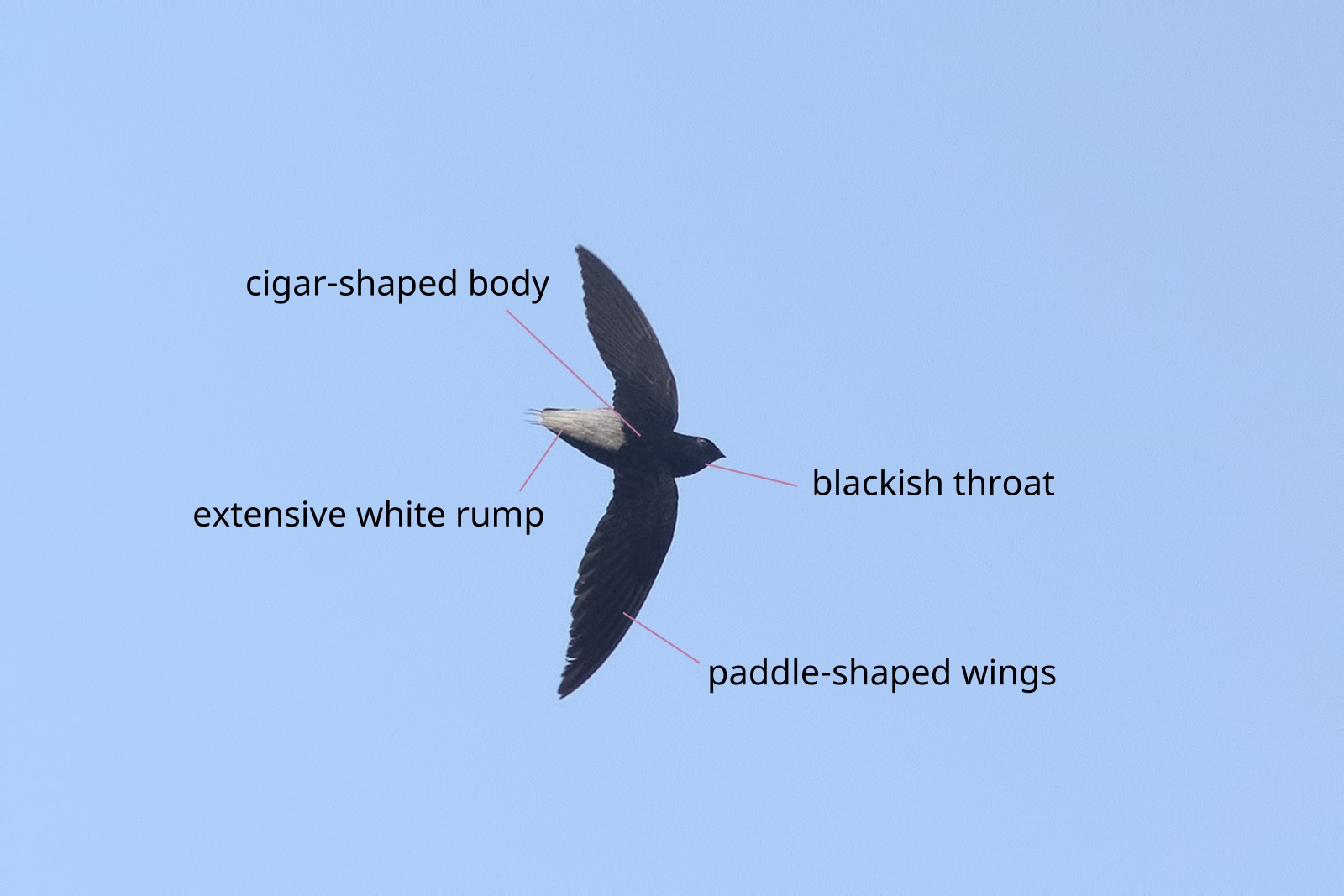
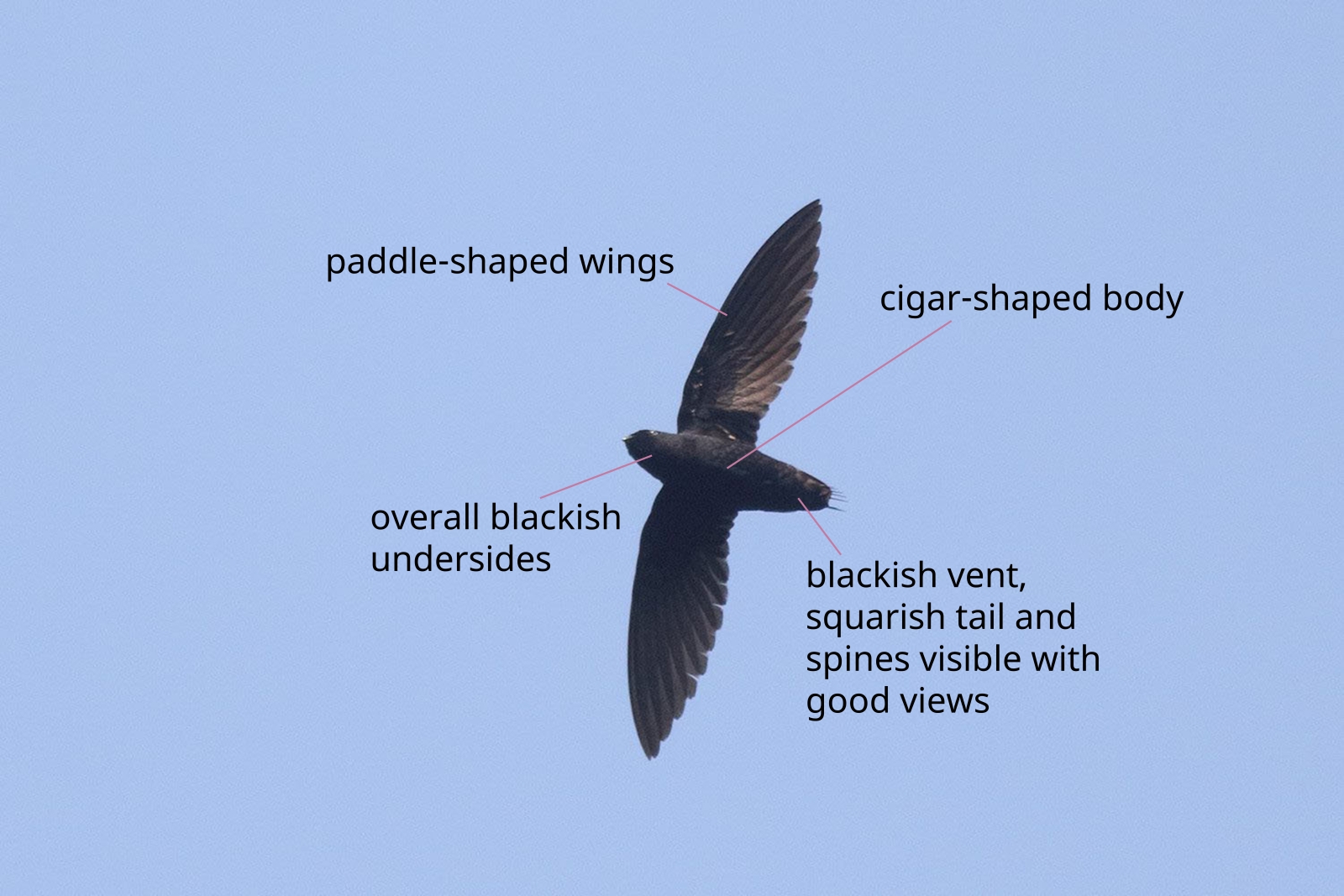
The Silver-rumped Spinetail resembles the needletails over the other species of swifts, where it possesses wings that are even more paddle-shaped compared to the needletails. The body of the Silver-rumped Spinetail is short and cigar-shaped with a seemingly truncated tail that ends in spines. It is also much smaller compared to the needletails. The overall plumage of the Silver-rumped Spinetail is blackish with glossy upperparts. Its rump is a bright silvery-white colour shaped like a triangle, similar to the white vent on the undersides of needletails except that it is on the upperparts for the Silver-rumped Spinetail. The Silver-rumped Spinetail was formerly resident in Singapore, but now they are only observed as a rare visitor. The flight of the Silver-rumped Spinetail can resemble that of the needletails with circling, soaring behaviour, but they are also observed to fly with rocking from side to side, somewhat similar but less “drunk” compared to Aerodramus swiftlets.
The Vagrant
Common Swift (Ap. apus)
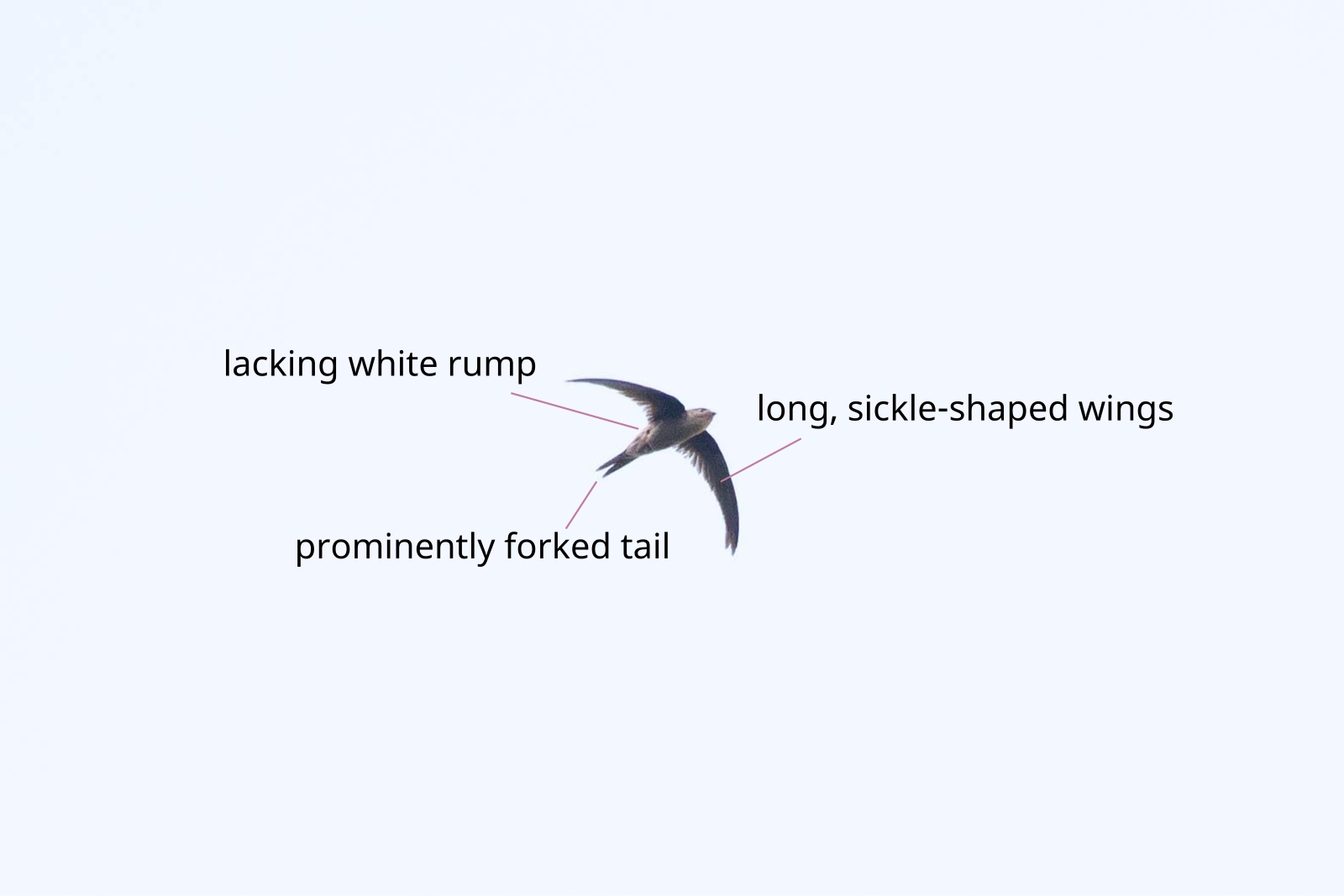
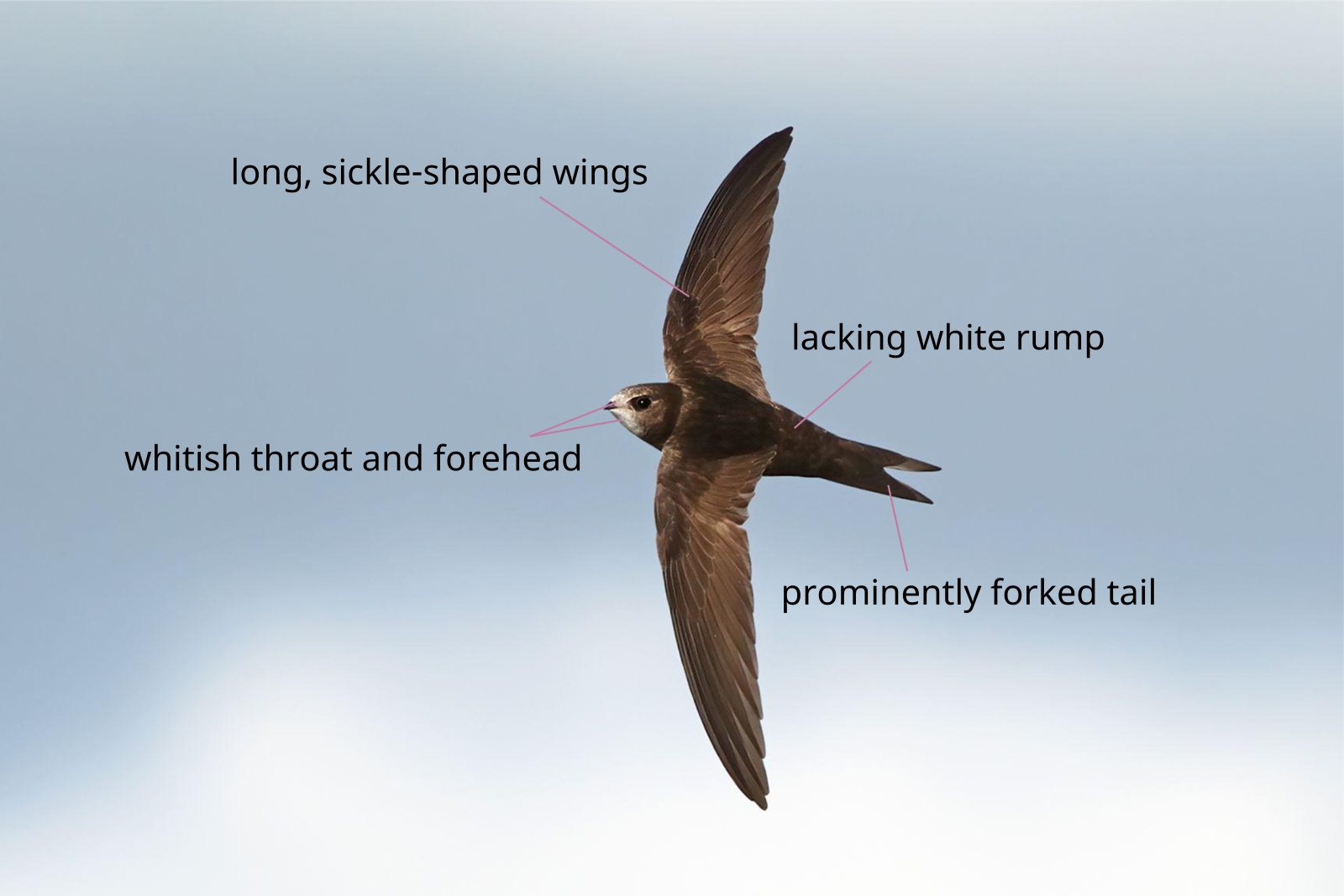
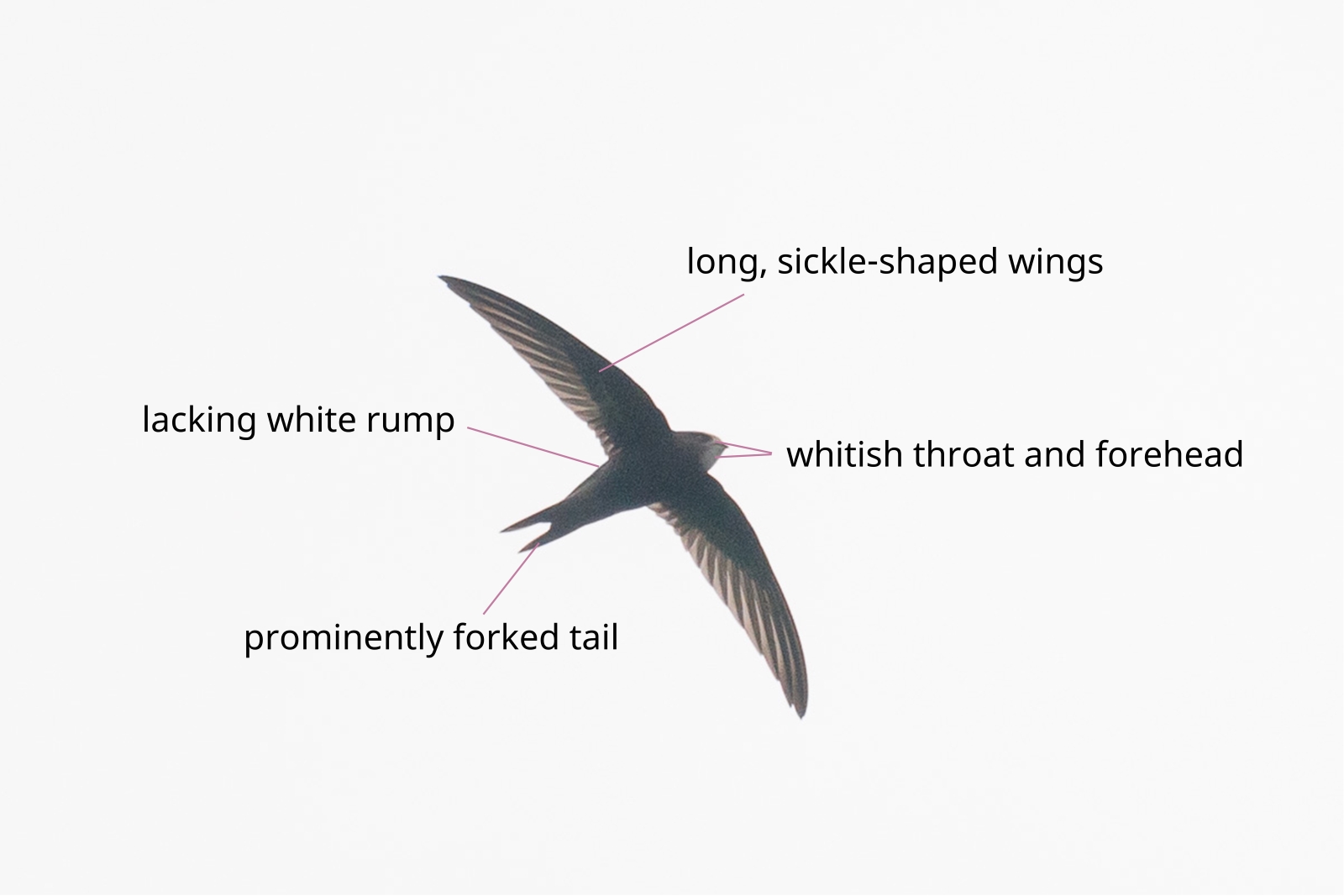
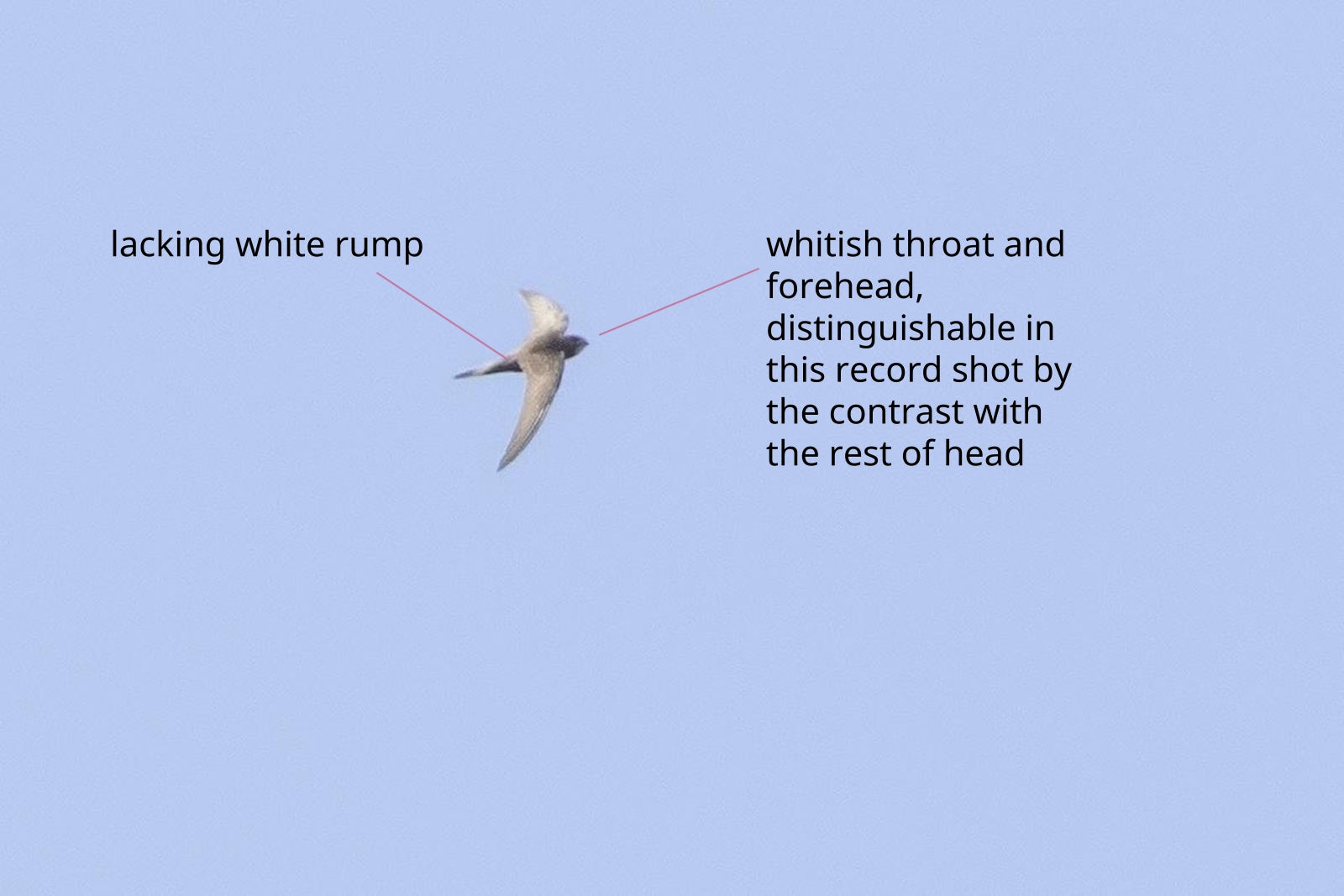
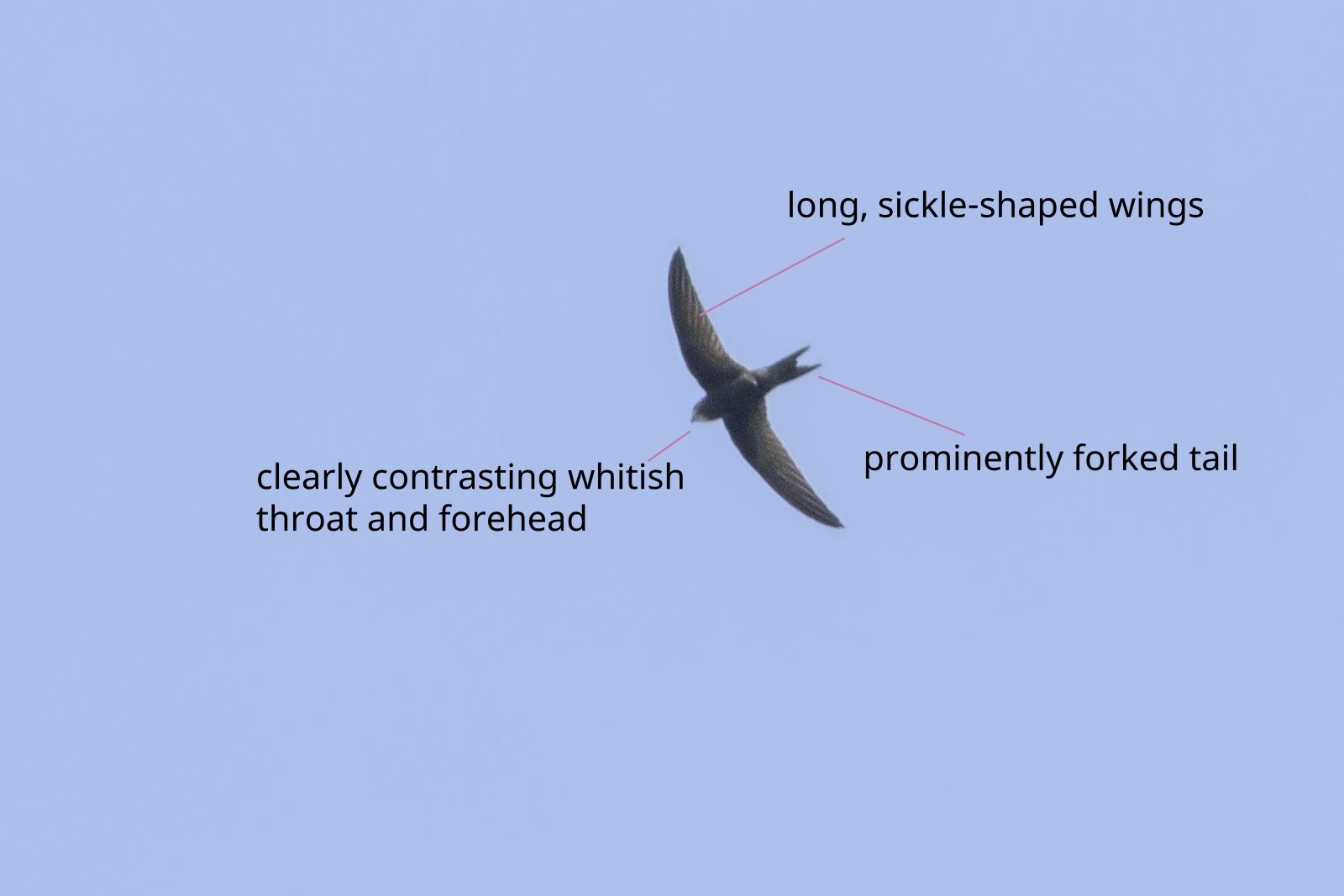
This species breeds from Europe to Mongolia and North China and typically winters in Africa. It is a vagrant in Singapore and is most similar in shape and size to the migratory Fork-tailed Swift. The most distinct differences from the Fork-tailed Swift are the lack of white rump patch and much less prominent scaly underparts on the Common Swift, appearing more uniformly blackish-brown on both the upper and undersides. It also has a whitish throat like the Fork-tailed Swift, but usually with a stronger contrast with the upper breast, and the subspecies pekinensis that has been documented in Singapore has a whitish forehead which the Fork-tailed Swift lacks. Next time you see a swift which resembles a Fork-tailed Swift, do take a closer look, for you might just be looking at a vagrant Common Swift!
Other Swifts We Can Expect…?
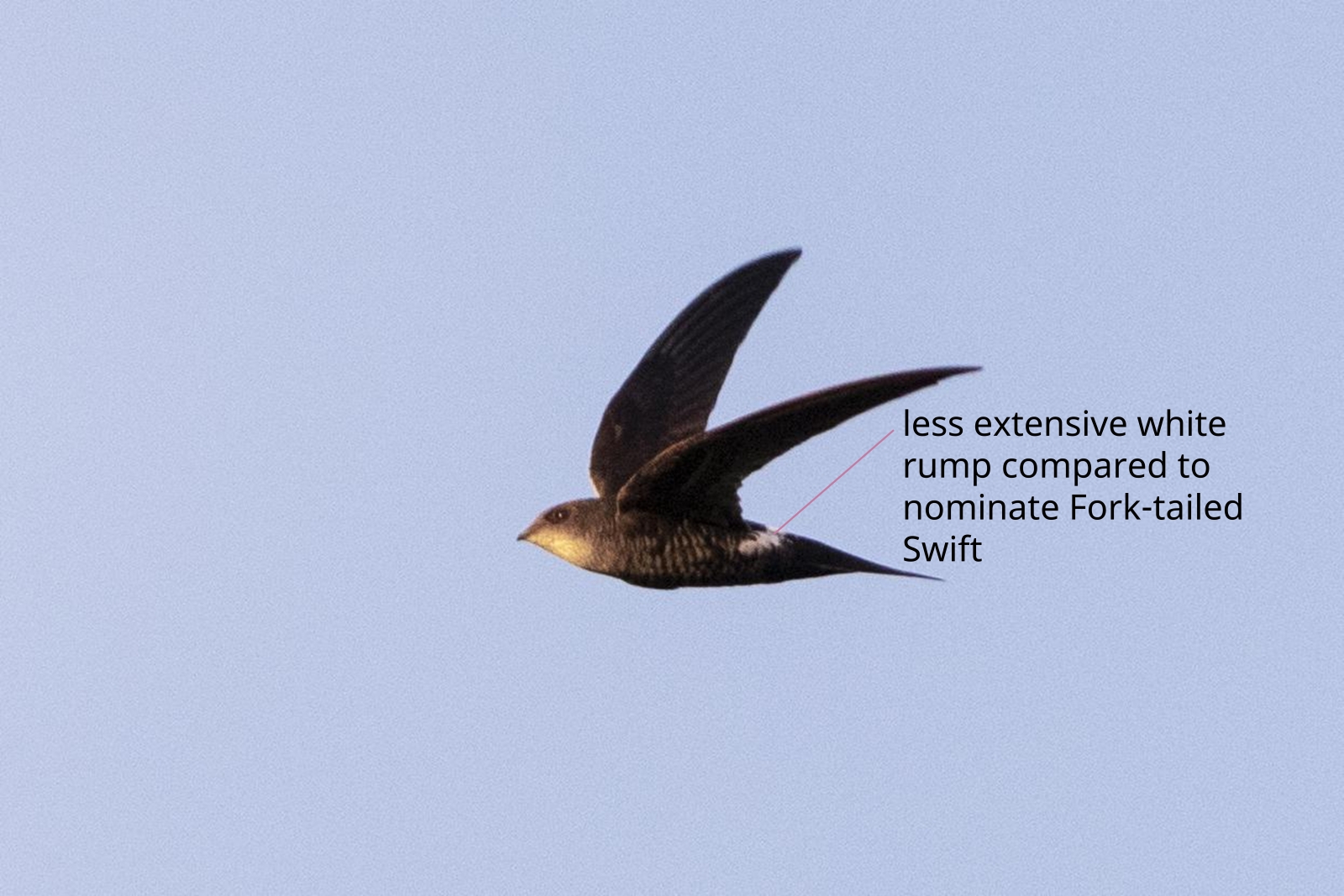
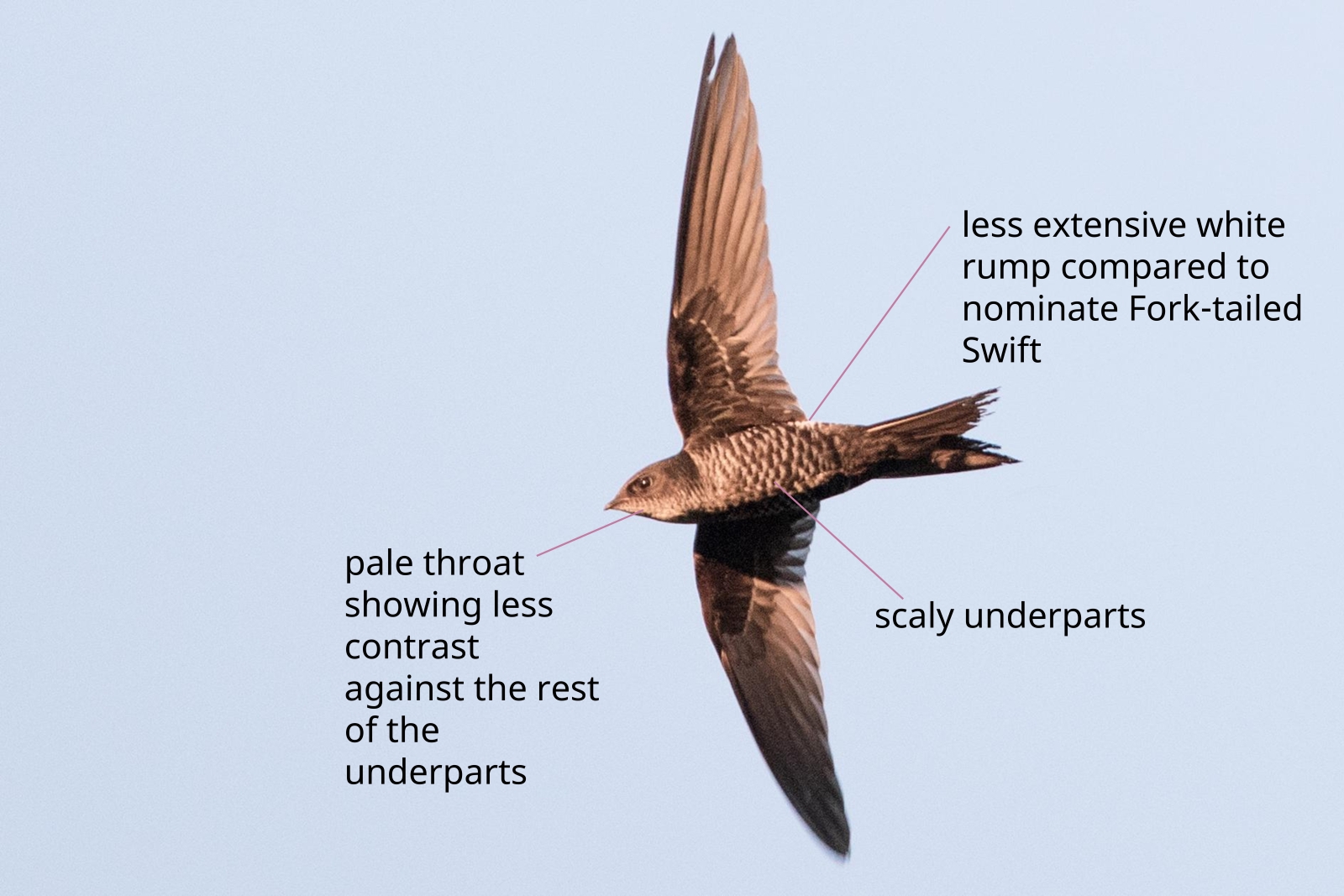
Now that we have covered the swifts that have been spotted in Singapore, we can speculate potential swift species that may make their way to Singapore. The Fork-tailed (Cook’s) Swift (Ap. pacificus cooki) is a taxon that was recently re-lumped with the Fork-tailed Swift complex (though it is thought by some to be a full species, and it doesn’t change the fact that this taxon could be expected in Singapore), and its range encompasses South-east Asia, with its northernmost range reaching South China and its southernmost range reaching Central Malay Peninsula. It is extremely similar to the migratory Fork-tailed Swift that we observe in Singapore, the key differences being that the rump patch is significantly narrower compared to Fork-tailed Swift; the throat is also less white compared to Fork-tailed Swift, giving it a pale brownish-grey look. A distinct contrast in the darkness of the plumage can also be observed between the underside of the inner and outer wing with the outer wing being paler; this is a feature that is not observed, or less distinct, in the Fork-tailed Swift. While the understanding of this species’ migratory movements is not well known, it is not inconceivable that they could show up in Singapore. Hence, the next time you see what looks like a Fork-tailed Swift, do give it a good scrutiny!
What about the discussion of some names that you might have read or heard of, such as the Himalayan Swiftlet (Ae. brevirostris), or Germain’s Swiftlet (Ae. fuciphagus germani)? It is a hot (and controversial) debate as to whether the Himalayan Swiftlet migrates down to Singapore during winter, but given the challenge revolving around the identification of Aerodramus swiftlets in the field, this species will not be added to the Singapore checklist unless a properly validated record is available. As for Germain’s Swiftlet, it has been lumped and is currently recognised as a subspecies of the Edible-nest Swiftlet (Ae. fuciphagus). Hence, “Blackible-nest” Swiftlets it is! P.S. To the readers who use eBird for listing, Aerodramus Swiftlets can be listed as “dark swiftlet sp. (Ae. sp.)” unless you can conclusively identify them to species level (e.g. by observing them in their nests).
Conclusion
We hope that this article has helped to clarify the identification of swifts you might observe in the skies, as well as help you differentiate the swifts from other similar-looking groups such as the swallows and treeswifts. Perhaps now, you will gain newfound appreciation of these amazing and powerful “fun-sized” birds and give them a second look while birding!
Gallery
All the photographs in the article above have been compiled in this gallery for ease of view.
Acknowledgements
A big thank you to everyone who contributed photographs to the article, as well as Chen Xi, Keita and Yichen for comments on the article.