
Jared Tan
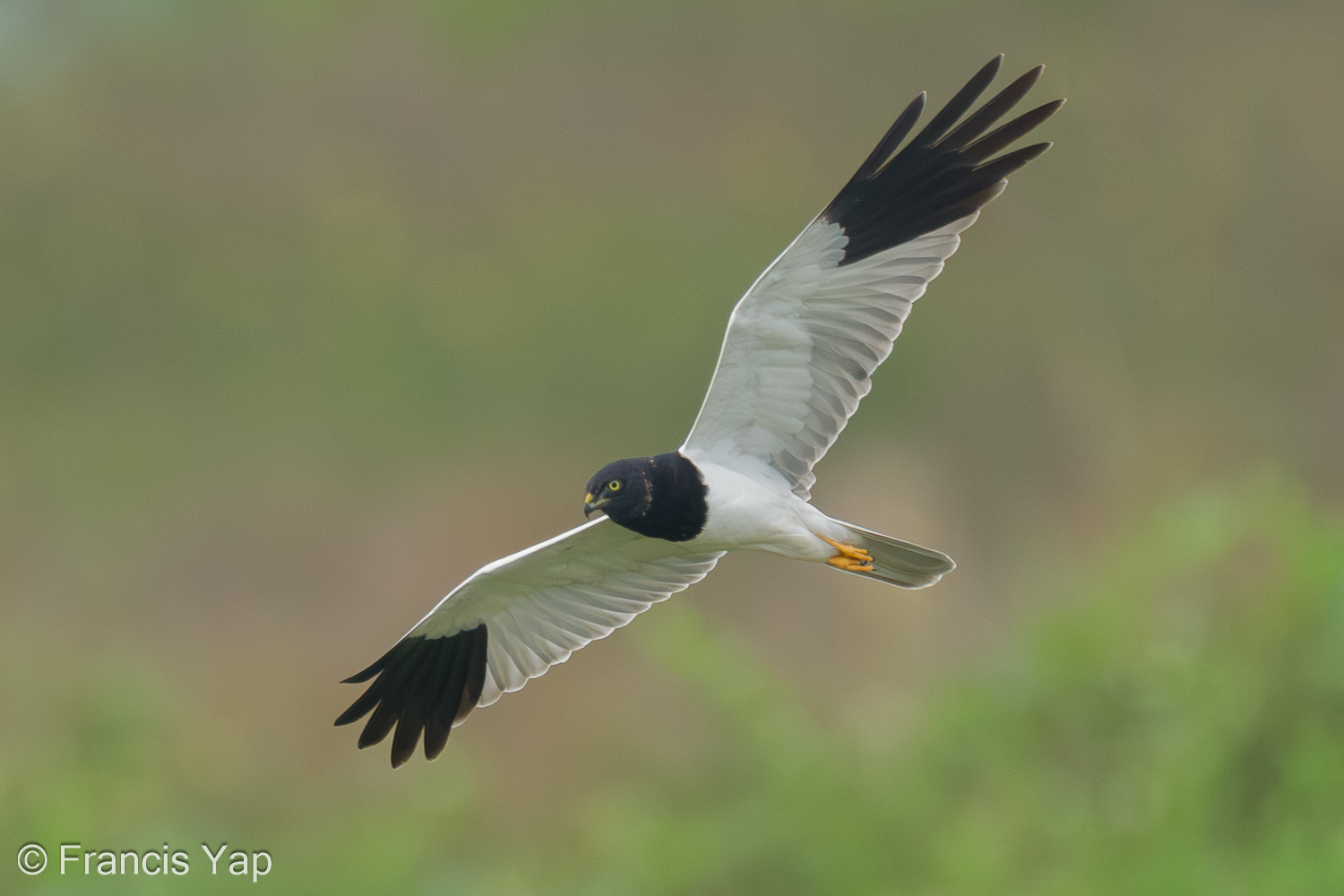
Many species of raptors arrive in Singapore around October to November, the most abundant of which are the Crested Honey Buzzards, Chinese Sparrowhawks and Japanese Sparrowhawks. Among the rarer migrants that arrive in Singapore are the Harriers. Three species of Harriers have been recorded in Singapore – the more regular Pied Harrier and Eastern Marsh Harrier, and the much rarer Hen Harrier (only 3 confirmed records).
Pied Harrier Circus melanoleucos and Eastern Marsh Harrier C. spilonotus are grassland specialists, usually showing five ‘fingers’ in flight. Pied Harrier typically arrives from the first week of November onwards, while Eastern Marsh Harrier usually arrives from mid-October onwards. While most sightings are usually limited to raptor-watching sessions, over the years patches of grassland have sometimes yielded wintering birds, such as in Changi (where the airport has now been constructed), and more recently in Tuas South. Rapid urbanisation has caused suitable large areas of grassland habitat to become more and more scarce. It would thus come as no surprise that opportunities to see these raptors wintering on our shores are likely to diminish further in the coming years.
Harriers have proven to be a seemingly difficult group of birds for most to identify, and this article hopes to shed some light on some of the features which may be used to distinguish between the two species regularly found here. We will first take a look the male, female and immature plumages of each species, before comparing some of the more easily confused groups of plumages.
Distinguishing between Eastern Marsh Harrier and Pied Harrier
Giss
Taking a look at the overall shape and structure of Pied Harrier and Eastern Marsh Harrier, Pied Harrier generally has narrower, more pointed wings and more slender body, compared to the broader, more rounded wings and bulkier body of Eastern Marsh Harrier.
Head Shape
Taking a closer look at the shape of the head. Pied Harrier has a more rounded-appearance to the head, with a steeper gradient from the throat to the bill. On the other hand, Eastern Marsh Harrier tends to have a more pointed, elongated-looking head, with the throat having a gentler gradient going up towards the bill. Of course, depending on the posture of the bird’s head, this feature may be difficult to determine at times, but where possible a quick look at the head shape would be a good start to identifying the species you are looking at.
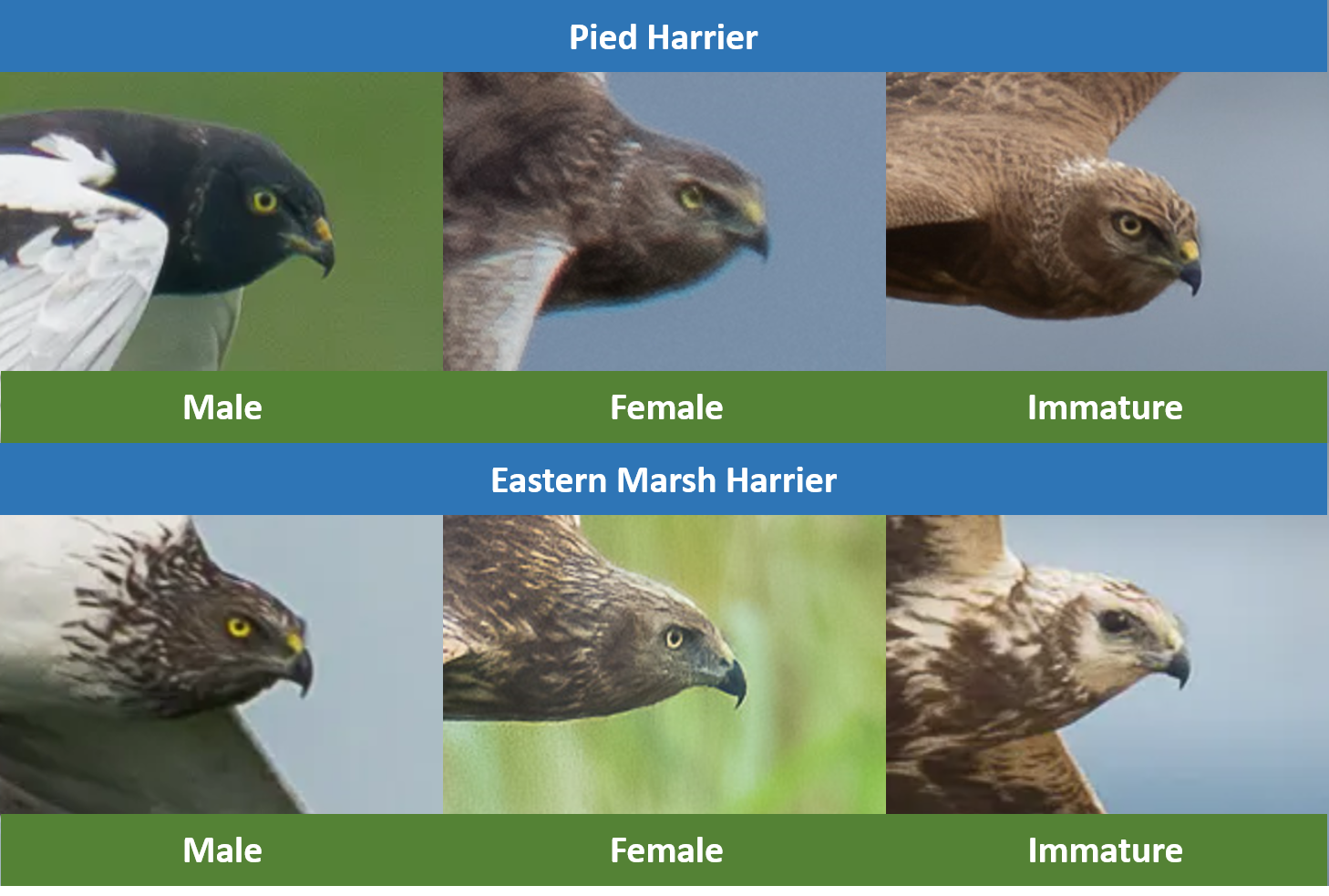
Close-up photographs of the faces of Pied Harrier and Eastern Marsh Harrier. Photo credit: Francis Yap (PH M; EMH M, F, Imm), Adrian Silas Tay (PH F, Imm)
Pied Harrier
Male
Male Pied Harriers are unmistakable, covered mostly with contrasting patches of black and white. They have a black head and upperbreast, black outer primaries, and extensive white underparts. From above, they have a black mantle and back, a black band across the median coverts, and a large white patch over the lesser coverts.
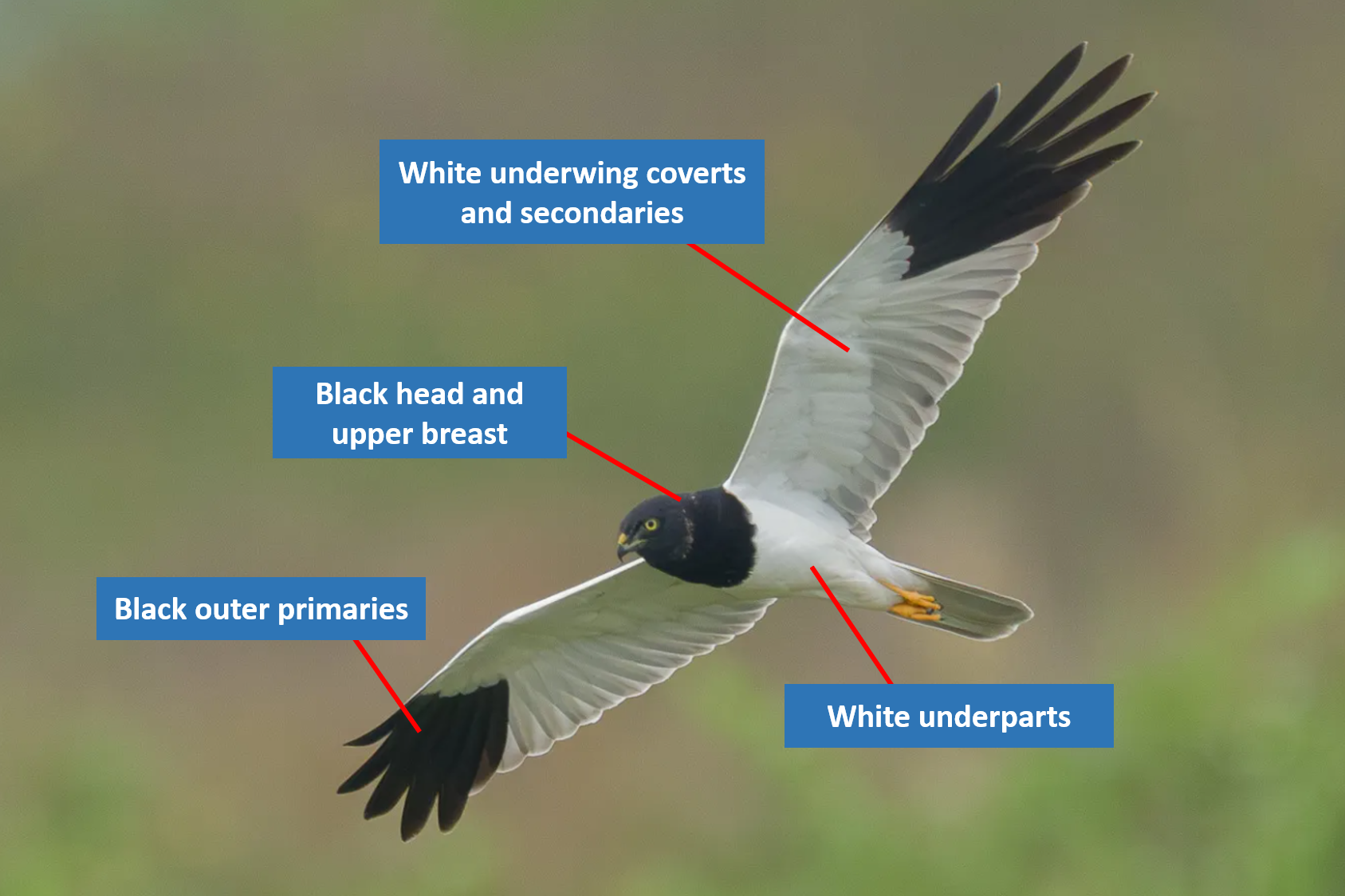
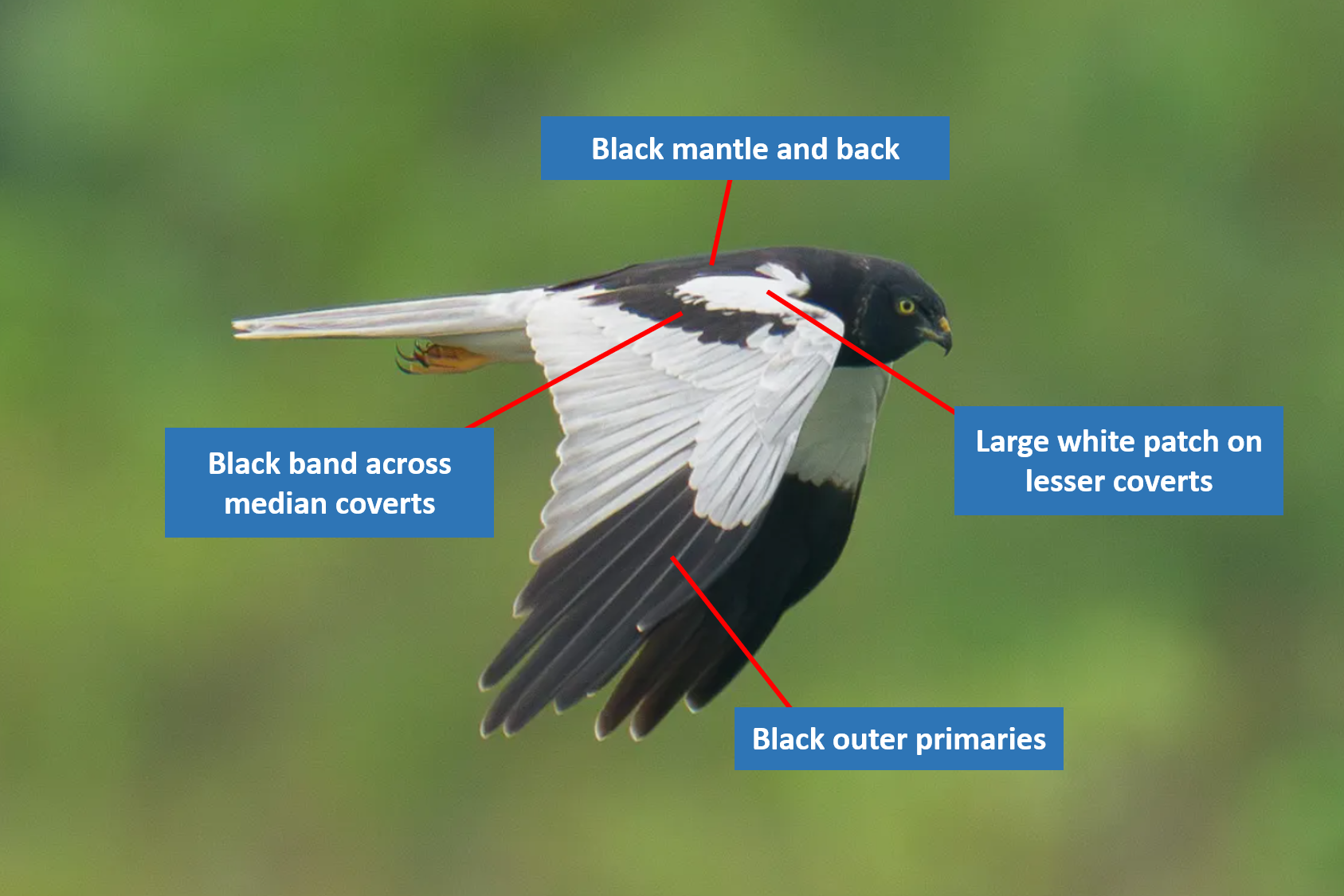
Male Pied Harrier. Photo credit: Francis Yap.
Female
Female Pied Harriers look very different from the males, having a brown head and streaking down to the breast. They have white thighs and vent, as well as extensive dark barring on the primaries and secondaries. From above, white ‘shoulders’ can be seen, contrasting with the brown lesser coverts. Dark barring is seen on the whitish primary coverts and greyish secondaries, and the primaries are dark-tipped. Dark bands are visible on the uppertail with white uppertail coverts.
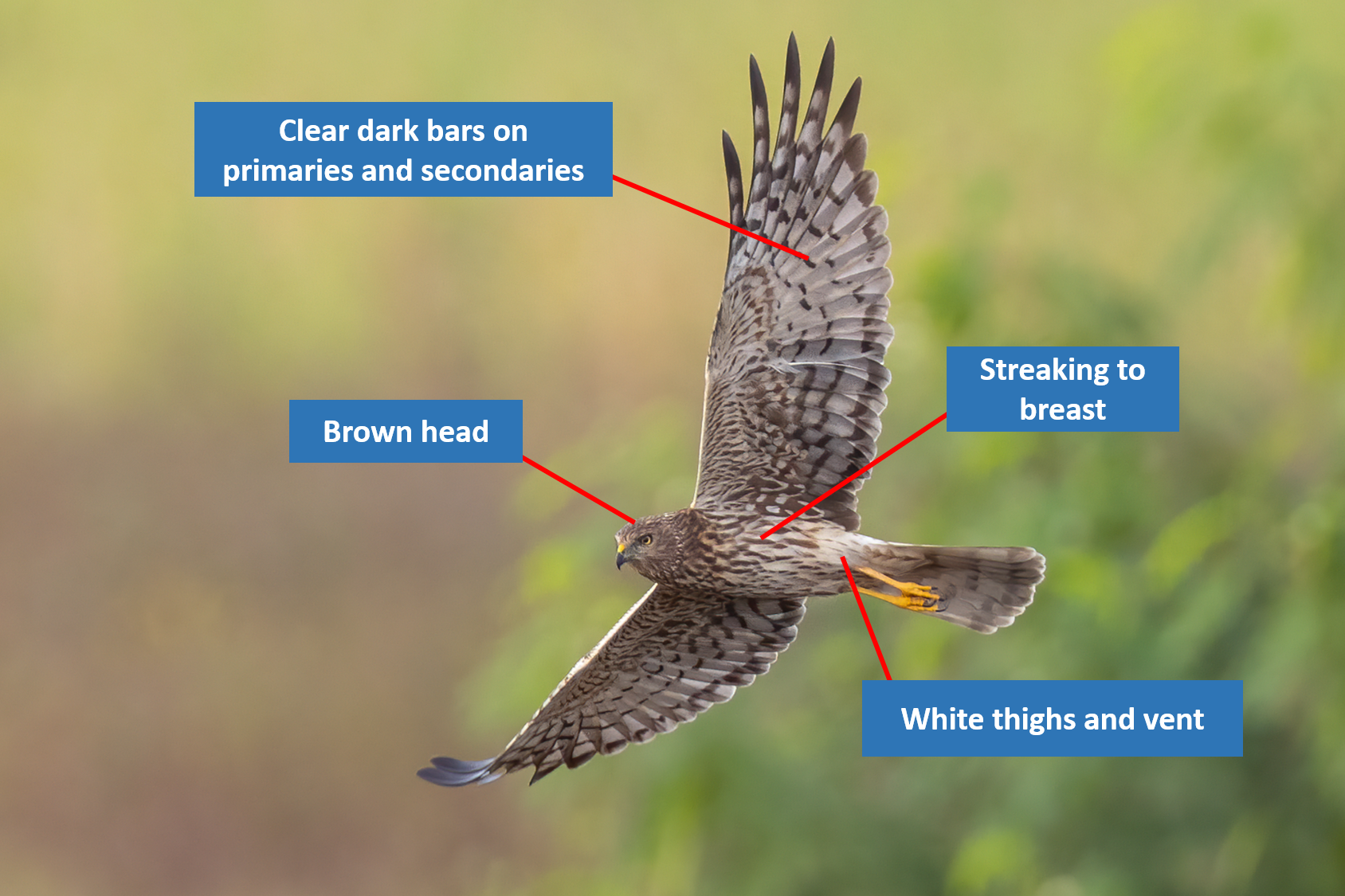
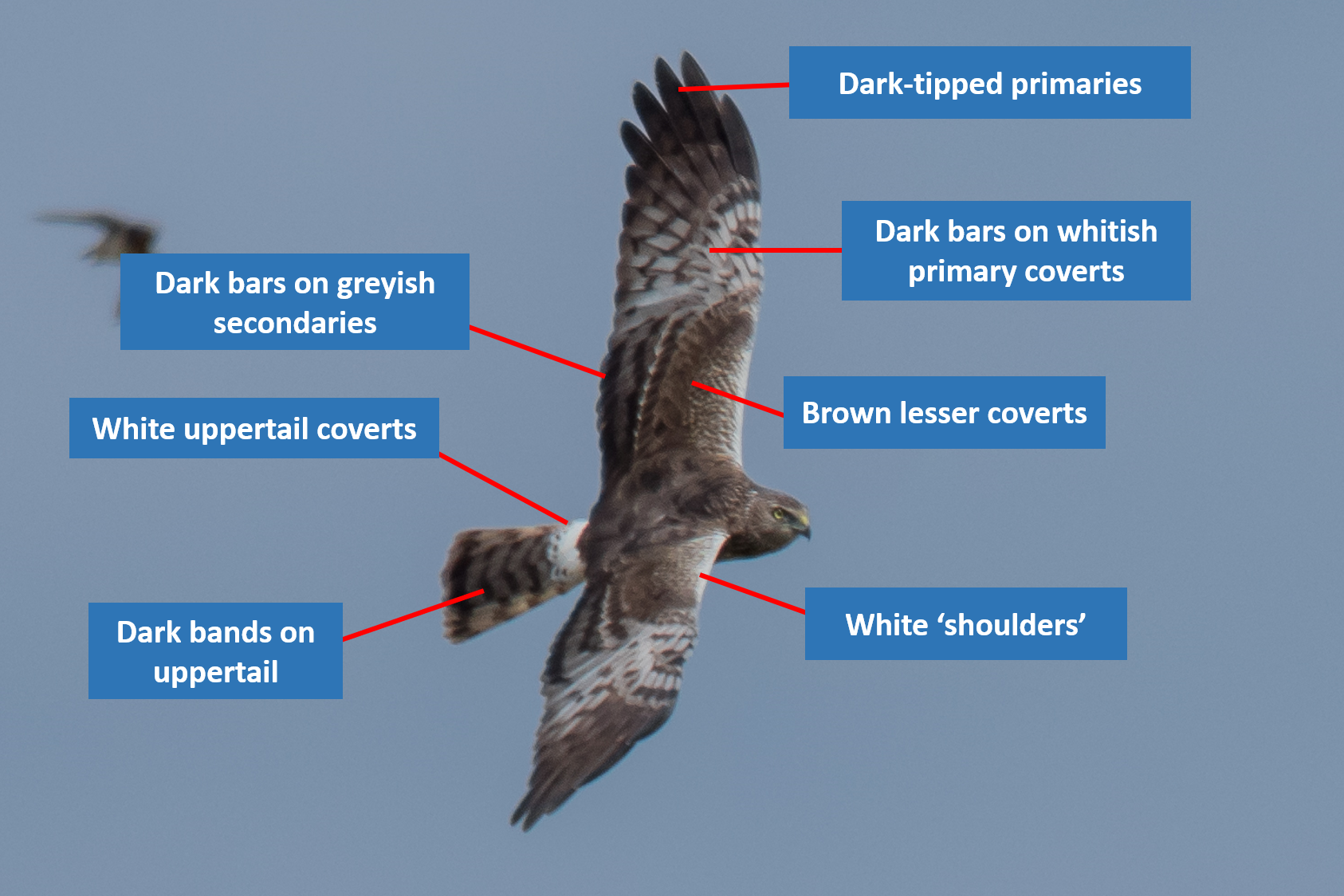
Female Pied Harrier. Photo credit: Adrian Silas Tay.
Immature
Immature Pied Harriers are much plainer looking than the adults, having an overall brown plumage. They have a brown head, underparts, and underwing coverts, with barring on the whitish primaries and greyish secondaries. From above, the upperparts are also mostly brown, with white uppertail coverts and pale bands on the uppertail.
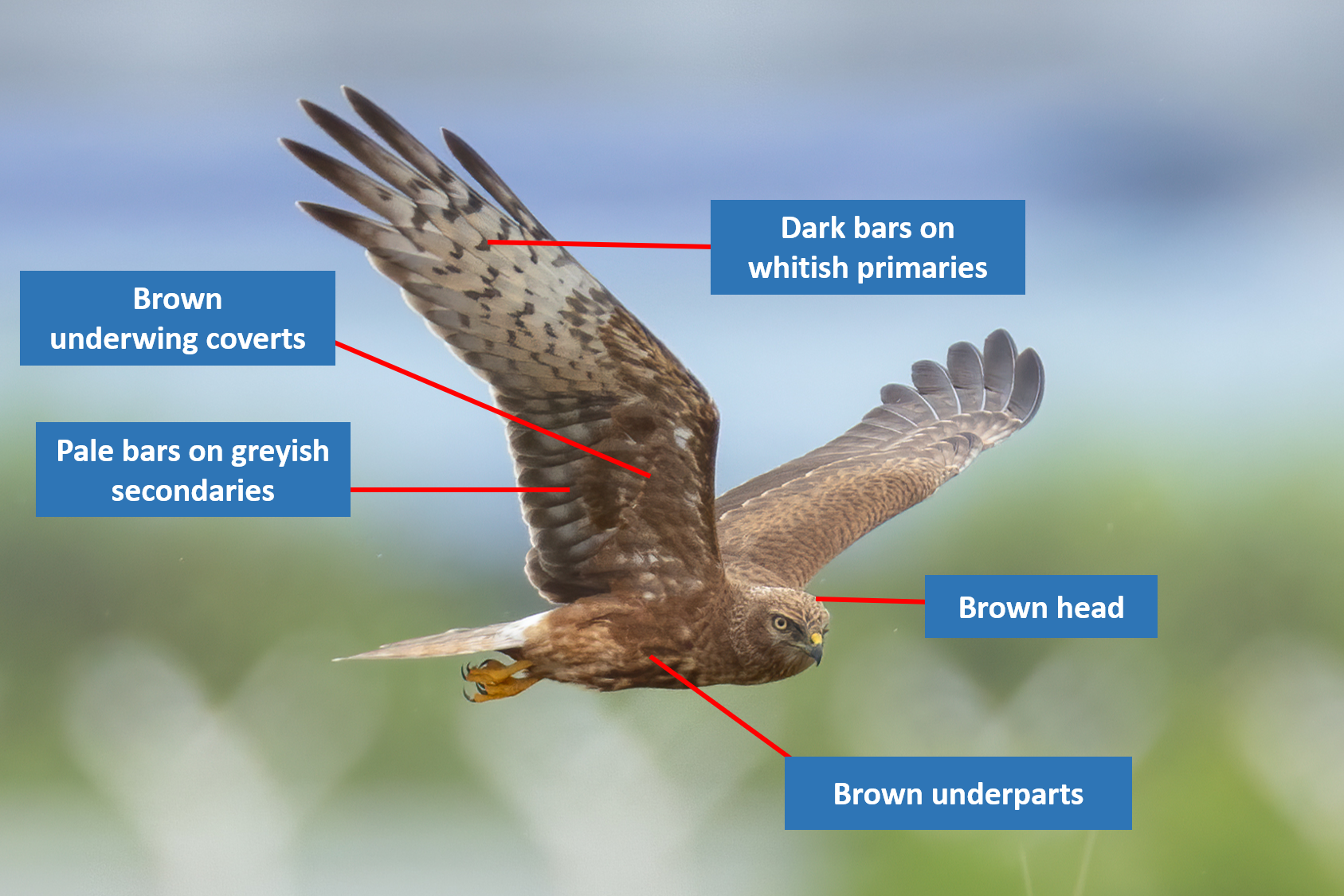
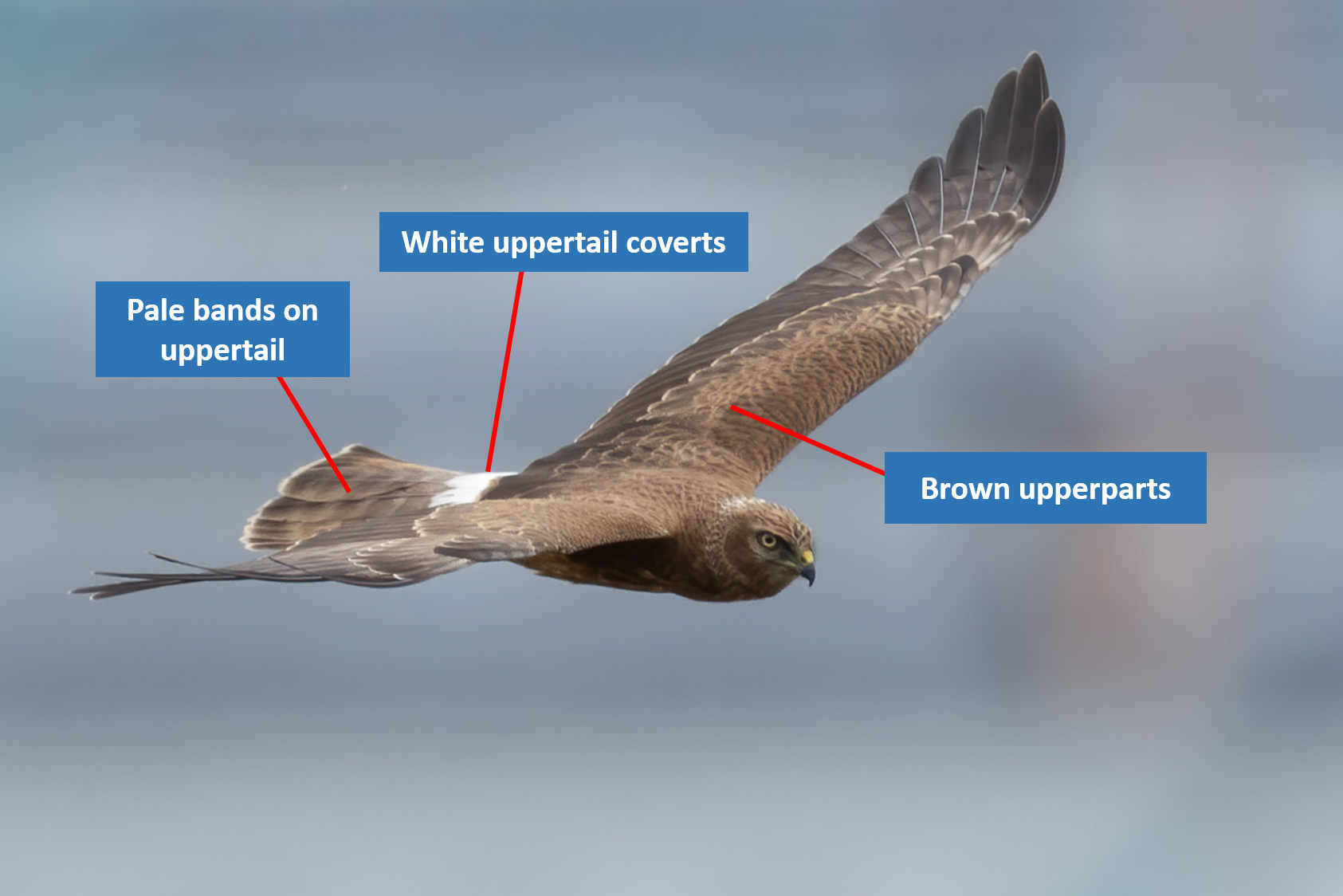
Immature Pied Harrier. Photo credit: Adrian Silas Tay.
Eastern Marsh Harrier
Male
Male Eastern Marsh Harriers have a dark head (ranging from grey to black), with streaking to the upper breast. The underparts and underwings are mostly white, with the exception of the dark outermost primaries. From above, they have a dark mantle, back, and lesser coverts, and white ‘shoulders’. They also have white uppertail coverts, and an unbarred light grey tail.
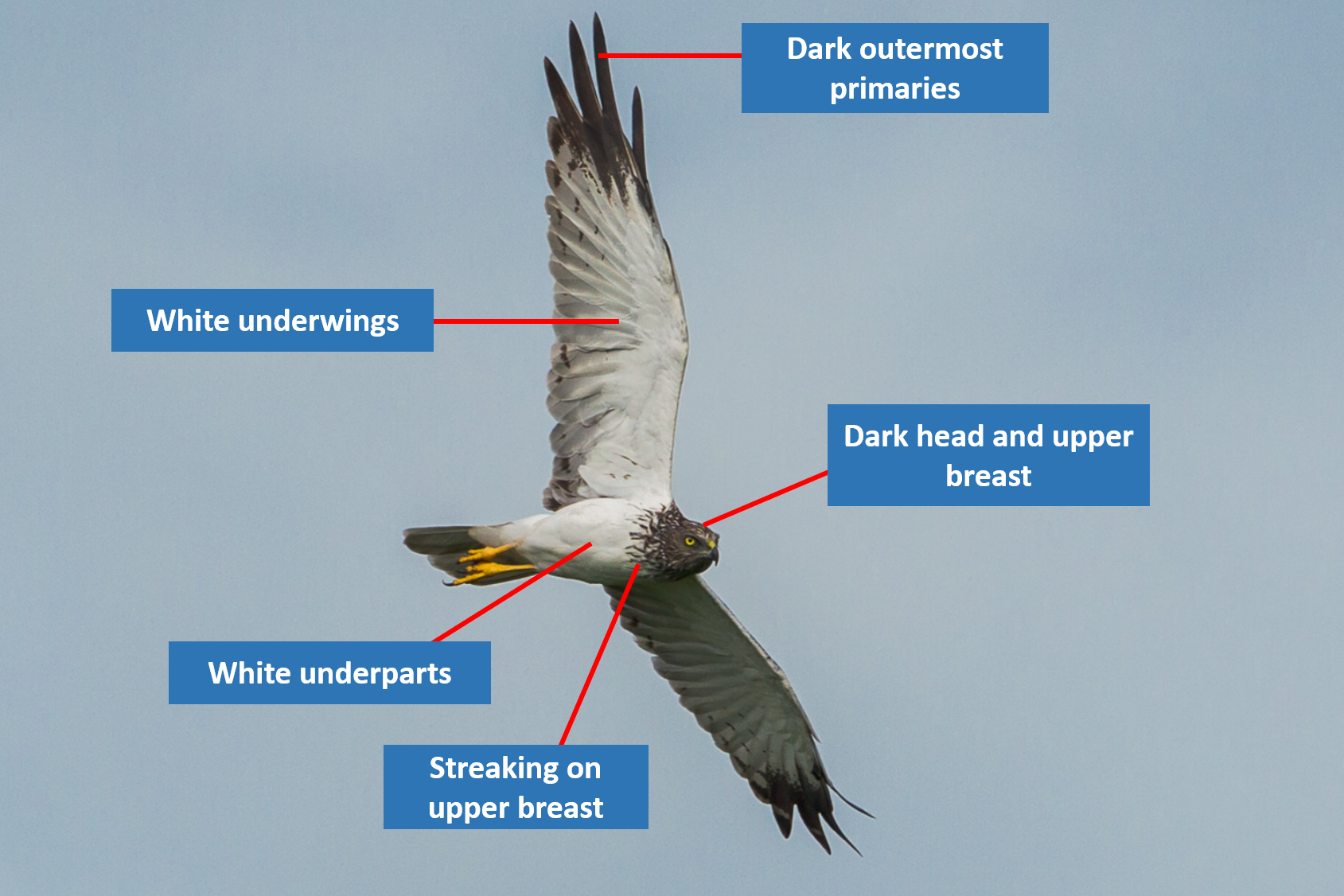
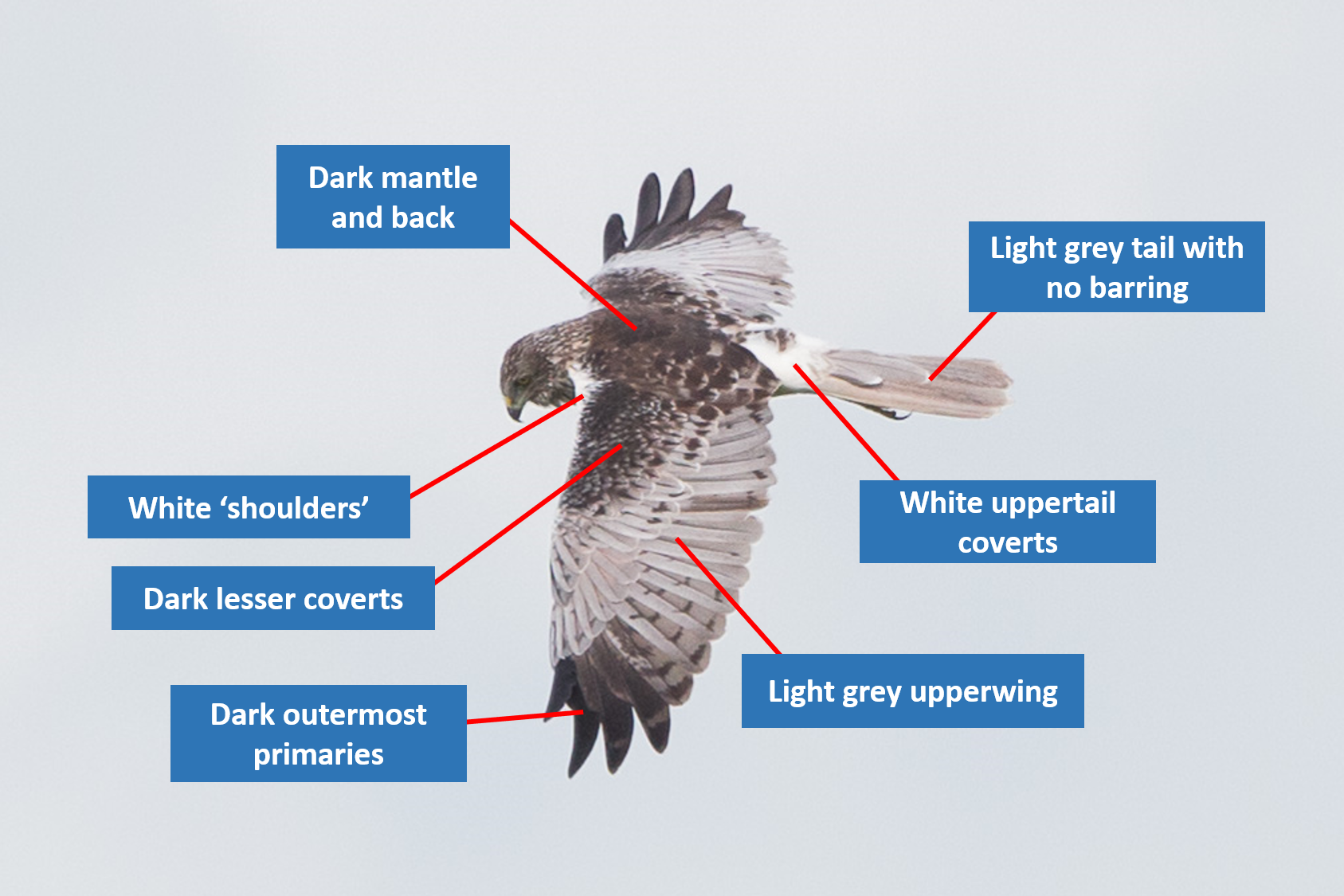
Male Eastern Marsh Harrier. Photo credit: Francis Yap.
Female
Female Eastern Marsh Harriers have an overall brown plumage, with streaking extending from the neck all the way down to the belly. The underwing coverts are light brown, and also often show some level of streaking as well. The primaries are whitish with pale barring, which can be variable at times. From above, the upperparts are also brown, with some white on the uppertail coverts (less than Pied Harrier), and barring on the uppertail (thinner bars than Pied Harrier).
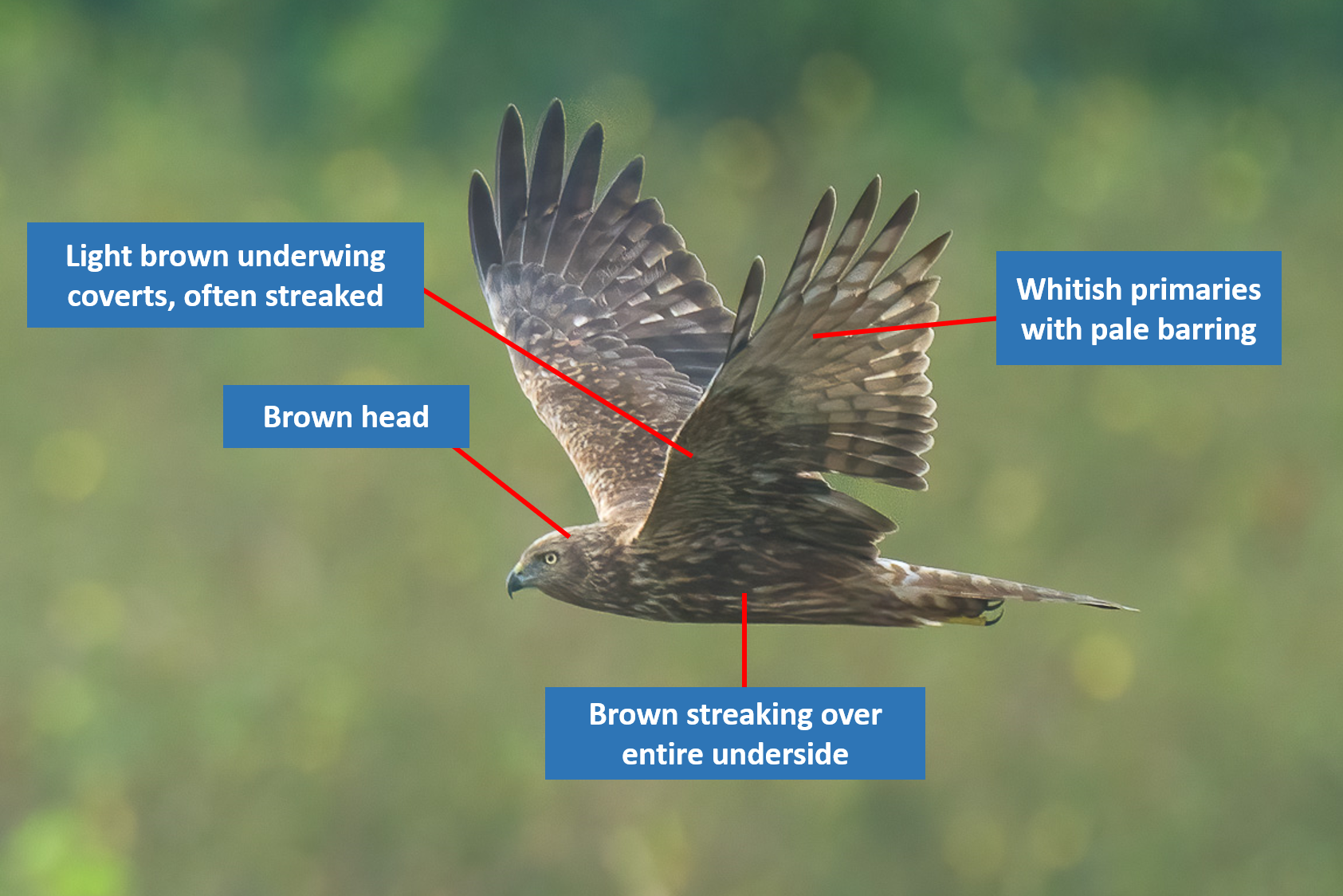
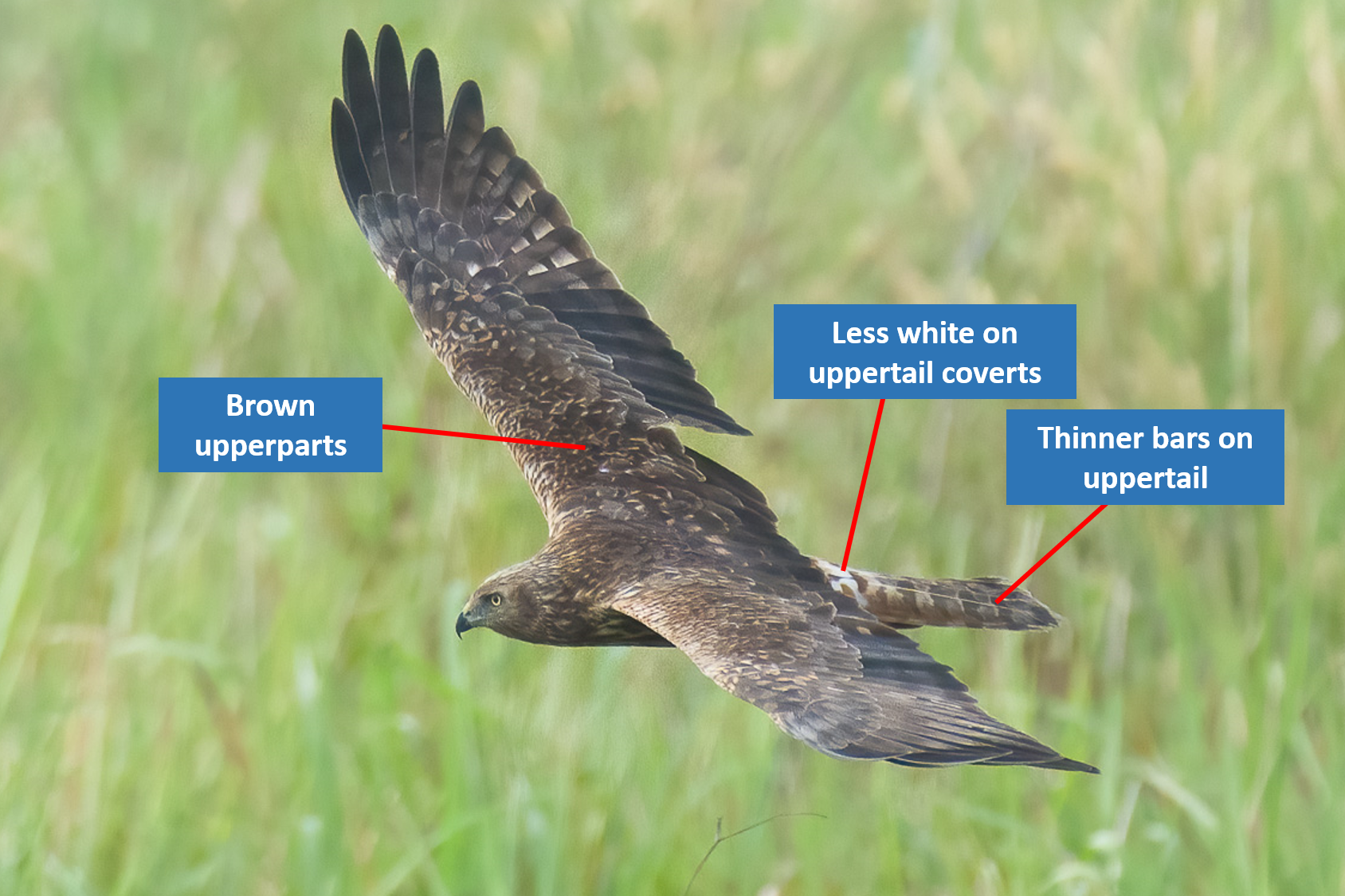
Female Eastern Marsh Harrier. Photo credit: Francis Yap.
Immature
Lastly, we come to the immature Eastern Marsh Harrier. They have an overall dark brown plumage, with a distinctive whitish face and may have a streaked white band across the breast. The underparts, underwing coverts and secondaries are dark brown, and primaries are whitish and unbarred. From above, the upperparts are also mostly dark brown, with whitish streaked ‘shoulders’ and a small amount of white on the uppertail coverts. The crown to nape may also be whitish and streaked as well.
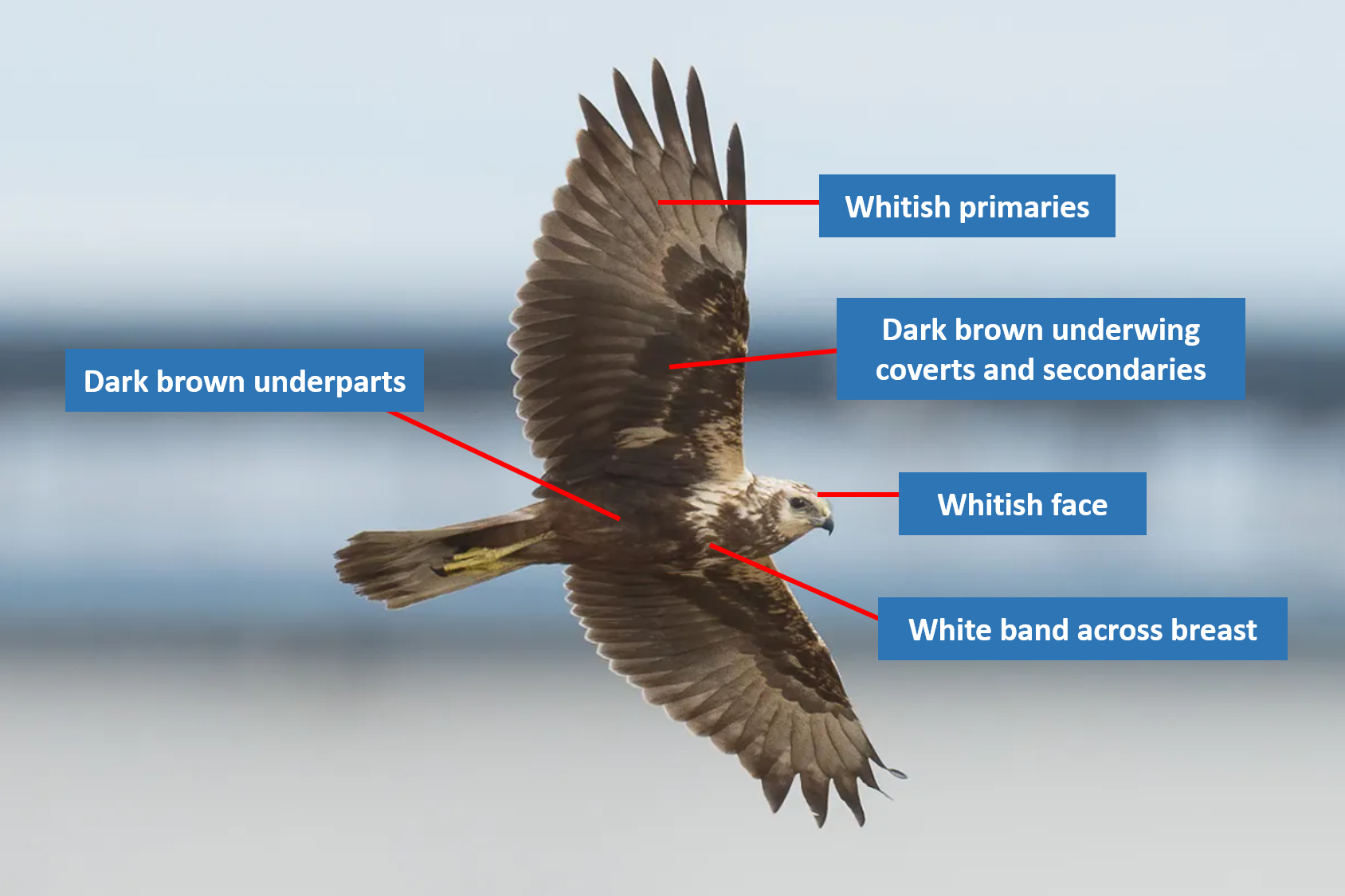
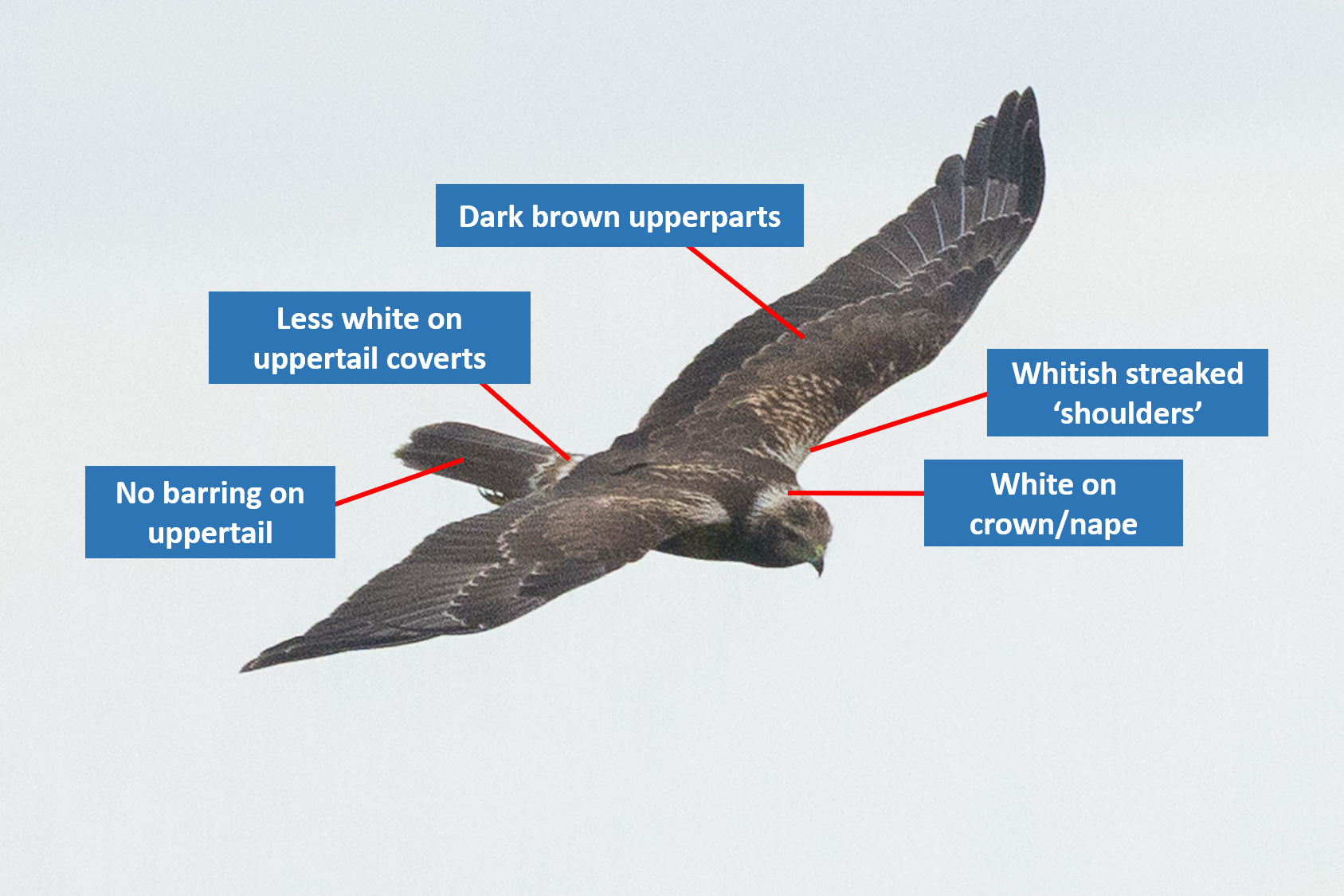
Immature Eastern Marsh Harrier. Photo credit: Francis Yap.
Distinguishing between Easily-Confused Sets of Plumages
Now that we have covered the detailed features of the various plumages for each species, let us now take a look at some of the more easily-confused sets of plumages, namely the ‘hooded’ plumages (female Pied Harrier and subadult male Eastern Marsh Harrier) and ‘brown’ plumages (immature Pied Harrier, female Eastern Marsh Harrier and immature Eastern Marsh Harrier).
‘Hooded’ Plumages: Female Pied Harrier and Subadult Male Eastern Marsh Harrier
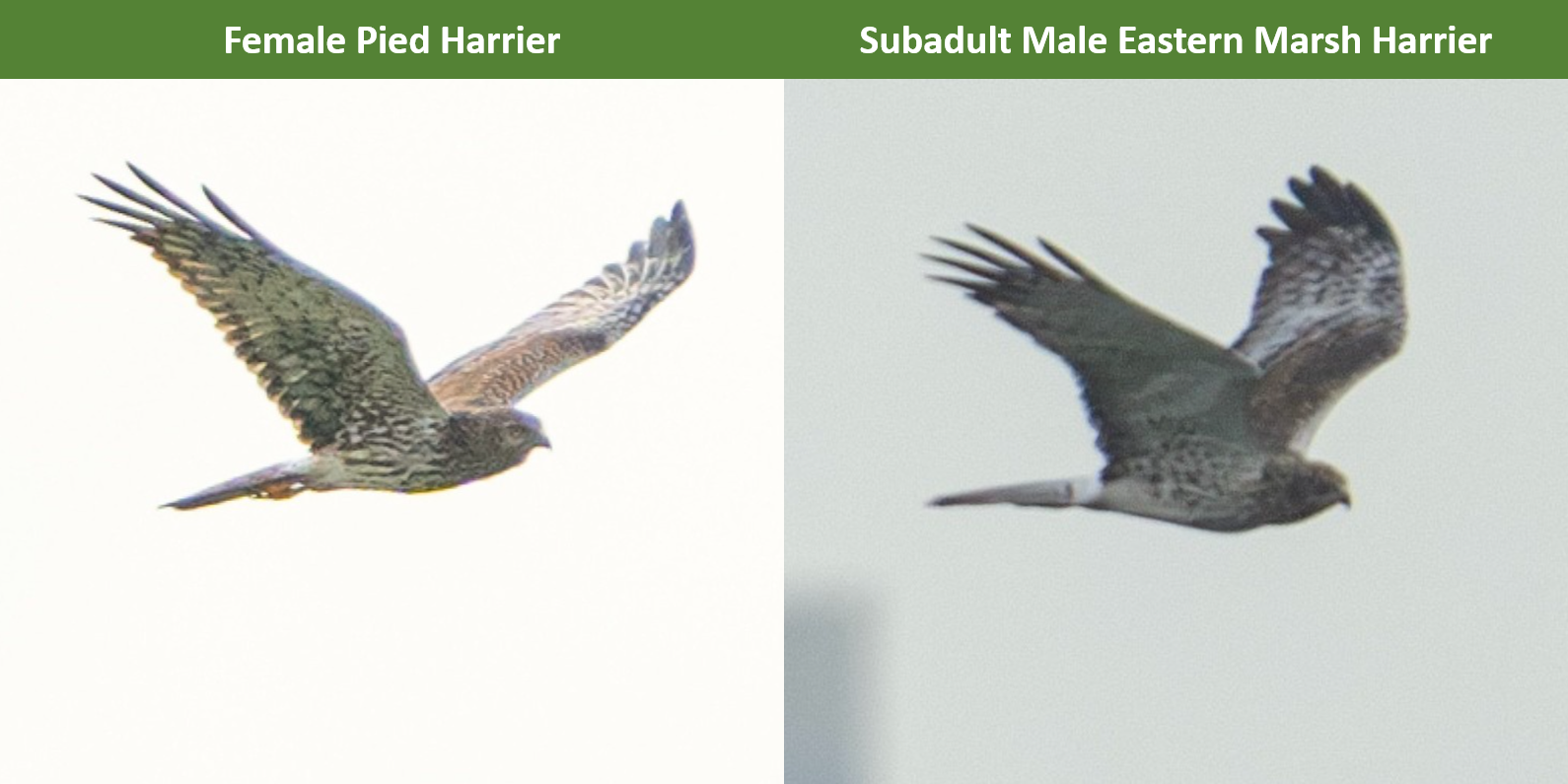
Subadult male Eastern Marsh Harrier and Female Pied Harrier. Photo credit: Jared Tan.
The first commonly confused pair is that of the female Pied Harrier and subadult Male Eastern Marsh Harrier. While both show a dark head with streaking to the breast and markings on the underwing, the streaking on the breast, markings on the underwing, and bands on the uppertail may be used to tell them apart. The table below shows a summary of the features they can be distinguished by.
| Trait | Pied Harrier (Female) | Eastern Marsh Harrier (Subadult male) |
| Face shape | Rounder; Steep incline from throat to bill |
Narrows to bill; Gentler incline from throat to bill |
| Face colour | Brown | Grey/black |
| Hood and streaking | Brownish hood and streaking to breast | Grey/black hood and streaking limited to upperbreast |
| Underwing | More extensively marked with barring on primaries and secondaries | Cleaner white with fewer markings |
| ‘Shoulders’ | Both may show whitish ‘shoulders’ | |
| Uppertail | Brown uppertail with bands;
Whitish uppertail coverts |
Grey uppertail without bands; Whitish uppertail coverts |
‘Brown’ Plumages: Immature Pied Harrier, Female Eastern Marsh Harrier and Immature Eastern Marsh Harrier
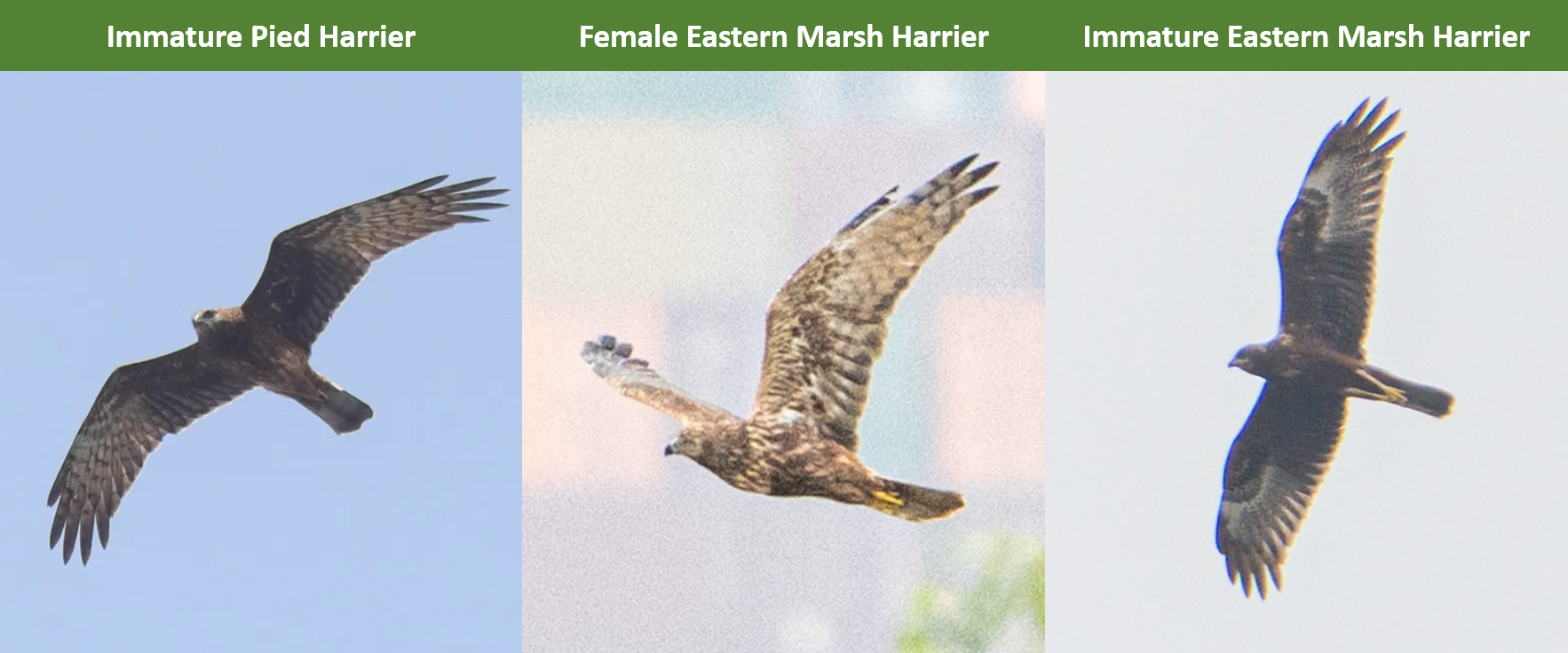
Immature Pied Harrier, female Eastern Marsh Harrier, and immature Eastern Marsh Harrier. Photo credit: Francis Yap (PH Imm); Jared Tan (EMH F, Imm)
The next set of plumages we will compare is that of the immature Pied Harrier, female Eastern Marsh Harrier, and immature Eastern Marsh Harrier, which all have an overall brown plumage. The table below shows a summary of the features which may be used to distinguish between them.
| Trait | Pied Harrier (Immature) |
Eastern Marsh Harrier (Female) | Eastern Marsh Harrier (Immature) |
| Face shape | Rounder; Steep incline from throat to bill |
Narrows to bill; Gentler incline from throat to bill | Narrows to bill; Gentler incline from throat to bill |
| Face colour | Brown | Brown | White/brown |
| Underparts | Uniformly brown | Brown with streaking to belly | Dark brown with whitish band across breast |
| Underwing | Brown underwing coverts;
Barring on whitish primaries and greyish secondaries |
Light brown underwing coverts, may appear streaked;
Barring on whitish primaries and greyish secondaries |
Dark brown underwing coverts, may have white patches; Unbarred whitish primaries and brownish secondaries |
| ‘Shoulders’ | No white ‘shoulders’ | No white ‘shoulders’ | Streaked whitish ‘shoulders’ |
| Uppertail | Brown with pale bands;
More white on uppertail coverts |
Brown with bands (thinner than in Pied Harrier);
Less white on uppertail coverts |
Dark brown without bands; Less white on uppertail coverts |
A Very Rare Vagrant: Hen Harrier
While we regularly encounter Pied Harrier and Eastern Marsh Harrier in Singapore, it is worth noting that we actually have a third species, the Hen Harrier C. cyaneus, of which there are three records (1948, 1963 and 1982). Let us take a quick look at the distinguishing features for this species.
Firstly, Hen Harrier also has a more rounded face, similar to that of Pied Harrier, and also shows five ‘fingers’ when in flight. The wings are generally broader and more rounded when compared to Pied Harrier. Male Hen Harriers are distinctive, with a light grey head to upperbreast and white underparts. Both the upperwing and underwing are whitish, with black outer primaries and a dark trailing edge. The uppertail is grey with no barring, and the uppertail coverts are white.
The difficulty comes when trying to distinguish female/immature Hen Harrier from female Pied Harrier. Female/immature Hen Harrier share a similar overall look to female Pied Harrier, with a brownish head and streaking to the breast and dark barring on the primaries and secondaries. The uppertail also shows similar bands with white uppertail coverts. However, female/immature Hen Harrier has a more prominent facial disc and broader bars on the secondaries than Pied Harrier. Female/immature Hen Harrier also lacks the white ‘shoulders’ seen in female Pied Harrier.
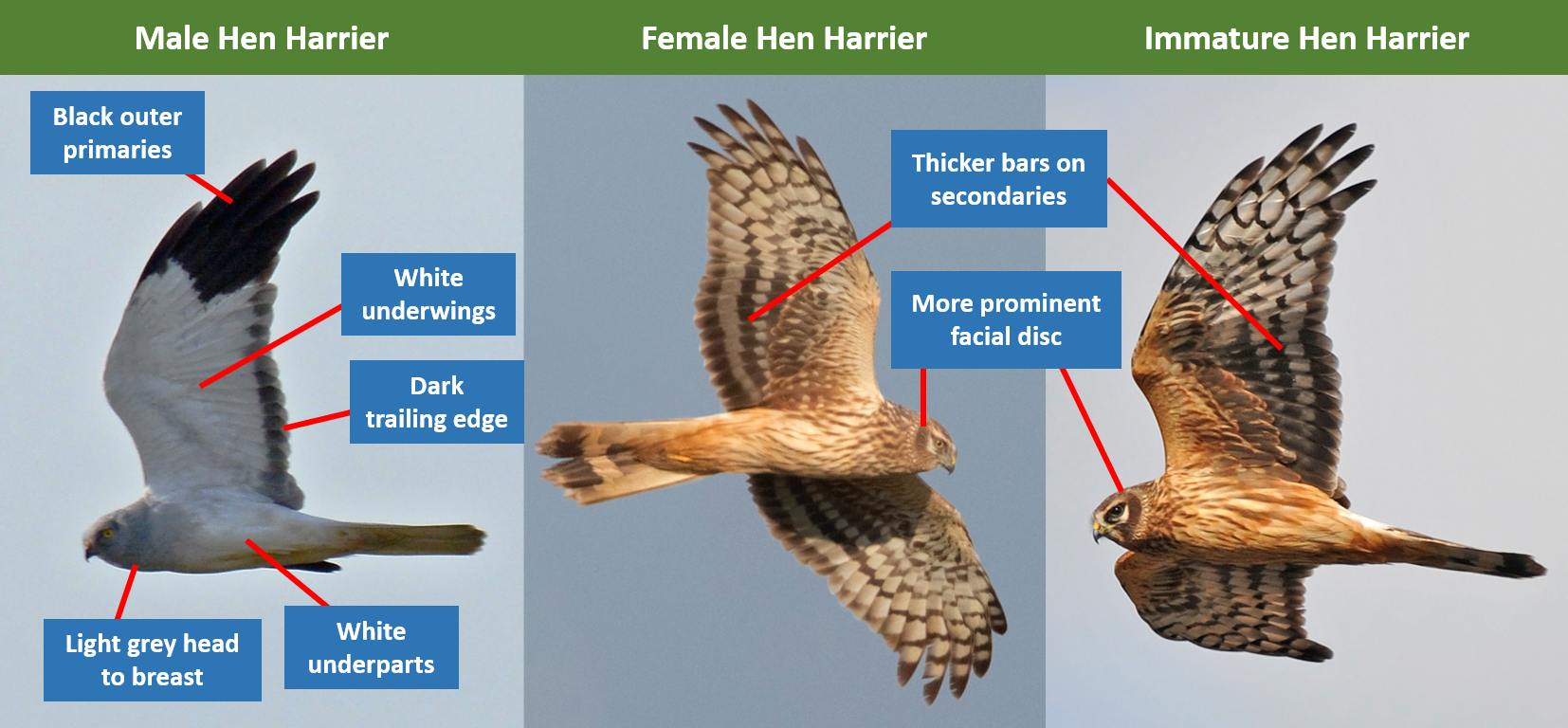
Male, female and immature Hen Harrier. Photo credit: Pete Blanchard (M, Imm); Ayuwat Jearwattanakanok (F).
Harriers are not an easy group of birds to identify, and variation within each type of plumage may often complicate things further, thus it is always best to use a combination of multiple features to identify a bird. We hope that this article has been useful in starting you off on identifying harriers in Singapore, and do keep us updated if you happen to see any candidates for Hen Harrier!