Richard White
The arrival of a Eurasian Hoopoe (Upupa epops) in a landed housing estate at Branksome Road, Singapore, from the middle of January 2026 was a cause for significant excitement in the birding and bird photography community. The species has been on the wish list of many local birders and there is even an historic (albeit unconfirmed) record in 1987. The existence of several records in Australia adds further weight to the prospects of wild vagrancy to Singapore although the potential that any/all of the Australian records may have been ship assisted cannot be ruled out.
Initially reported around 17 January 2026, the bird was successfully twitched by many over the next couple of weeks. The last confirmed sighting of the bird was on 29 January 2026. It should be noted that after this time the level of visitation reduced in part due to the fact that the residents had grown weary of large numbers of visitors. We should remember that our ability to enjoy opportunities such as this relies heavily on goodwill of locals and we should remain respectful of their privacy at all times.
The record was submitted to the Records Committee of the Bird Society of Singapore and was evaluated. The response of the RC is summarised below:
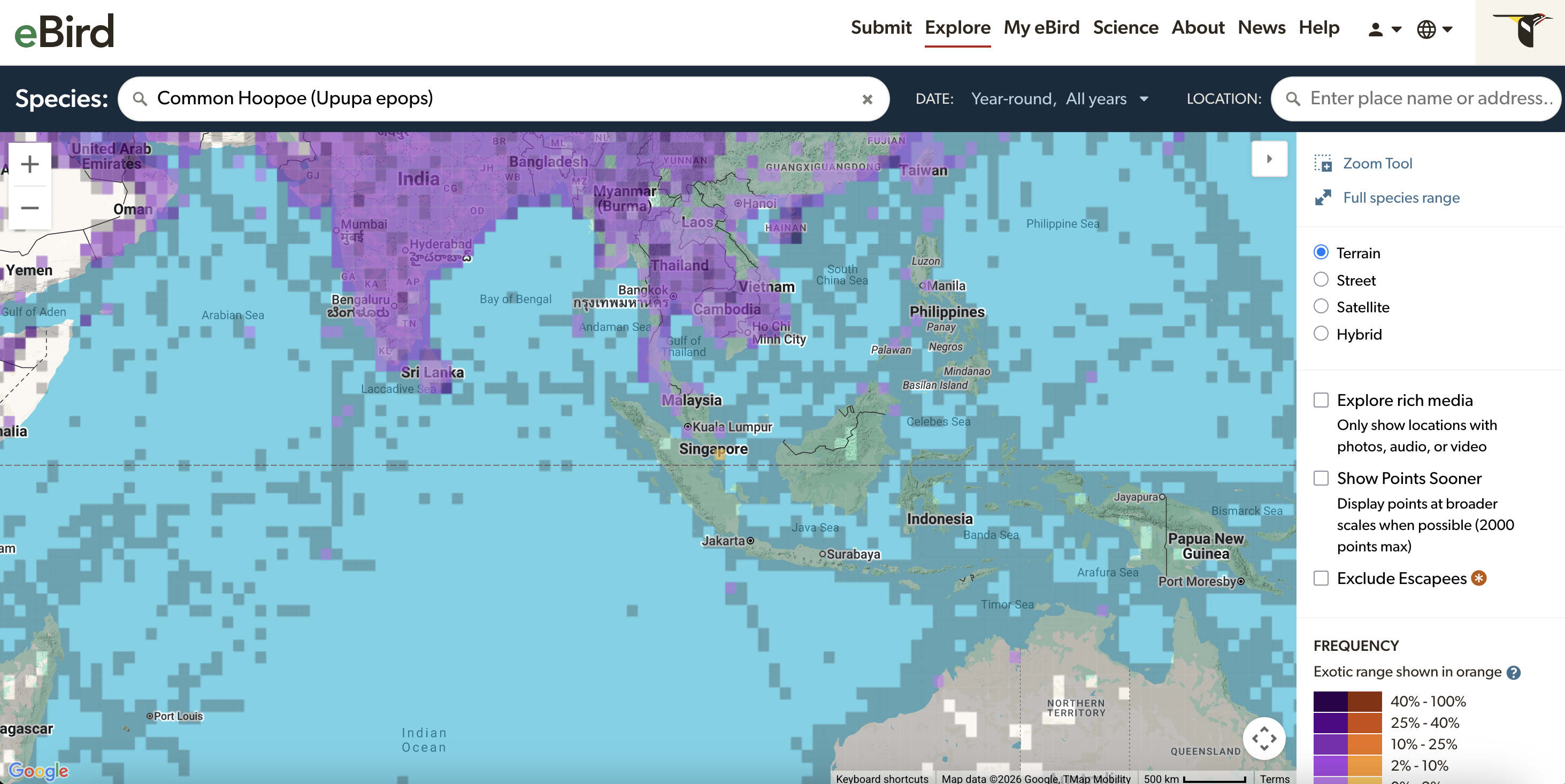
The first, and rather obvious statement, is that there is no question over the identification. Some work was required to determine the subspecies of the bird. There are 8 subspecies of Eurasian Hoopoe recognized, with a range that extends from Europe and Africa through to Southeast Asia. Vagrancy of the African or European subspecies would seem far less likely that one of the Asian subspecies.
The conclusion was that this bird is of the subspecies saturata, set apart from the nominate epops by greyer back and thinner bill than major. The subtle white subterminal band on the crest eliminates longirostris.
So far so good. The saturata population is the migratory north Asian population that might be expected to occur here; although longirostris occurs closer and is known to breed in northern peninsular Malaysia but is more sedentary.
Further support for potential wild provenance of this bird was evidence that the bird was unringed and skittish. Could this be a genuine wild vagrant?
The timing of the occurrence is suitable – northern migrants could be in this region at this time. Is the habitat suitable? There’s no clear answer here. Within the usual range the species may be found in suburban gardens, and as we know vagrants can show up anywhere. However, some feel that the housing estate habitat of this individual is not a strong plus for a wild vagrant.
Analysis of the many images taken began to show further evidence against this being a wild vagrant. Examination of the tail feathers showed asymmetrical wear with at least two broken feathers on the right side of the tail. In a highly terrestrial species such as the Eurasian Hoopoe (which is also a cavity nester), heavy tail wear would not be surprising. However, this would be expected to be broadly uniform across the whole tail.
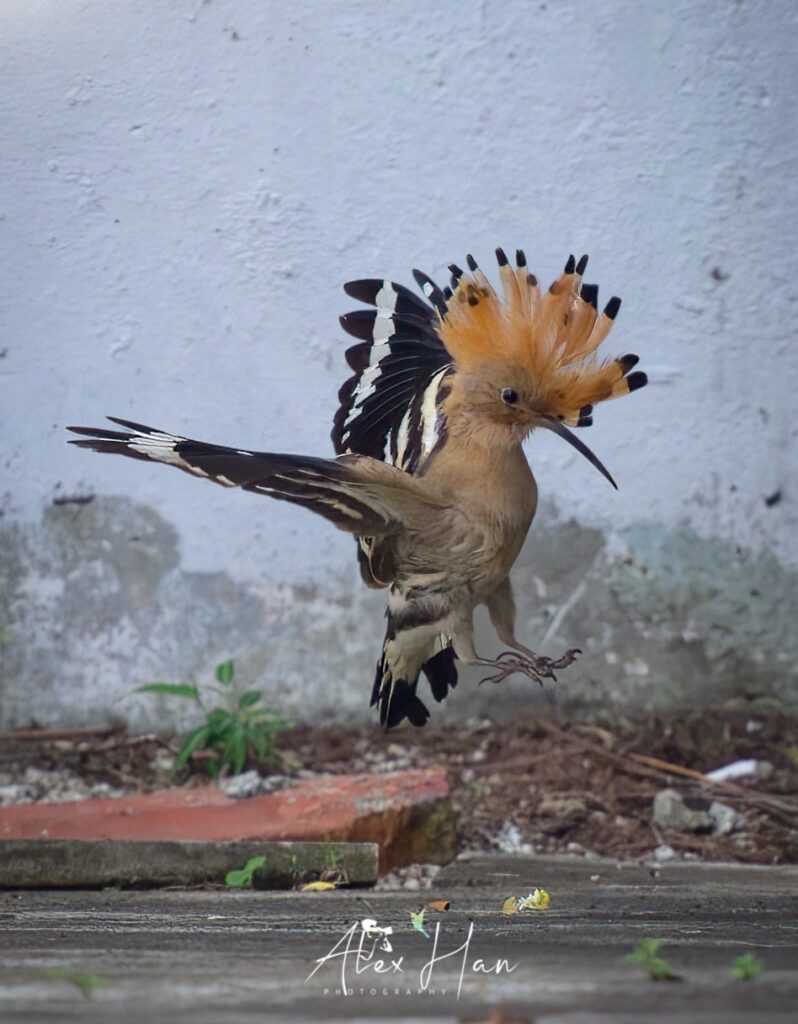
In addition, an image of the bird taking flight by Alex Han showed that the left hindclaw is significantly longer than that on the right foot. An abnormality like this is considered unusual in wild birds, while deformities of feet and claws are far more frequent in cagebirds.
While discussing captivity and the bird trade as a potential origin it is necessary to review available literature to assess whether the species is traded. At least two reports by TRAFFIC relating to wildlife trade in Thailand (Phassaraudomsak & Krishnasamy, 2018) and Vietnam (Eaton et al., 2017) both reference the presence of Eurasian hoopoes in bird markets so it is a traded species.
These two factors combined were cited by members of the RC in a 7-0 vote to assign the bird to Category E1 – “Species that are most likely to have originated from captivity”.
At times like this when it feels like you have been denied a chance to add this very striking bird to a life list it’s worth remembering that when it comes to list it’s “Your list and your rules”. The RC can’t be sure that the bird is not a genuine wild vagrant, but on this occasion the balance of evidence points in that direction. Here’s hoping we get another, unambiguous, candidate soon.
References
Phassaraudomsak, M. and Krishnasamy, K. (2018). Trading Faces: A rapid assessment on the use of Facebook to trade in wildlife in Thailand. TRAFFIC, Petaling Jaya, Selangor, Malaysia. Retrieved from: https://www.traffic.org/site/assets/files/11073/trading_faces_thailand_2019.pdf
Eaton, J. A., Nguyen, M. D. T., Willemsen, M., Lee, J., and Chng, S. C. L. (2017). Caged in the city: An inventory of birds for sale in Ha Noi and Ho Chi Minh City, Viet Nam. TRAFFIC, Southeast Asia Regional Office, Petaling Jaya, Selangor, Malaysia. Retrieved from: https://www.traffic.org/site/assets/files/1580/caged-in-the-city.pdf